‘Noise alone is not fireworks’: Veteran pyrotechnician on evolution of fireworks in Kerala
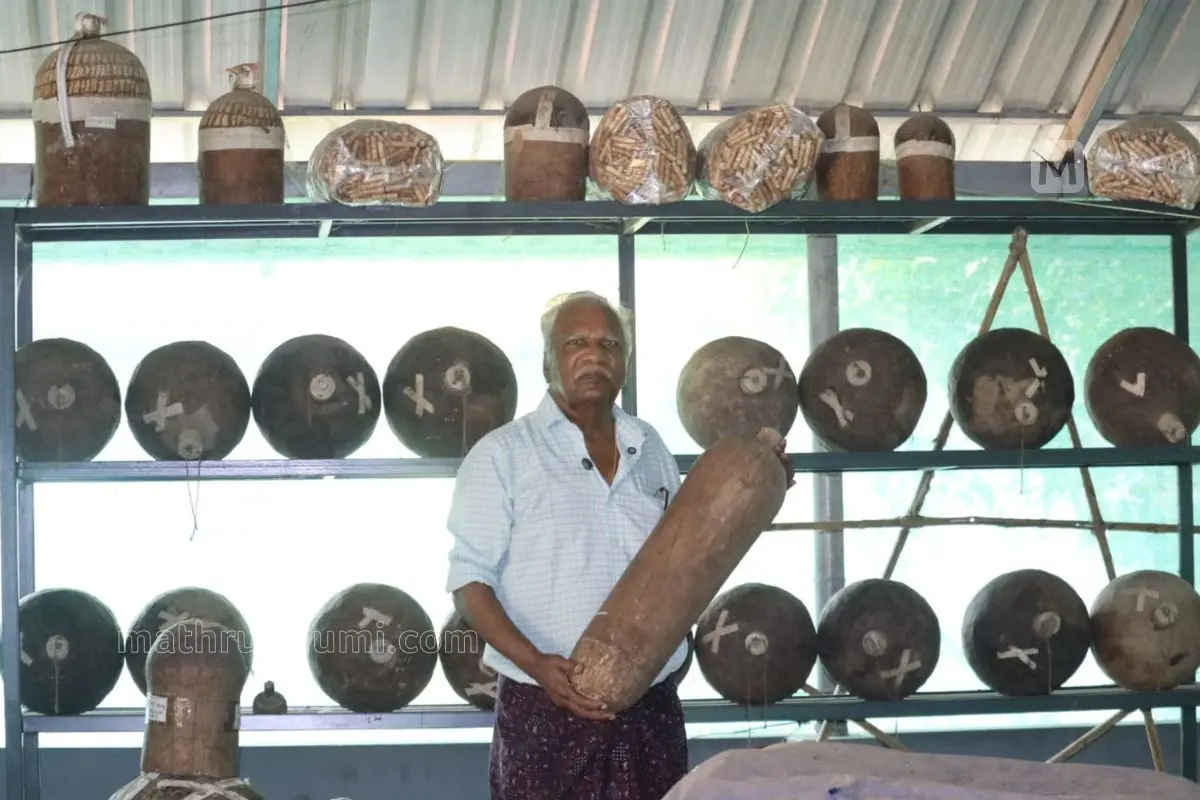
The thunderous fireworks of Thrissur Pooram in Kerala are among the most spectacular sights in India. But behind the booming shells and dazzling colours lies a tradition shaped by generations of craftsmen. Speaking to 'Mathrubhumi English', veteran pyrotechnician Francis Karekkatt recalls the artistry, science and discipline that once defined the fireworks of Kerala.
When the sky blooms over Thrissur
As midnight approaches during Thrissur Pooram, the vast temple grounds fall into a brief hush. Then a spark rises. Moments later, the sky erupts — shells burst into blazing circles of red, green and gold, thunder rolling across the city as thousands watch in awe.
For most spectators, the fireworks are simply a spectacle. But for those who built them, they represent a craft refined through generations. “Fireworks are not just about noise,” veteran pyrotechnician Francis Karekkatt says. “A good firework must bloom beautifully in the sky. It should look like a flower opening.” Francis has spent decades in the industry and has witnessed how the art of fireworks in Kerala has changed — from handmade shells and bamboo tubes to modern electronic ignition systems.
When fireworks were built to last
In earlier decades, fireworks were made with lighter explosive charges — small-scale, precise, or lightweight breaching explosives — using good-quality materials.
“The explosive content used to be much lower,” recalls Francis. “Because of that, the same mortar tubes, made from multiple layers of metal and constructed somewhat like tightly rolled newspaper rods, could be used for many years.”
Festival organisers often produced hundreds or even thousands of tubes at a time. Sponsors helped share the cost, and their names were painted on the tubes. “They were used only once a year,” he adds. “If maintained properly, they could last for generations. Only a small part of the inner layer would tear, but since the tubes had many layers, this damage did not significantly affect their usability.
The shift to modern technology
Technology has dramatically changed how fireworks are fired today.
In many modern displays, particularly those conducted abroad, fireworks are often ignited electronically using small spark devices triggered remotely. “This means workers no longer have to handle burning fuses (pyrotechnic initiators that control the ignition timing of fireworks, typically consisting of a black powder core wrapped in protective layers like cotton, string, or nitrocellulose lacquer ),” Francis explains. “It reduces the chances of accidents.” The displays are safer and more precise.
Reloading shells into mortar tubes has always been one of the most dangerous stages. The residual sparks or unburnt powder left in the tube can ignite when a new shell is inserted. Even a small mistake can trigger an explosion, putting workers at serious risk of injury or death. In the past, accidents sometimes occurred when residual fire remained inside the tube.
Despite their beauty, fireworks remain dangerous work. One of the most common mistakes is leaving finished fireworks inside the work shed.
“If a spark enters the shed, thousands of crackers can ignite at once,” Francis says. “It may sound like a single huge explosion.”
Even small oversights can prove fatal. When fuses are left to dry, dust or grains of sand can stick to them.
“When those fuses are cut later, friction can create sparks,” he explains. Several workers have died in such accidents across Kerala.
Finished fireworks should never be left loosely in the work shed, as a stray spark could ignite them all at once. They should be stored in fireproof, well-ventilated containers or sheds, kept away from heat, sparks, and friction. Each batch should be separated and handled carefully to prevent accidental chain reactions.
The art of the aerial shell
Making a large fireworks shell(ball or canister shaped cardboard/paper filled with pyrotechnic composition (the effects and colour). On the bottom of the shell is a lift charge that propels the shell into the air, which is attached to a long fuse. It was once a labour-intensive process.
Craftsmen wrapped layers of paper around a mould, sometimes up to twenty-four layers for large shells.
“Judging the thickness requires experience,” he says. Paper shells shattered evenly when they burst, scattering burning pellets in a perfect circle. Plastic shells used today often crack unevenly. “The spread becomes weaker,” he says. “The beauty of the burst is reduced.”
A craft balanced between art and risk
For veteran fireworks makers, the trade remains a delicate balance of science, craftsmanship and discipline. “Every small detail matters,” Francis says. A fuse cut too dry, a mixture that is slightly too strong, a shell is stored in the wrong place, any one of these mistakes can turn a celebration into a tragedy. Yet when everything works perfectly, the result is unforgettable.
“When a shell bursts high in the sky,” Francis says, “and the colours spread evenly like a flower… that is when fireworks become art.”