From Western novels to Indian stage: The captivating Kathakali rendition of Hemingway's tale | VIDEO
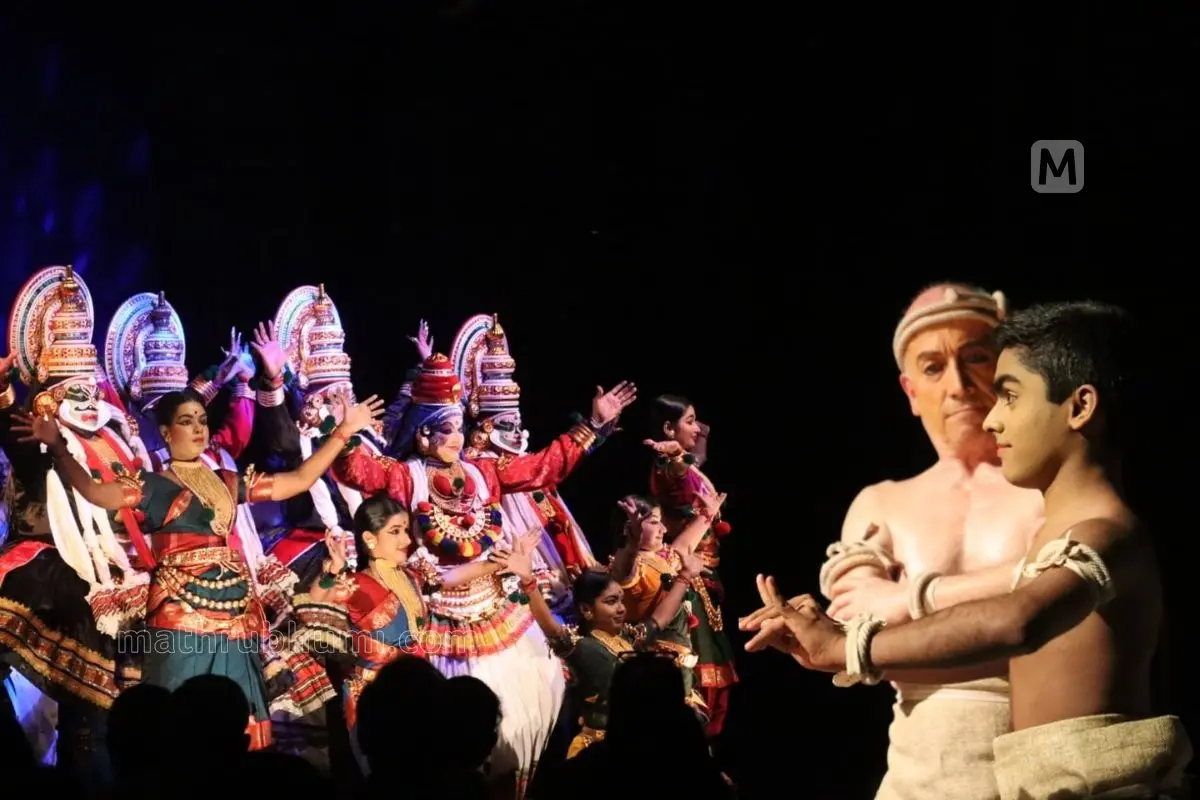
Have you ever watched Kathakali in 360 degrees? At the fourth edition of the Peruvanam International Village Festival in Thrissur, Kerala Kalamandalam presented a Kathakali adaptation of Ernest Hemingway’s Nobel Prize-winning novella 'The Old Man and the Sea', offering audiences an experience different from the conventional staging.
Bringing together Western literary modernism and a classical Indian performance tradition rooted in epics and mythology, the production broke away from the fixed platform usually associated with Kathakali. Performers moved through and around the audience, responding to rhythm and space, allowing Hemingway’s story to unfold not from a distance, but all around the viewer.
What makes this Kathakali experiment full of unexpected turns and theatrical surprises? The adaptation was directed and choreographed by Kathakali artist and academician Kalamandalam Neeraj, who described the work as an exploration of how far Kathakali’s grammar could stretch without altering its core structure. Rather than attempting to modernise the form, the production aimed to translate a modern literary narrative into Kathakali’s established idiom.
From a one-man show to a full production
The idea of adapting Hemingway’s novella began nearly four years ago. It was originally conceived as a solo performance focused entirely on Santiago, the ageing Cuban fisherman at the heart of the story. “It was first planned as a one-man show,” Neeraj said. “Later, we realised the story could be expanded within the grammatical and technical framework of Kathakali.” A crucial turning point came when the text was shaped into an attakatha, the lyrical script written specifically for Kathakali performance. That task was undertaken by Neeraj’s father, Mohandas. “My father Mohandas was the reason this became an attakatha,” Neeraj said. “Once the text entered that structure, the narrative could fully inhabit Kathakali.”
Expanding Kathakali’s themes
Kathakali traditionally depicts kings, warriors and gods, with stories centred on bravery, revenge or duty, often drawn from Indian mythology. In contrast, The Old Man and the Sea tells the story of an ordinary man, with Santiago’s struggle defined by patience and endurance rather than heroic deeds.
“In Kerala, audiences are accustomed to seeing larger-than-life, valorous characters in Kathakali. With this production, we wanted to show that the life of a common man can also be expressed through the form.”
Kathakali traditionally depicts kings, warriors and gods, with stories centred on bravery, revenge or duty, often drawn from Indian mythology. In contrast, The Old Man and the Sea tells the story of an ordinary man, with Santiago’s struggle defined by patience and endurance rather than heroic deeds.
“In Kerala, audiences are accustomed to seeing larger-than-life, valorous characters in Kathakali. With this production, we wanted to show that the life of a common man can also be expressed through the form.”
Conveying dreams and memory
Hemingway’s novella moves between Santiago’s present struggle at sea and his inner world of dreams and memories. In Kathakali, where storytelling is largely linear, these shifts were suggested through variations in rhythm, expression and movement rather than through direct scene changes.
Neeraj said these sequences were approached as emotional states rather than literal episodes, allowing the fisherman’s inner life to surface without disturbing the structural discipline of Kathakali.
The characters
The role of Santiago, the ageing Cuban fisherman at the heart of the story, was performed by Mario Barzaghi, an Italian theatre practitioner and trained Kathakali artiste. Barzaghi, director-actor of the Milan-based Teatro dell’Albero, has studied Kathakali at Kerala Kalamandalam since the 1980s.
Peesappilly Rajeevan portrayed the Sea, a role with no clear precedent in Kathakali. The character was felt as a presence rather than a physical entity. Students of Kerala Kalamandalam performed the supporting roles. Including vocalists and percussionists, the production involved around 20 artistes.
Peesappilly Rajeevan as sea
Visual and narrative challenges
Representing the Sea as a character posed one of the production’s central challenges. While Kathakali often evokes natural settings through gesture and music, embodying the ocean required a fresh visual approach. Rajeevan’s costume drew from female Kathakali roles, with a headgear adapted from Nangiar Koothu, suggesting the fluid and expansive nature of the Sea rather than depicting it literally.
Another challenge lay in translating Hemingway’s restrained, economical prose into Kathakali’s traditionally rich and descriptive lyrical style, without diluting the tone of the original narrative.
Music and percussion
Music and percussion played a crucial role in anchoring the performance. The compositions followed established Kathakali patterns, preserving the familiar soundscape even as the narrative moved into unfamiliar territory. The vocal ensemble included Kalamandalam Vinod, Viswas, Vineesh and Sreejith. The percussion section featured Venu Mohan and Ravishankar on the chenda, Nithin Krishna on the idakka, and Sreejith and Vaishakh on the maddalam.
A Measured Experiment
Neeraj emphasised the experimental nature of the work. “New stories have been added to Kathakali before, but their success is always doubtful. Sometimes the orientation changes so much that it becomes a reconstruction rather than a new work.” This awareness shaped the production, ensuring that innovation remained within Kathakali’s established grammar.
The adaptation is not intended for temple festivals or conventional Kathakali venues. Instead, it is designed for larger theatre spaces where audiences are open to seeing how classical forms can engage with modern narratives.
The Story of Santiago
The 'Old Man and the Sea' tells of Santiago, an elderly Cuban fisherman who endures 84 days without a catch. On the eighty-fifth day, he hooks a giant marlin and struggles with it for three days, enduring pain and exhaustion while admiring the fish’s strength. Santiago finally kills the marlin and lashes it to his boat, but sharks are drawn to its blood and devour the fish, leaving only its skeleton.
Exhausted, Santiago returns home before dawn, where his devoted apprentice Manolin tends to him. Despite the loss, Santiago dreams of lions, symbolising endurance and hope, and he and Manolin plan to fish together again.
Produced by Kerala Kalamandalam Deemed University for Art and Culture, this Kathakali adaptation of 'The Old Man and the Sea' stands as a considered experiment in blending classical form with modern narrative, testing how a centuries-old art form can respond to stories of ordinary human struggle, memory, and resilience.