International Calligraphy Festival of Kerala 2025: Where words come alive
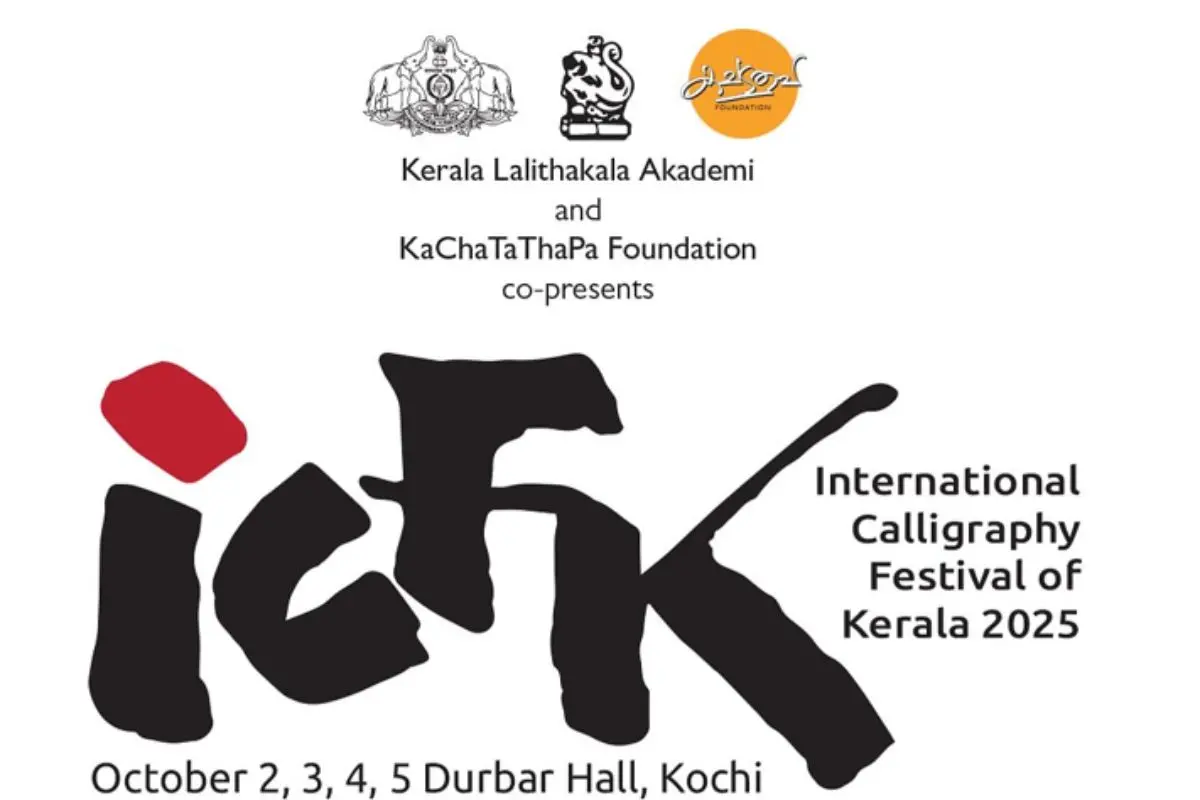
The cosmopolitan city of Kochi, already renowned for its free-spirited nature and artistic beat, has become a living museum this October. Between October 2 and 5, the International Calligraphy Festival of Kerala (ICFK) 2025 is taking place at the grand Durbar Hall, attracting artists, students, and art enthusiasts from across the globe.
Hosted together by the KaChaTaThaPa Foundation and the Kerala Lalithakala Akademi, this four-day carnival of culture is a celebration of the ageless art of lovely writing -- a devotion to lines, letters, and tongues that bridge the divide between borders and centuries.
There is a poetics to looking at someone write well, and that's what the festival achieves -- the beauty of ink, the rhythm of brush, and the sheer intimacy between artist and alphabet. Calligraphy has never been just about writing; it's about emotion, energy, and expression. And in the vibrant centre of Kochi, that creed has materialised through the brushstrokes of more than thirty renowned calligraphers from India and a large number of other nations. They have brought their languages with them, their scripts, and their individual philosophies of art, converting Durbar Hall into a miniature of worldwide cultural heritage.
The festival area itself is a beautiful combination of tradition and modernity. While walking through the exhibition, people come across works done in Malayalam, Devanagari, Tamil, Hindi, and English, every script narrating a different tale through its rhythm and movement. Walls also bear the elegance of Arabic, Urdu, Hebrew, Iranian, and Korean calligraphic sentiments. Every piece is a glimpse into a world where words are not merely read, but experienced, where the slightest curve of a letter can contain centuries of meaning. For most visitors, it's a surprise -- a reminder that writing, once used in everyday life, can also serve as meditation.
Among the numerous impressive aspects of the event is one collaboration between art and fashion that grabbed everyone's attention. Students of the Kerala Institute of Design showcased Khadi fabric garments, embellished with hand-drawn calligraphic patterns. The apparel was in honour of Mahatma Gandhi on Gandhi Jayanti, combining aesthetics with social and cultural significance. The event was a place where tradition and modernity converged, and language turned into wearable art. Seeing the students striding along the ramp in handwoven Khadi that has been painted with flowing scripts, the crowd couldn't help but reminisce on how art changes -- sometimes on paper, sometimes on fabric, and sometimes on the very texture of life itself.
Another favourite of the festival is the India Pen Show, a heaven for writing lovers and pen collectors. The showcase is filled with pens, their prices varying from an affordable ₹50 to exquisite masterworks priced at a staggering ₹5 lakh. It's not only an exhibit of instruments; it's an ode to the time-tested partnership between human imagination and the use of the pen. The sheen of high-end nibs, the sophistication of handmade barrels, and the retro charm of fountain pens have attracted a throng that cuts across generations. For those who hold the old-fashioned notion that the pen is mightier than the keyboard, this exhibit is like a confirmation.
Workshops and talks during the festival add substance to the visual beauty. Calligraphy enthusiasts come together to be taught about skills, instruments, and philosophies that make calligraphy an international art form. Veteran calligraphers offer tips on the delicacy of strokes, balance of composition, and spiritual practice behind each curve and line. Workshops enable fans to try ink, paper, and brush, while panel discussions discuss how digital technologies, artificial intelligence, and social media are transforming artistic practices.
During a single session, discussion shifts to how AI-created fonts and automated scripts pose the idea of originality in calligraphy into question -- but most artists are optimistic that such technologies will, rather than displace human imagination, stimulate new visions and interest in ancient writing systems.
Evenings are no less magical. When the sun goes down over Kochi, Durbar Hall rings with the beat of music and rhythm. One evening, the prolific Carnatic singer TM Krishna fills the auditorium with his heartfelt performances, weaving an ideal synthesis of silence and sound. Another evening, the ancient percussion group Thayambaka, conducted by Krishnadas and his company, charges the air, the rhythmic movements reflecting the pulse of the Malayalam script itself. These performances establish a lovely conversation between the visual and performing arts, reminding the audience that everything in the arts, whether with ink or voice, is born of the same human desire to express itself.
Narayana Bhattathiri -- the creator of the KaChaTaThaPa Foundation and the leading figure in Malayalam calligraphy -- whose passion and vision have brought this festival to life.
Bhattathiri, who has devoted his life to mentoring young calligraphers and safeguarding ancient scripts, feels that the art form is about to enter a new era. "Calligraphy is not painting with letters," he says. "It is rhythm, structure, and emotion. Each letter has energy. Even as language evolves, the energy of letters doesn't change." For him, the festival is not just an exhibition; it's a movement to bring back respect for handwritten beauty when most writing is done on screens. He recognises the challenge posed by printing technology and artificial intelligence but stays hopeful.
"AI can mimic handwriting, but it can never capture the emotion behind a stroke," he says. "That is the soul of calligraphy, and that will never disappear."
The festival's determination to honour both heritage and innovation also shines through in its awards. Every year, the Lipi Kala Puraskaram recognises individuals who have made phenomenal contributions towards the world of script-based art. Young calligraphers below 30 years of age will be given cash awards and certificates for their upcoming talent. For most of them, it is the first time they are getting their due on the global platform, and the boost from the festival could be the spark that moulds their destiny.
As one walks through the festival, one can feel the soft conversation between the past and present. The Malayalam calligraphic pieces are not only beautiful art but also emotionally evocative. In a virtual world where typing in local scripts is now the everyday norm, these hand-written alphabets are a reminder to visitors of an era when each letter was written with care and purpose. Some of the pieces translate ancient Malayalam poems, whereas others play around with abstract forms that erase the line between language and art. Each work has something to say -- something of identity, something of belonging, something of rediscovery of the self through script.
For most visitors, and particularly for the younger crowd, this is a new form of art experience. School and college students who pass through the corridors are amazed at the way something as basic as handwriting can become so deep. They participate in the workshops, experiencing ink and brush for the first time, and in the process, remember the tactile pleasure of writing. "It's like painting words," a student remarks, with ink-stained hands. "I didn't know writing could feel this alive."
As the festival progresses, conversations extend beyond the gallery walls. Artists discuss collaborations, educators plan to introduce calligraphy workshops in schools, and designers explore ways to integrate script art into contemporary design and branding. The festival becomes a fertile ground for ideas, partnerships, and cultural exchange. In many ways, it also becomes a statement about Kerala’s evolving art scene — a space that embraces tradition without being confined by it.
Kochi, with its richness of layered history in language and culture, is the ideal setting for such a festival. Once a hub port in the spice trade and a meeting place for traders from Arabia, China, and Europe, the city has always been a junction of ideas. Now, as it welcomes calligraphers from across the globe, that legacy of cultural exchange is perpetuated. The streets that wind past Durbar Hall, lined with cafés and art boutiques, hum with tourists debating scripts, styles, and methods. There is a feeling that something greater is occurring -- a soft but forceful reaffirmation of the power of art to bring us together.
Calligraphy, fundamentally, is the practice of slowing down. In an age of speed and pixels, it takes patience, focus, and respect for detail. To see a calligrapher work is nearly meditative -- the steady hand, the measured breath, the controlled stroke. Few visitors stand silently as artists perform live writing. The movement becomes theatre, each sweep of ink unrolling like a dance. It's the meditative state that beckons people in, reminding them of the human touch in each creative process.
The festival isn't merely about presenting completed work; it's also about process, discipline, and philosophy. Some installations and short films address the place where calligraphy meets other arts like architecture, music, and computer design. One part of the hall has a collaborative piece in which visitors can inscribe a single word in their language as part of an ever-growing wall of multilingual writing. At the close of the festival, it has become a shared work of art — a tapestry of dozens of languages' worth of words, inscribed by hundreds of hands.
As Kochi’s cultural calendar continues to fill with international art events, the International Calligraphy Festival stands out for its depth and purpose. It’s not about spectacle; it’s about substance. It brings attention back to something ancient yet urgent -- the beauty of mindful creation. The written word, once merely a tool of communication, reclaims its place as a form of art that speaks across time and language.
For the artists, too, it is a moment of contemplation. In a world growing ever more digitised, what is the act of holding a pen, dipping it in the ink, and guiding it across paper? For many, it is one of resistance -- an affirmation of the human in an age of algorithms. As one of the participants states, "Every stroke is a fingerprint of the soul. No machine can reproduce that."
The Kerala International Calligraphy Festival 2025, in all its vibrancy and serenity, tells us that art does not always scream; there are times when it is just a whisper. The festival is a tribute to that whisper -- to the beauty of silence, rhythm, and lettering. While Durbar Hall radiates the golden glow of sunset and the final day looms near, tourists slow down, not wanting to leave the world of ink and fantasy behind. In those moments, it seems that Kochi itself is writing -- chronicling a tale in strokes and symbols, mapping out its own path as a city that still fosters creativity in all its forms.