The temple song you’ve never heard: How Brahmanippattu keeps ancient goddess rituals alive |VIDEO
Deep inside Kerala’s temples, there is a sound that often goes unnoticed — a song that resembles chanting, yet carries a deeply ritualistic power. This is Brahmanippattu, a rare sacred art form that survives in only a handful of temples. More than music, it is a spiritual system of invocation, closely tied to devotion, ritual and life’s most significant moments. Saritha Krishnakumar, a singer of this tradition, spoke to ‘Mathrubhumi’ about its evolution and its enduring place in Kerala’s temple culture.
“To many, it sounds like chanting. But Brahmanippattu is a complete ritual musical system. “Whether the deity is Durga or Bhadrakali, each divine form has its own set of songs. The tradition is associated with key stages of life — marriage, emotional healing and sacred offerings,” says Saritha.
Where the goddess is invoked
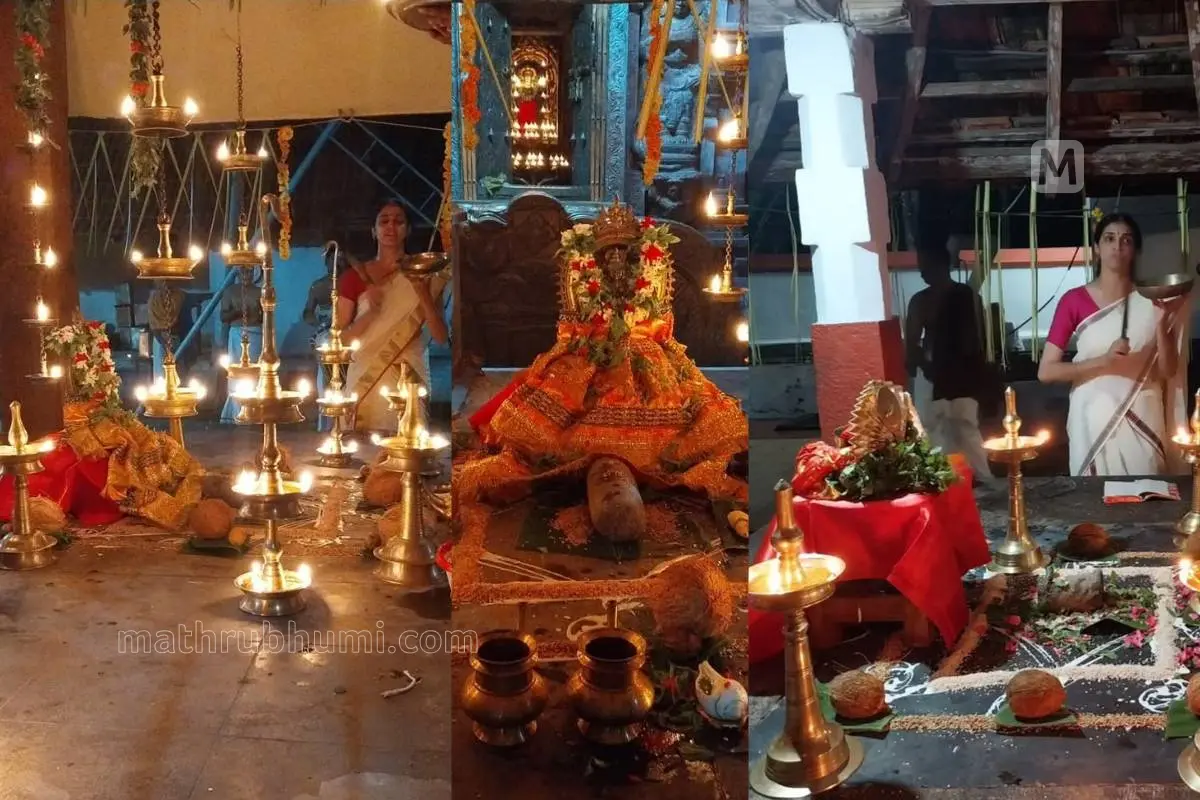
Brahmanippattu is traditionally sung in goddess temples across mid-Kerala and parts of north Kerala, usually in the ‘namaskara mandapam’ — the structure in front of a temple’s sanctum sanctorum — following a detailed series of ritual preparations. The mandapam is adorned with white cloth and silk cloth. Ritual symbols (padmam, which are the floor designs made from five colored powders) are prepared using natural powders on tender coconut palm leaves and rice flour. A coconut is placed on an 'ammikkallu' (grinding stone) symbolising the sacrificial point, and a mirror is placed inside a kindi (a traditional Kerala water vessel with a spout).
“The goddess is invoked into the mirror — that is the core ritual of Brahmanippattu,” Saritha explains. In some temples, a 'thidambu' (replica of the deity) or the 'ammikkallu' itself is used instead, depending on local customs.
A ritual that unfolds through the day
The song is not completed in a single sitting. It is usually a full-day ceremony, performed in three segments known as madas (time durations): the morning mada after Ushapooja, the afternoon mada after Uchchapooja or before dusk, and the night mada after Deeparadhana. “‘Mada’ refers to time. The song follows the same rhythm as the temple’s puja cycle,” says Saritha. Each segment contains distinct portions, together forming the complete ritual performance.
Language of devotion and poetry
The songs are composed in Manipravalam, a literary blend of Sanskrit and Malayalam. They usually begin with Ganapati Stuti and Saraswati Stuti, followed by hymns to the goddess. “The Ganapati and Saraswati stutis are sung depending on the temple’s tradition,” Saritha notes. If the deity is Durga, her origin story is sung. In Bhadrakali temples, her birth, her battle with Darika and the appeasement of her wrath are rendered through song.