Inside the special Air France A321 carrying Pope Leo XIV across France | PHOTOS
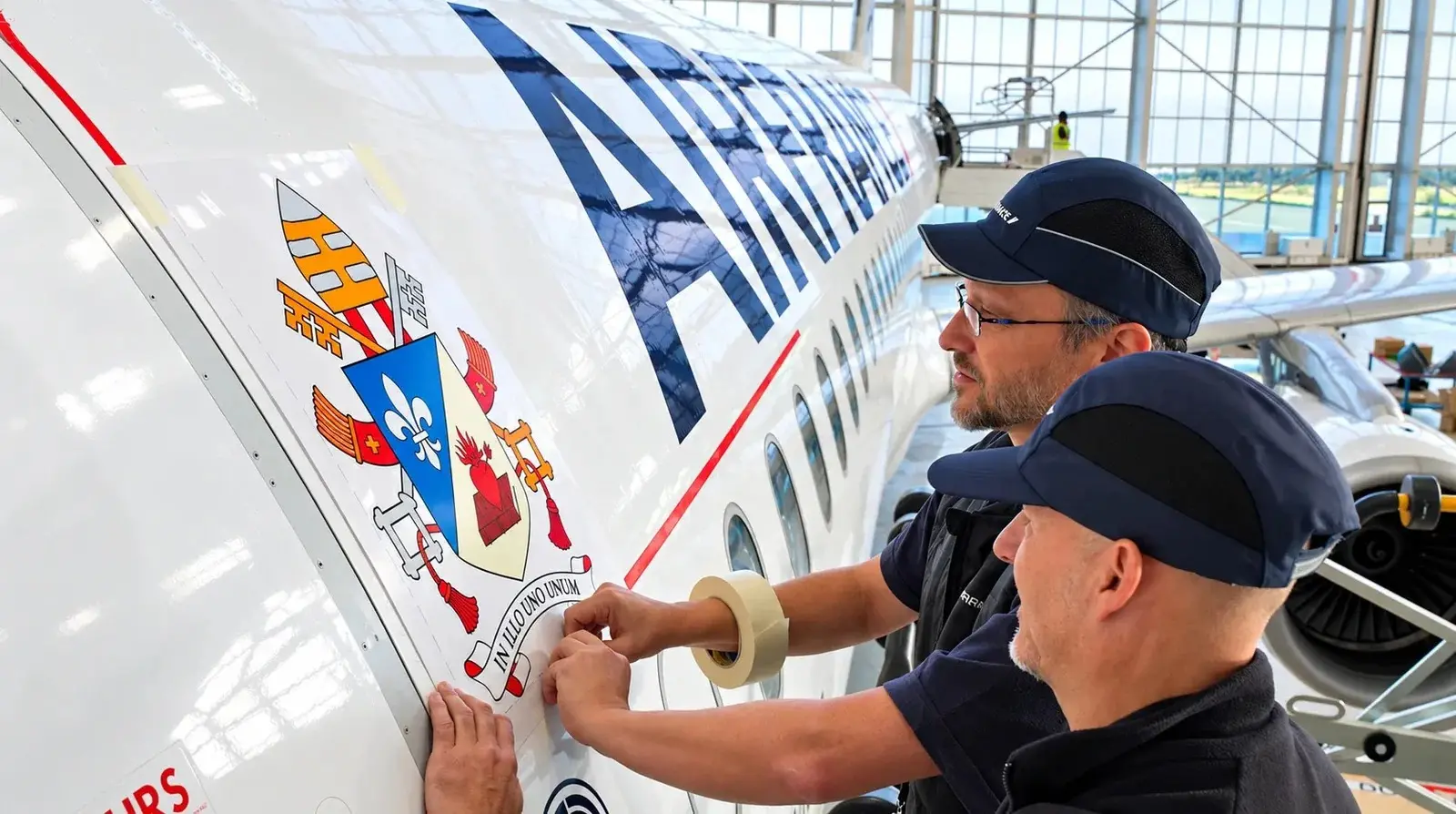
For a few days, an Airbus A321 in the Air France fleet has been carrying a name it normally would not, “Cité du Vatican” or the Vatican City. The aircraft has been specially prepared for Pope Leo XIV’s visit to France, turning what would ordinarily be a routine airline operation into an extraordinary mission involving more than 100 Air France employees.
From pilots and cabin crew to engineers, ground teams, security staff, catering personnel and operational coordinators, people from across the airline have been brought together for the Pope’s first visit to France.
Between September 26 and 28, the specially prepared A321 will fly the Pope and his delegation between Paris, Lourdes, Metz and Rome.
An aircraft prepared specially for the Pope
Air France has dedicated one Airbus A321 to the visit. The aircraft has been configured with two cabins to accommodate Pope Leo XIV, his immediate entourage, a delegation of more than 70 people and more than 80 accredited journalists from around the world.
The aircraft has also received a very visible change. The words “Cité du Vatican” have been placed on its fuselage, while the coat of arms of Vatican City State has been affixed near the front left-hand door through which the Pope will board.
Inside the aircraft, the Pope will have a more private space than an ordinary passenger. He will sit alone in the first row, separated from the rest of the cabin by a curtain. There will be no specially created papal menu. Instead, the Pope will be served food and a snack similar to what Air France offers its business-class passengers.
Even the smallest operational details have been carefully considered.
A mechanic will be on board
The special mission has also involved preparations on the maintenance side. The A321 underwent specific maintenance before beginning its three planned rotations. An Air France mechanic will travel with the aircraft so that technical assistance can be provided if necessary.
A reserve aircraft will also remain ready to take over should the designated A321 become unavailable. The flights have been given the status of state flights. This means they will receive the special arrangements applicable to aircraft transporting heads of state, including priority handling.
For Air France, the operation is not simply about flying a passenger from one airport to another. It requires coordination across several parts of the airline, with more than 100 employees involved in making the journey possible.
Three special flights across France
The A321’s special journey begins on Saturday, September 26, when it will depart Paris-Orly for Tarbes-Lourdes-Pyrénées. On September 28, it will fly from Lourdes to Metz-Nancy-Lorraine before continuing later that day to Rome-Fiumicino, taking Pope Leo XIV back to Italy. A second crew will take over in Metz for the final flight to Rome.
Air France captain Clémence Coussonneau, who will be at the controls of the aircraft, described the assignment as a rare moment in a pilot’s career.
“It is an immense source of pride to play a direct role in Pope Leo XIV’s visit to France,” she said, adding that the crew had been preparing for the mission for several weeks with enthusiasm and dedication. For the captain and her crew, the flight is also a journey to Lourdes, a place of deep religious significance, before continuing to Metz.
More than just an airline operation
The scale of the operation extends beyond the A321 itself.
Transavia, the low-cost airline within the Air France-KLM Group, will operate another special flight between Paris-Orly and Lourdes to carry a delegation of cardinals, bishops and journalists covering the Pope’s visit.
Together, the operations reflect the extensive planning required when a major religious and diplomatic visit involves air travel across several cities.
For the Air France teams involved, the mission also carries a personal significance.
The airline has described the opportunity to have the Pope and his delegation among its passengers as a source of great pride. For many of the employees involved, it is likely to be one of those unusual assignments that remain part of their professional memories for years.
A journey with a long Air France history
This is not the first time Air France has carried a Pope. The airline has a history of transporting pontiffs on important journeys, including some remarkable moments in aviation history.
In 1989, Pope John Paul II travelled aboard an Air France Concorde from Saint-Denis in Réunion to Lusaka in Zambia during his tour of Africa. Seven years later, in 1996, Air France operated his return journey from Reims to Rome aboard an Airbus A310 following his visit to France.
Pope Benedict XVI also travelled with Air France during his visit to France in 2008. An Airbus A321 operated the flights between Paris-Orly and Lourdes and then from Lourdes to Rome.
The choice of the A321 for Pope Leo XIV therefore continues a connection that has been built over several decades.
A poster from another era
There is another small link between the present journey and Air France’s past. Before the flight from Paris to Lourdes, the airline plans to present Pope Leo XIV with a collector’s poster created by artist Plaquet.
The poster recalls Air France’s long association with religious travel. The story goes back to the Catholic Church’s 1950 Jubilee, when Max Hymans, then chairman of Air France, encouraged the airline to promote travel to religious destinations. This led to the creation of promotional material featuring Lourdes and Rome.
During Pope Benedict XVI’s visit to France in 2008, Air France presented him with the poster dedicated to Lourdes. It has since been displayed at the Vatican.
Now, more than a decade later, another Pope is travelling with Air France, this time aboard an A321 temporarily carrying the name of the Vatican itself.
For three days, the aircraft will be more than just another Air France jet moving between European airports. With its special markings, dedicated crew, maintenance support and carefully planned operation, it will become a small but distinctive part of Pope Leo XIV’s first journey to France.