A voice from Malayalam cinema; Sunny Joseph on KIFF 2025 Jury
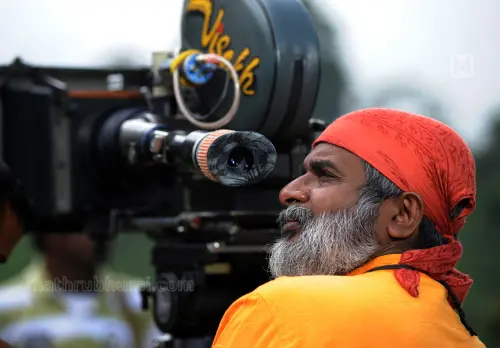
Sunny Joseph originally of Malayalam cinema, is one of the most outstanding cinematographers in the country. He is completely grounded and unassuming and never wears his fame and talent as an imaginary halo around his head. Precisely because of his grounded nature, it took this gentleman 40 long years to make his directorial debut with Salt of the Earth in Malayalam which took away a large slice of his life’s savings.
He retains his completely modest self, smiling as much through the awards and accolades that have come his way as much as the obstacles he faced that extended his desire to direct to 40 long years. He has bagged many awards among which one may mention the Kerala State Film Award for Best Cinematographer and the National Award for the best Experimental Film.
This year, Joseph was a prominent participant in the recently concluded 31st Kolkata International Film Festival (KIFF), which ran from November 6-13, 2025. Joseph was one of the five members of the international jury for the "Innovation in Moving Images" competition, which ultimately awarded the top prize to the Cuban film To the West in Zapata. He noted how the award for a non-fiction work highlighted the convergence of fiction and non-fiction filmmaking. His involvement included (a) serving as a jury member for International Cinema in Innovations in Moving Images, (b) speaking at a major seminar on AI in Cinema. (c) delivering a memorial lecture, and (d) presenting his film as director.
Being a member of the Jury was quite challenging. “You not only must watch the films very closely, and with objectivity, taking off your hat as a cinematographer alone. You get to watch many global films but you also get to know members of the jury who are involved in films in a big way and learn a lot about the film industry in their countries,” he says.
In his panel talk on AI in cinema, he said, “While AI boosts efficiency. It is already taking away jobs. A friend who shot seven ad films a season did not get one this year, all were done by AI,” he said, adding, “The bigger concern is the death of truth- we can no longer be sure what’s real.”
Backtracking into his evolution through cinema, the grounded Joseph said, “I joined FTII in 1979. My intention was to become a film-director. So I took up editing as my specialization. But in the final year the cinematography department offered me a seat (I was first in second year exams and topped in cinematography too.) So, I reluctantly became a cinematographer. Every year, I got offers to do cinematography from master filmmakers. In 2002 I happened to show my Diploma Film Clown and the Dog to Krystoff Zanussi. He liked the film and asked me "Why did you waste 20 years?" That is when I thought of directing a film. Yet it took another twenty years for me to direct Salt of the Earth in 2022. Why so late? Every year was a hard struggle to run the family. I have invested my entire savings in this film. Getting a producer is another skill. I am poor at that.”
His pre-festival presentation on Ghatak at the Satyajit Ray Film and Television Institute, was extremely enlightening because his perspective on Ghatak was quite different from those of others. He titled his talk “Ghatak and the Cinema of Empathy” and gave the audience a glimpse into the power of cinema through its magic ability to control time, space, people and Nature in any which way a filmmaker wished to. Cinema can control “time” like no other form of art or science or technology can. He explained this by stating “cinema can collapse time, can twist time extend time, and can also wipe out time. The same applies to characters in any film, the space the narrative moves in and the ambience in which the narrative is placed.”
Over the years, he has been director of cinematography in 65 films across 12 Indian languages. Joseph holds a Post Graduate Diploma in Cinematography from the Film and Television Institute of India (FTII), Pune. He is former Chairman and General Secretary of Indian Society of Cinematographers, (ISC). He began his career as cinematographer in 1987. Piravi the film which he photographed for Shaji N. Karun became a landmark in his career and in Indian Cinema. In 2002, Sunny assisted veteran cinematographer and Adoor Gopalakrishnan’s long-time collaborator, Mankada Ravi Varma in Nizhalkuthu (2002) and shot many scenes. Sunny is credited alongside Mankada Ravi Varma in the film. He has done the cinematography for films in several Indian languages like Malayalam, Tamil, Bengali, Kannada, Manipuri, Hindi and English with eminent directors ranging from G, Aravindan, Shaji N Karun, Aribam Shyam Sharma, Malay Bhattacharya, Buddhadeb Dasgupta, K.G. George, Pamela Rooks to Chandrashekar. He has directed six short films and two television serials before embarking on his first independent, full-length feature film.
About his work as cinematographer for films directed by some of the most outstanding filmmakers in Indian cinema, Sunny says, “Adoor Gopalakrishnan is outstanding for his precision of script and control of actors. I want to label him as ‘Master filmmaker of minimalism.’ Aravindan is a bright example representing the freedom of the true artist, his unique language of cinema and a true master. Buddhadeb Dasgupta challenged my creative ability to improve, a master of time and space. Complete Filmmaker. Aribam Shyam Sharma is a living example of Pure Cinema. A pure soul who symbolizes the spiritual essence of India. Shaji N Karun began as an eminent cinematographer and master director from who I learnt a lot about cinema. TV Chandran is my crazy friend who loves cinema. I was fortunate to work with him, another master filmmaker.”
Now that he is a full-fledged filmmaker, asked to explain the difference between cinematography and direction, Sunny says, “Direction means taking full responsibility for my cinema. Cinematography is more heartache. It is a zero error job.” Among the best cinematographers in Indian cinema, he mentions Subrata Mitra, VK Murthy and Sven Nykvist, Roger Deakins, Vadim Yusov, Vittorio Storraro in international cinema.
About his foray into direction in 2022 with a film titled Salt of the Earth, Sunny says, “While I was the Director of Revathy Kalamandir Film Academy, three of my students had to do cinematography and the students lacked a sense of direction. So I stepped in to do a film for them. Eventually, it became a full length feature film. My students Arjun, Souvik and Anil did the cinematography. The credit for visual quality goes to them. And Anil is my son too. Arjun has already done cinematography for two feature films. Souvik is doing serials and short films in Kolkata. Anil is assisting some of the Malayalam Cinematographers. The editing was also done by two of my students Ramu and Aravind.”
What motivated the idea for the story where two Catholic priests are on two sides of two extreme beliefs in God, one liberal and one extremely fundamentalist? Says Sunny, “I call myself an agnostic. When I heard stories of intolerance and hatred happening across the country, I thought that I should talk about true spirituality. So the ideas of Narayana Guru (One Caste, One Religion, One God for Humanity) made me tell this story. Christianity is what I feel deeply so I placed the story within that context. The place of women in religion was also a subtext in the story. Why is God a Father and not a Mother? I believe that true spirituality is knowing the interconnectedness of one another. And knowing that we are all ONE. If there is a God, God can be exist only in human hearts. When we have compassion we make God present. An act of hatred can never be for God.”
The film is a drama that examines questions of good and evil through the story of Emmanuel, a novice living a peaceful life in a Capuchin monastery. His world is challenged by questions about God's silence, triggered by a television program. Bhoomiyude Uppu has been screened at several international film festivals, including the Moscow International Film Festival (2023) and the Kolkata International Film Festival (2022), where it was in competition for Indian language films.
Sunny was all praise for the films he was jury of which celebrated films that push the boundaries of storytelling and form, with awards given to: To the West in Zapata (Best Film), Riverstone (Best Director), and Lijepa Vecer Lijepa Dan (Special Jury Award). Other films such as My Last Face: Kungbara and Aparthiba (A World Beyond) were also noted as winners in this and related categories, highlighting diverse and innovative global cinema.