Journey of rhapsodies: Scott Ezell on Indigenous life, poetry and resistance
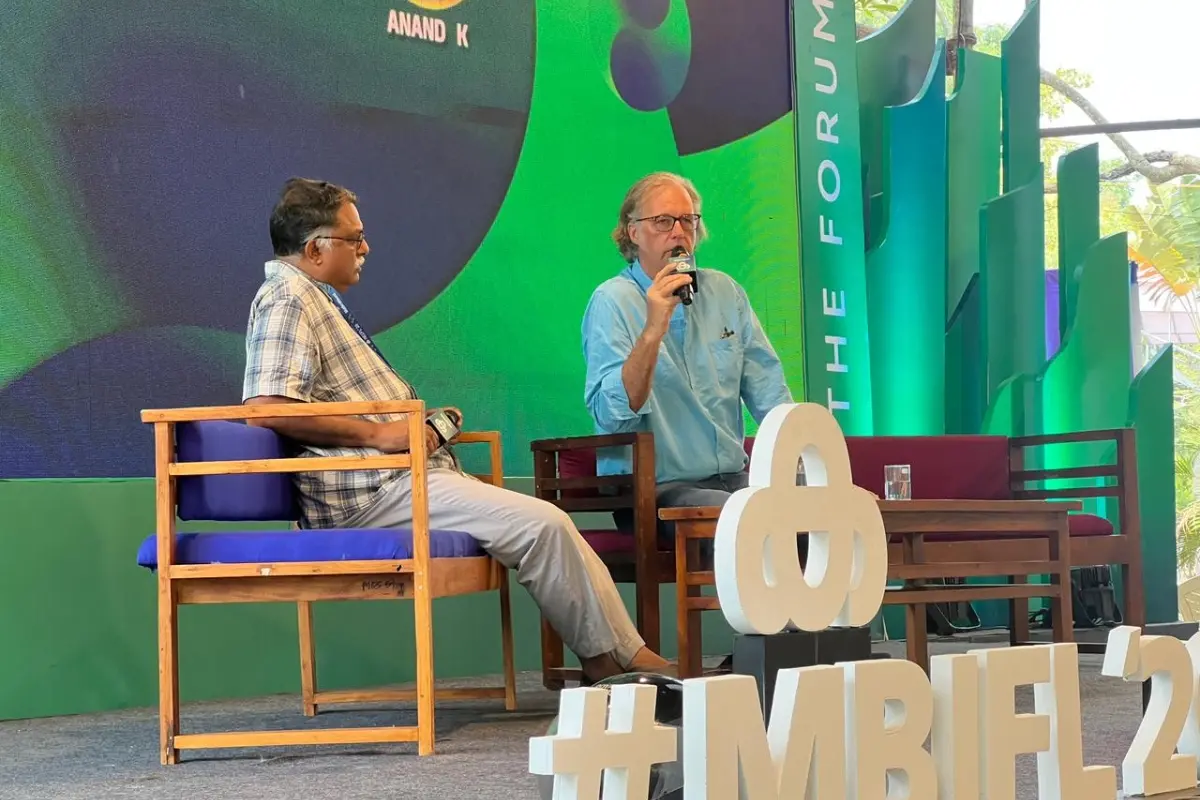
The session ‘Journey of Rhapsodies’ at Mathrubhumi International Festival of Letters 2026 (MBIFL 2026) featured US poet, musician, and activist Scott Ezell in conversation with journalist and author Anand K. The discussion explored Ezell’s long engagement with Indigenous cultures, particularly in the Americas and Asia, and the intersections of poetry, music, activism, and resistance to industrial and imperial systems.
A life shaped by movement and listening
The session opened with a reflection on Scott Ezell not merely as a traveller, but as someone whose life has been shaped by long periods of listening, observing, and living alongside Indigenous communities. Introducing him, the moderator described Ezell as “more than a person” and “a metaphor”, someone who has lived multiple lives that most people only imagine.
Central to the conversation was Ezell’s book ‘Journey to the End of the Empire’, which documents his repeated journeys through China-occupied Tibet between 2004 and 2019. Often travelling alone by hitchhiking or rented bicycles, Ezell moved beyond familiar routes and tourist centres into rural and remote regions, spending time with people whose lives are rarely recorded.
These journeys, he explained, were not about spectacle, but about presence — about staying long enough to notice how life changes under occupation, surveillance, and industrial pressure.
Indigenous time versus industrial speed
Linking his experiences to the festival’s theme, The Paradox of Pace, Ezell spoke about a fundamental difference in how time is lived.
“Indigenous time exists in a different register from industrial time,” he said, explaining that this difference comes from the relationship with land. In industrial societies, land is treated primarily as a resource. “In Indigenous cultures, land is sacred.”
As global life accelerates, Ezell warned that something essential is being lost. “As our world moves faster and faster, our experiences become thinner — reduced to swipes on screens,” he said, adding that the speed of modern life is inseparable from environmental destruction. According to him, accelerating extraction also means “accelerating the dissolution of human consciousness”.
For Ezell, Indigenous ways of living offer not nostalgia, but an alternative — a reminder that another rhythm of life is still possible.
Witnessing Tibet beyond the postcard
Ezell’s account of Tibet moved away from romantic imagery and into lived reality. Over fifteen years of travel, he witnessed increasing militarisation, surveillance, and ecological damage. What began as a travel narrative gradually became something heavier.
“It became impossible to write only about beauty,” he said. As a result, the book evolved into “both a celebration and a record of loss”.
He recalled an encounter where Chinese authorities objected to his use of the term Shangri-La, insisting it no longer existed. Ezell continued to use the name deliberately, describing it as an act of resistance — a refusal to accept the erasure of meaning through official language.
Another moment he recounted was playing his guitar at Tiananmen Square, a space deeply marked by violence and silence. When questioned by soldiers about his identity, his response was simple: “I am a guitarist.” For him, roaming and singing were not performances, but assertions of freedom.
Also read: Jaya Ekadashi 2026: Date, timings, rituals and spiritual significance
Activism as lived reality, not a choice
When asked about activism and poetry, Ezell rejected the idea of ranking one above the other. He spoke instead about Indigenous communities as the true front-line activists.
“Indigenous people are the world’s most committed environmental activists because they are defending their homes — the only land they will ever have,” he said. Unlike outsiders, they cannot step away from protest. Resistance, for them, is inseparable from survival.
He reminded the audience of the risks involved, naming environmental defenders Berta Cáceres and Isidro Baldenegro, both of whom were murdered. For Ezell, writing is simply one way of responding morally to such realities, not a separate or safer act.
Music as quiet defiance
Music, Ezell explained, has always run alongside his writing. Growing up before digital communication, he spent long hours reading and playing guitar. He described his style as “organic folk”, allowing songs to grow rather than forcing them into form.
Like poetry, music is a form of resistance — not through confrontation, but connection. It gathers people, opens emotional space, and allows imagination to travel where bodies may not.
Language, borders, and shared histories
Speaking about language, Ezell reflected on how colonial histories shape trust and suspicion. While American history creates distance in places like Mexico, Tibet presented a different dynamic due to US support for Tibetan independence.
Most Tibetans he met spoke Mandarin, and Ezell himself speaks the language. Still, he stressed that fluency was secondary. “Communication mattered more than the language itself,” he said, pointing to shared human curiosity that exists beyond borders.
Poetry beyond the state
Although much of Ezell’s work is rooted in the Pacific Rim, he resisted being defined by geography. What unifies his writing, he said, is an interest in alternatives to state systems.
“State systems are hierarchical and linear. Indigenous cultures are horizontal. Poetry is non-linear,” he explained, describing poetry as “a non-state space — a site of autonomy and freedom”.
Writing the book, he added, became “another journey running parallel to the physical one”, offering space for reflection and deeper understanding over time.
Asked whether his journeys revealed a clear purpose, Ezell rejected the idea of a single moment of clarity. Instead, he described life as something that unfolds through choices — one step leading quietly to the next.
A song that carries history
The session closed with Ezell performing ‘Grey Flowers’, a song he began writing in Tiananmen Square in 2004 during his first journey into Tibet and completed years later in the United States. Introducing the song, he reminded the audience that what happens in Tibet is not isolated, but part of a global pattern — one that continues to repeat wherever power, speed, and silence collide.