‘Killer Novas’ of the soul: Omar Musa on trauma, culture and the rhythms of revolt at MBIFL 2026
"When two dark stars collide, they create a cosmic explosion that sends ripples throughout the cosmos."
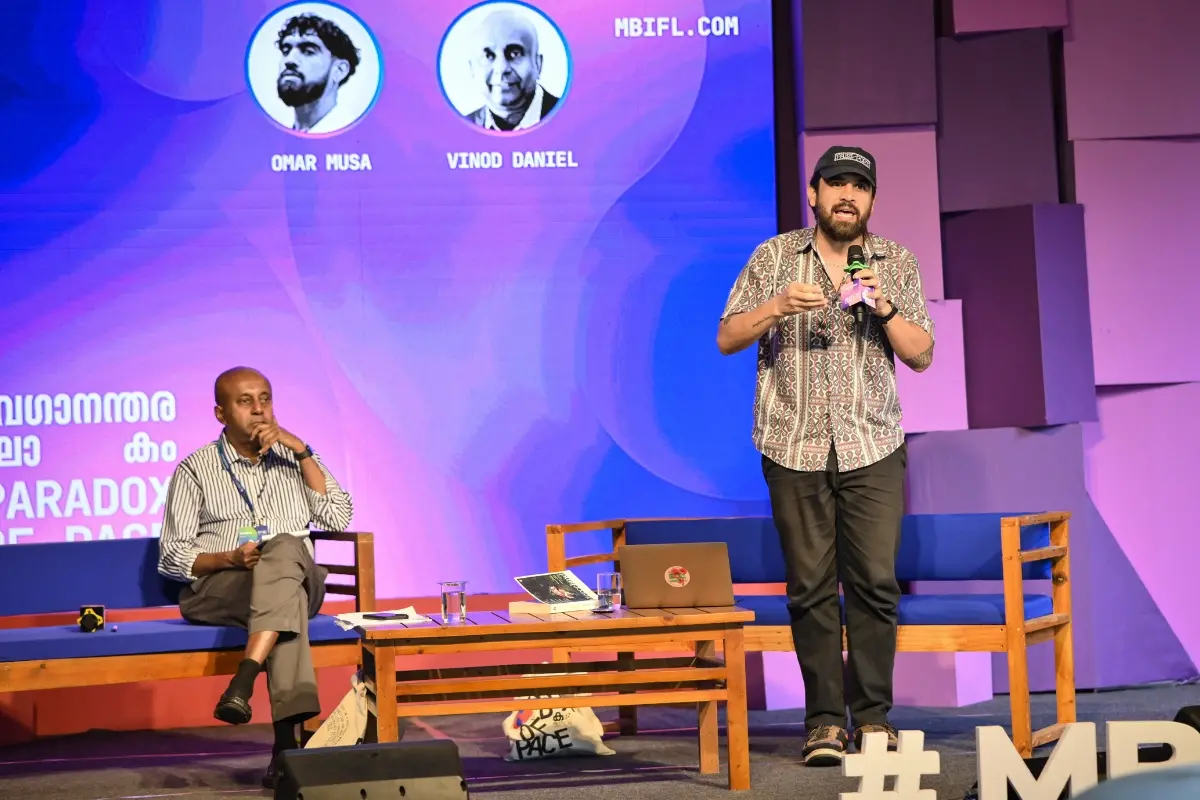
Omar Bin Musa did not offer a lesson in astrophysics, but a metaphor for the human condition at the 7th edition of the Mathrubhumi International Festival of Letters (MBIFL). Speaking at the session titled 'The Rebel on the Stage: The Rhythms of Revolt', the Australian poet, rapper, and visual artist dismantled the boundaries between genre and geography, suggesting that we all deal with 'Killer Novas' of our own - whether it be the collision of cultures during colonization or the personal traumas that shape our history.
Moderated by museologist Vinod Daniel, the session was more of an excavation into a multi-layered identity. Born to a Malaysian poet father and an Irish-Australian journalist mother, Musa's artistry is a direct result of living in the 'No Man's Land' between cultures. While he hesitated to label himself a rebel, his body of work, spanning hip-hop albums, woodcuts, and novels suggests a fierce resistance against being boxed in.
Musa’s entry into hip-hop was born of a disconnect. He recalled how poetry in his father’s Malaysian village was performed with "full gusto, body and breath," whereas the poetry readings he attended in Australia felt dusty and dormant. Hip-hop became the bridge. It was political, personal, and fierce, a way for a young Muslim boy growing up in a post-9/11 Australia to claim an identity that was often villainized by the media.
He illustrated this struggle through his song 'Too Hard to Say', a lyrical exploration of being caught in the crossfire of expectations. Musa described the exhaustion of being "too Muslim" for secular society yet "not Muslim enough" for the devout -- a paradox where one is viewed as a potential threat on a plane while simultaneously being judged for having tattoos and a history of addiction.
Yet, Musa argued that this hybrid existence, once a source of isolation, has become his greatest artistic asset.
When the fatigue of writing and performing nearly extinguished his creative spark in his thirties, Musa found salvation not on a stage, but on a riverboat in Kalimantan, Borneo. A journey into the heart of his ancestral land introduced him to the ancient art of woodcarving.
"I carve my stories in wood. My ancestors sailed in the woods. They will carry me out in the woods," Musa reflected.
What began as a therapeutic escape from words became a new language entirely. He learned to carve designs, roll them with ink, and dance upon the cloth to press the print -- a practice believed to imbue the artwork with semangat (spirit). This tactile connection to Borneo revitalized his writing, leading to his latest novel, 'Fierce Land'.
In 'Fierce Land', Musa turns his gaze toward the environmental devastation of Borneo. Moving away from the suburban angst of his earlier work, 'Here Come the Dogs', he crafts a narrative where the rainforest is not merely a setting, but a protagonist. He describes the book as a ghost story, haunted by the specters of disappearing languages, colonial sins, and the vanished forest itself.
The session concluded with a stark critique of his home nation. Musa observed that Australia has yet to grapple with the "original sin" of indigenous dispossession and the lingering shadows of the White Australia Policy. By facing these historical ghosts, whether through the rhythm of a rap verse or the ink of a woodcut,
In many ways, Musa continues to prove that the most powerful revolts are often the ones that turn trauma into art.