‘Uniformity of India is the real danger’, says Jawhar Sircar at MBIFL 2026
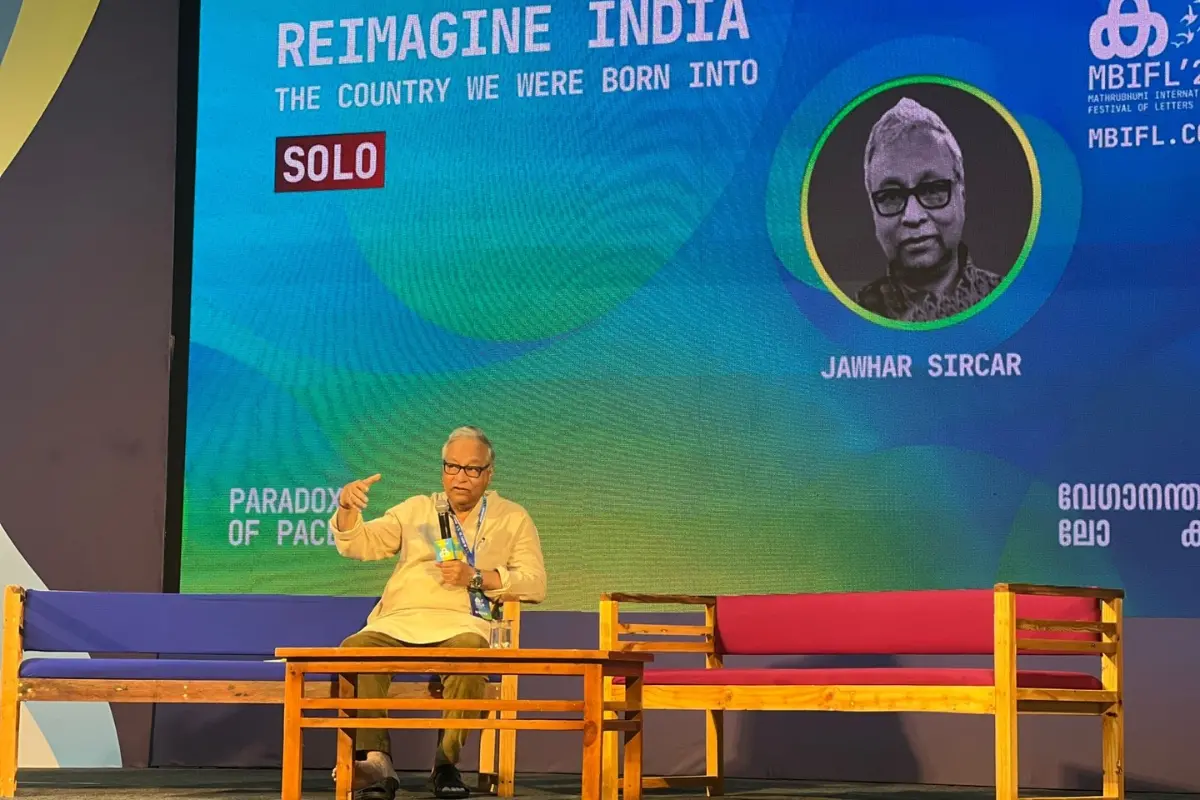
Opening his address, Sircar located himself outside conventional political binaries, underlining his discomfort with formal politics despite having served within it. “I was made an MP for absolutely no fault of mine. I worked in the political class with a lot of discomfort.”He said half-jokingly.
He clarified that his intervention was not aligned with ideological camps. “My area of interest is neither the government nor the usual Hindu Right versus Left debate.”
Sircar described his intellectual work as an effort to understand what lies beneath visible politics. “My work over the last 25 years has been to get into studies that are not visible to the naked eye.”
Rather than focusing on headline-driven debates, he said his attention remained on the deeper civilisational glue. “What I focus on is the history of the ingredients that hold up the idea of India.”
India as similarity, not sameness
Rejecting the notion of a standardised nation, Sircar argued that India never functioned through uniformity. “India has never had one all-India pattern — one language, one exam, one food habit, one ritual.”
Drawing a striking comparison, he added: “What is common between a Bengali and a Malayali is not very different from what is common between a Scottish man and a Polish man.”
Yet, he said, India continues to function as a civilisational whole. “The overarching will of India is the result of centuries of intricate planning where divergence was never erased.”
Sircar sharply criticised attempts to impose sameness. “Standardisation is the opposite of the equilibrium of India.”
He warned that uniform frameworks misunderstand how India historically held together. “It is only those who do not understand the problem who insist on one standing standard.”
Rituals, festivals and lived pluralism
Using festivals as examples, Sircar illustrated how local traditions coexist without contradiction. “Nobody remembers the original intent anymore, but the actual intent was fertility, worship, renewal.”
He explained that rituals adapt regionally. “In some places, the goddess is worshipped as fertility; in others, as destruction. Both coexist.”
On cultural practice, he noted: “Only two states dress the goddess one way; everywhere else, the local culture takes over.”
Sircar rejected the idea of unity in diversity as a slogan. “This is not unity in diversity as a slogan. This is an organic equilibrium.” He argued that India’s cohesion emerges from difference, not uniform rules. “All local customs start conflicting, then merge into a sublimity that feels independent yet collective.”
Explaining how the same festival carries contrasting meanings, Sircar said: “In North India, Diwali is about lighting the darkest night of the year. “In East India, we worship the darkness itself — Kali.”
For him, this contradiction was not weakness. “We are not scared of contradictions. That is the strength.”
Sircar made a sharp observation on authority and belief. “No healthy man is ever scared of government. But people are scared when power mixes with faith.”
Challenging dominant mythological interpretations, Sircar said: “Asuras were not always villains. In many regions, they are ancestors.”
He cited regions where Ravana is revered rather than demonised. “In Mandla, Bastar, Kangra, and parts of Bengal, Ravana is not a demon — he is lineage.”
Citizenship and modern anxiety
On contemporary debates around citizenship and documentation, Sircar warned of a historical rupture. “This is the first time in Indian history that people are asked to prove whether they belong.”
He cautioned against reinterpretations of legal identity. “The word ‘citizen’ is now being interpreted in ways our laws never intended.”
Sircar concluded by returning to his core argument — that India survives through acceptance, not force.“The soul of India presses on diversity, on the oraganic equilibrium of tons of cntradictions”
“If we discover uniformity, we lose our India.”