Explainer: Rs 10,200 crore upgrade for India's Pinaka rocket launchers
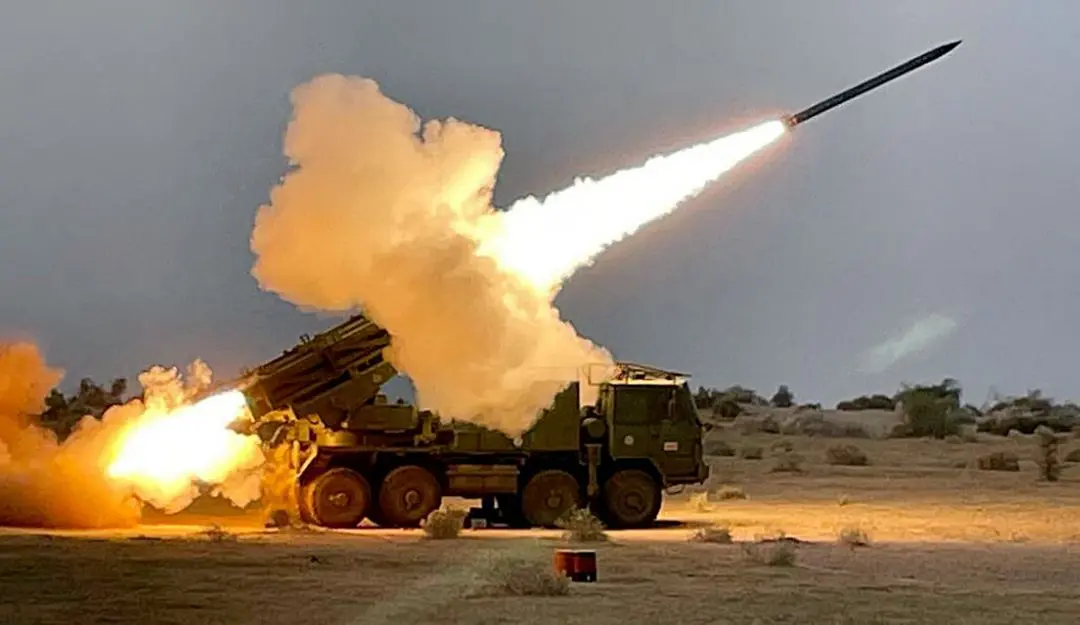
In a big step for India's homegrown Pinaka multi-barrel rocket launchers, the Prime Minister-led Cabinet Committee on Security approved two major deals on Wednesday. These deals, worth around Rs 10,200 crore, aim to enhance the rocket system's firepower by equipping it with advanced ammunition.
The two deals include high-explosive pre-fragmented rocket ammunition worth around Rs 5,700 crore and area denial munitions costing approximately ₹4,500 crore. These will support the 10 Pinaka regiments already ordered by the Indian Army.
Pinaka multi-barrel rocket launchers
The Pinaka Multi-Barrel Rocket Launcher (MBRL) is a combat-tested artillery system designed for all-weather operations. It provides indirect area fire, making it highly effective in battle. Indirect area fire means launching rockets or artillery shells without directly aiming at the target. Instead, they follow a preset trajectory to hit a wide area, making it useful for battlefield coverage.
This advanced artillery system is designed to quickly launch multiple rockets, striking key enemy positions in a short time. With fast response and accurate targeting, it effectively hits critical and time-sensitive targets. The Pinaka Multi-Barrel Rocket Launcher (MBRL) plays a crucial role in modern warfare with its high firepower and battlefield effectiveness.
During firing, the launcher is kept stable with four hydraulic supports. A platform (cradle) holds the rocket containers (pods) and is connected to a rotating base. It carries two rocket containers placed side by side, ensuring accurate launching.
Each rocket container (pod) holds six tubes arranged in a 2x3 pattern (two rows with three tubes in each row), where rockets are loaded for launching. The control system (Man-Machine Interface) is placed inside the vehicle’s cabin, allowing the operator to manage the launcher safely from inside.
The launcher can be operated in three ways:
* Automatically using a Fire Control Computer (FCC)
* Through the Launcher’s Computer (LC)
* Manually by the operator
Before firing, the launcher needs to be aligned and aimed. This is done either automatically using an Automatic Gun Alignment and Pointing System (AGAPS) or manually with a Dial Sight to ensure accurate targeting.
Main features of Pinaka
* Quick Fire & Move: The system can fire and relocate quickly to avoid enemy detection, thanks to automatic leveling and stabilization for steady aiming.
* Rapid Firing: It can launch 12 rockets in just 44 seconds, delivering high firepower in a short time.
* Precise Targeting: Ensures high accuracy with a one-milliradian precision for both horizontal (AZ) and vertical (EL) aiming.
* Fast Programming: All 12 rockets can be programmed within 20 seconds, allowing for quick mission execution.
* Advanced Navigation: Uses an Inertial Navigation System (INS) for fast and precise positioning, ensuring rockets are aimed accurately and quickly before launch.
* Versatile Payloads: The rockets can carry different types of explosives, making them suitable for various mission needs.
* Environmentally Safe: The munitions are designed to meet international safety standards, minimizing environmental impact.
The Pinaka system is considered one of the best multi-launch rocket systems in the world. It can fire high-explosive pre-fragmented rockets that reach up to 45 km and area-denial rockets that cover 37 km. The area-denial rockets release multiple small explosives (bomblets) over a wide area, including anti-tank and anti-personnel mines, making it highly effective in combat.
India has developed extended-range versions of the Pinaka rocket system, which can hit targets up to 75 km. There are future plans to increase its range to 120 km and later to 300 km.
The country is also promoting Pinaka for export, along with other indigenous defense systems like the BrahMos supersonic cruise missile and the Akash air defense system. Armenia has already purchased Pinaka and Akash, while several nations in ASEAN, Africa, and Europe have shown interest in acquiring them.
Pinaka Regiment
A Pinaka regiment is made up of three groups (batteries), each having six launchers, totaling 18 launchers. Every launcher can fire 12 rockets over a range of more than 40 km in just 44 seconds. Apart from the launchers, the regiment includes support vehicles, a radar system for tracking targets, and a command post to control operations.
The Pinaka multi-barrel rocket launcher used by the Indian Army now comes with high-explosive pre-fragmented rockets, improving its firepower. These advanced rockets can hit targets up to 45 km away with greater precision and impact.
Designed to cover a wide area with deadly fragments, these rockets are highly effective against enemy troops and vehicles. This upgrade makes the Pinaka system even more powerful, ensuring better performance in combat situations.
Pinaka’s Area-Denial Rockets
The Pinaka multi-barrel rocket launcher now includes area-denial rockets, designed to prevent enemy movement by scattering small explosives (bomblets) across a wide area. These bomblets include anti-tank and anti-personnel mines, making it difficult for enemy forces to enter or operate in the targeted zone.
Developed to strengthen defenses and secure key locations, these rockets have a range of up to 37 km, adding significant firepower to the Pinaka system in battle.
These area-denial rockets enhance battlefield control, ensuring superior defense and tactical advantage in combat.
The author of this article is an award-winning Science Writer and a Defence, Aerospace & Political Analyst based in Bengaluru.