A daughter, her storm of a mother: Reading Arundhati Roy's ‘Mother Mary Comes to Me’
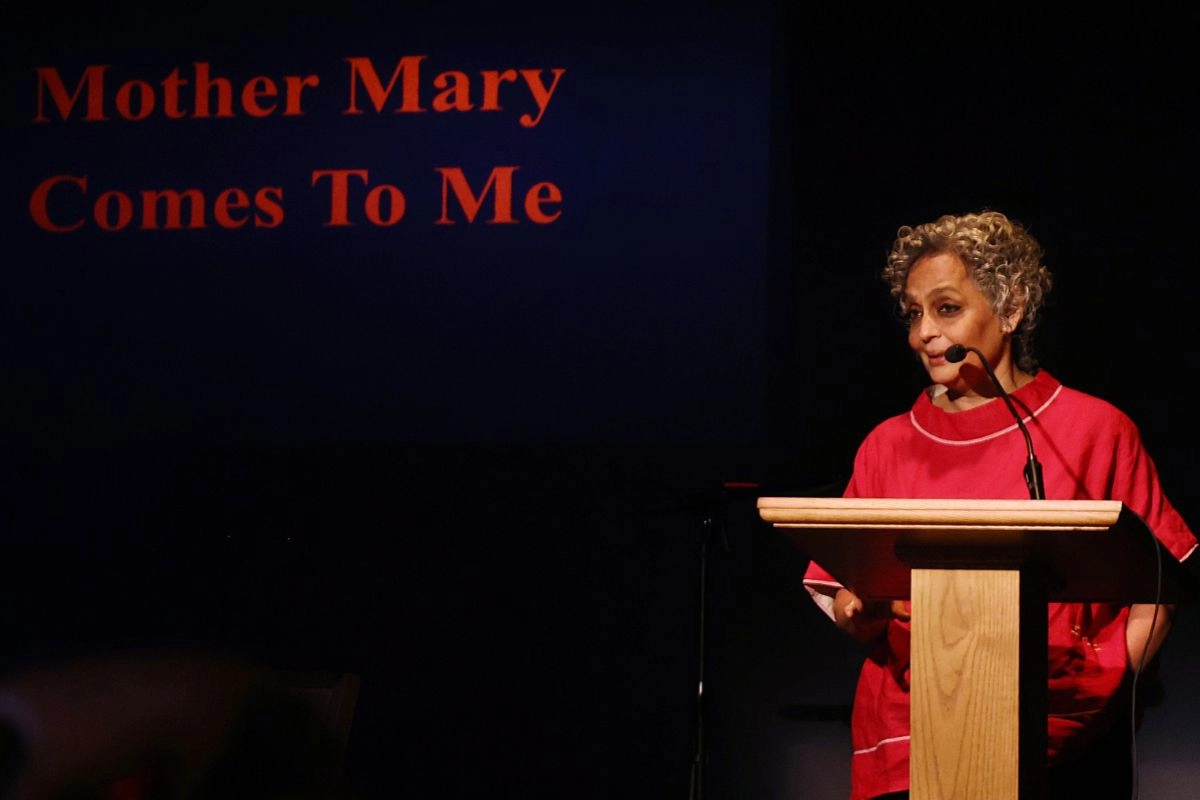
On Arundhati Roy's 65th birthday, a reader looks back at her memoir Mother Mary Comes to Me, the story of a daughter and her storm of a mother.
Arundhati Roy: what can be said about her that hasn't already been said? Architect, actor, screenwriter, production designer, author, activist, or perhaps a literary goddess? Yet it wasn't any of these titles that made me want to read this memoir. It was my friends. One said, "You have got to read this book." Another exclaimed, "Maybe not, it might resonate too well!" Either way, the universe had decided, and oh, what a memoir it was to find me. The book is about a child and her storm of a mother. The vast majority of readers might assume it is a portrait of Mary Roy, but it is truly an ode to the shaping of the Arundhati Roy we know today.
The chapters tell a story of survival, human instinct and the unconquered moons of a little Arundhati, or rather, moons no one knew she would conquer. They are written in pure harmony, which, ironically, remains out of sight in many aspects of her life. Arundhati writes about Mary Roy in absolute awe, sometimes in horror, and most times as an emotional stranger, referring to her as "She" or "Mrs. Roy." While most of us are products of diplomacy, the author takes a different route. She is unsparing in her language towards Mrs. Roy. The intricacies of the mother-daughter relationship are well explored, yet the dissonance between the two is appalling, almost uncomfortable, as it drags unfazed sentiments to the surface. Despite chasing desires of freedom, or in her words "un-noble things," Mary Roy lingers like a shadow throughout.
To praise Mrs. Roy slowly becomes a question of conscience as her daughter peels back the nuances of what makes her who she is. I wish she had joked about the stories of emotional neglect. How could anyone treat another person in such a manner? Can someone be an angel to others and a gangster in her children's lives? She was ambitious for her school, yet called her own son ugly and subjected him to her temper. This shouldn't be surprising, as it simply reflects the duality of human nature. I wonder how Arundhati believed the world would perceive the woman who gave birth to her. To me, this is a daughter's account of her mother's life: a cold, rather brutal one.
Through all this, Arundhati blossoms, contrary to what some might assume, that she would crumble. She builds character. She becomes what many fear: a woman of opinions, a writer. The journey to becoming a writer seemed like a benediction, and in her words, that is how she felt. Was it so? An abandoned baby [verify], swaddled in a crib of litter and watched over by mosquitoes. Who is she? The reader is left wondering whether this is how she viewed herself. Through the hurricane, she becomes the successful writer. How could she not, when she had ambition, one quality believed to be shared with her mother? Even when accusations pile up against her, she cruises through with ease, again an ode to the childhood she had, or, rather, endured. Still, somewhere along the way, the daughter always seems to live in service of Mrs. Roy, a valiant organ-child who spent her childhood breathing for her.
As a reader, I felt anger, disbelief, love, even hate, though I believe that wasn't Arundhati's goal. What is remarkable, and a little scary, is the way she remembers each detail of her life, almost photographically, as if she had been turning this book into reality all along. She breezes through Mrs. Roy's final days and the aftermath. There she is, imagining her mother walking on the high seas, looking through her binoculars with straightened shoulders, just as her mother would.
Once in a while you come across a book and an author that make you wonder how similar human interactions and experiences are. More than Mother Mary coming to her, this was Arundhati reaching out to Mary Roy. She may or may not have reached her, but Mary Roy continues to live in these pages. As for me, it felt like she came to me.
ALSO READ | Where to begin with Arundhati Roy | A reader's guide