What changed in NCERT’s image of the Mohenjo-daro ‘Dancing Girl’- and why?
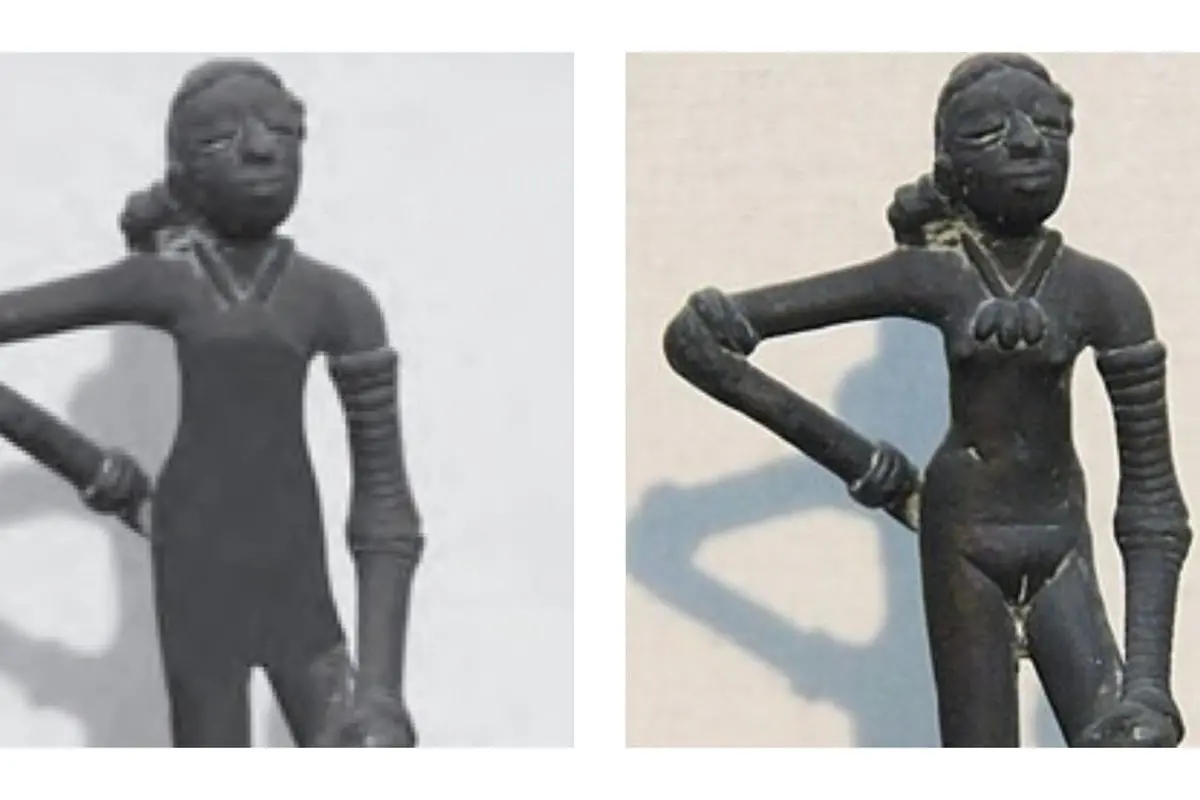
New Delhi: The National Council of Educational Research and Training (NCERT) has come under scrutiny after the iconic “Dancing Girl” of Mohenjo-daro appeared in an altered form in its newly introduced Class 9 arts education textbook, prompting criticism from academics and raising questions about the representation of historical artefacts in school curricula.
The image appears in Madhurima, NCERT’s new arts education textbook for Class 9, in a chapter titled History of Arts. Observers have noted that the bronze figurine’s bare torso appears to have been visually modified, with shading used across the upper body that obscures anatomical details visible in the original sculpture.
The representation contrasts with the image of the same artefact published in NCERT’s Class 6 Social Science textbook, where the figurine appears closer to its original form.
The “Dancing Girl”, discovered at Mohenjo-daro and dating to around 2600 BCE, is among the most recognised artefacts of the Indus Valley Civilisation. The bronze sculpture is widely regarded as an important example of early South Asian artistic achievement.
Reacting to the altered image, educationist and historian Michel Danino, who headed the committee that developed NCERT’s new Class 6 Social Science textbooks, said he had previously been informed that the figurine was considered “not age-appropriate” for younger students.
“This refers to our Grade 6 Social Science textbook. The reason I was given was that the image of the Dancing Girl was not age-appropriate,” Danino told PTI.
He said the textbook development team disagreed with that assessment and had consulted teachers, who did not view the image as problematic.
“The notion that nudity is inappropriate is, in my opinion, an obsolete Victorian view. Yet we speak of decolonising Indian education,” he said.
Commenting on the image used in the Class 9 arts textbook, Danino said he was initially surprised by the alteration.
“If the Dancing Girl cannot figure as she is, and with proper dimensions, in a chapter on Indian art, then we have a serious problem,” he said.
He further argued that modifying the image amounted to a misrepresentation of the original artefact.
“The modification misrepresents the original artefact,” Danino said, comparing it to historical alterations made to classical artworks. He added that altering images of archaeological objects without clear explanation risked creating a misleading representation of history.
According to the textbook, the figurine is a bronze sculpture from Mohenjo-daro created using the lost-wax casting technique, which it notes is still practised in parts of West Bengal, Jharkhand and Chhattisgarh.
The chapter describes the sculpture as depicting a figure standing with one knee bent, one hand on the waist and the chin slightly raised. Students are also encouraged to discuss what the pose might represent and to recreate the posture as part of a classroom activity.
Danino noted that archaeologists continue to debate the significance of the figurine and that little is known about its original context. However, he pointed to similar postures found on artefacts from the Harappan site of Bhirrana in Rajasthan, suggesting the stance may have held cultural or artistic significance.
NCERT has not publicly commented on the apparent differences between the representations of the Dancing Girl in its Class 6 and Class 9 textbooks.