India tests indigenous Bhargavastra system designed to destroy enemy drone swarms
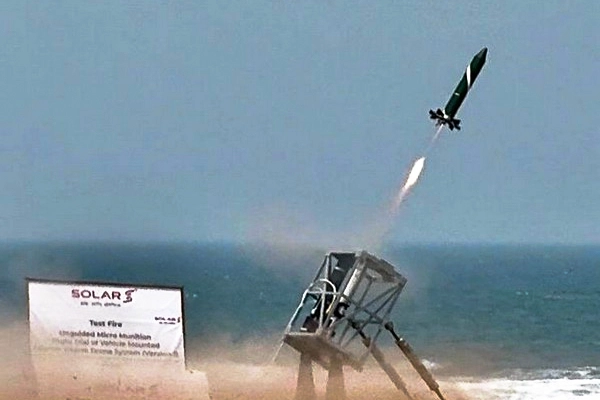
New Delhi: India's indigenous Bhargavastra counter-drone system has successfully completed its development trials at the Pokhran field firing ranges in Rajasthan, marking a milestone in the country's efforts to strengthen its defences against drone-based attacks.
Developed by Solar Defence and Aerospace Limited (SDAL), the trials were conducted between November 20 and 24. Bhargavastra is described as India's first indigenously designed and developed two-layer, vehicle-mounted counter-swarm drone system.
The system is designed to tackle hostile unmanned aerial vehicles (UAVs), weaponised drones, loitering munitions and coordinated drone swarms. Its multi-layer architecture combines indigenously developed unguided rockets with precision micro-missiles to engage different categories of aerial threats.
Unlike electronic counter-drone systems that rely on jamming communication signals or disrupting navigation, Bhargavastra uses a hard-kill approach. This means it physically destroys hostile drones rather than attempting to disable them electronically.
Its vehicle-mounted configuration allows it to be moved and deployed according to operational requirements. The system is designed to function in varied geographical conditions, including deserts, plains and high-altitude locations of up to 5,000 metres above mean sea level.
How Bhargavastra detects and destroys drones
Bhargavastra's Command and Control Centre serves as the central unit for detecting, tracking and responding to aerial threats. It integrates information from multiple sensors to provide operators with a real-time picture of incoming drones.
Its detection equipment includes:
- Radar: Designed to detect drones at distances of up to 10 km.
- Electro-Optical/Infrared systems: Used for surveillance, identification and tracking.
- Passive radio frequency sensors: Help detect drone-related radio-frequency activity.
- Command and Control Centre: Processes sensor information, tracks threats and assigns targets to launchers.
Once an incoming drone or swarm is detected, the command-and-control system analyses the information and enables operators to assign targets to the launchers.
The ability to track multiple aerial targets is particularly relevant in countering drone swarms, which can approach military positions in large numbers and potentially overwhelm conventional air defence systems.
Bhargavastra is also designed to integrate with the Indian Armed Forces' Command, Control, Communication and Intelligence (C4I) networks. This would allow it to function as part of a wider military surveillance and defence infrastructure.
Why the Bhargavastra trials matter
Drone warfare has become an increasingly important feature of modern military operations. Relatively inexpensive unmanned aircraft can be deployed for surveillance, reconnaissance and attacks on military infrastructure.
Coordinated drone swarms present an additional challenge because multiple aerial targets can approach simultaneously, putting pressure on conventional air defence systems.
Bhargavastra is being developed to address this threat through a combination of detection sensors, command-and-control capabilities and physical interception weapons.
Its ability to operate across different terrains, including high-altitude areas, is also relevant to India's varied border environments.
The successful completion of the latest development trials marks progress in the system's development. However, the trials should not be confused with confirmation of full-scale operational deployment or induction into the armed forces.
India's push to counter the growing threat of drone warfare
The development of Bhargavastra comes amid growing military interest in counter-drone technologies. Conflicts around the world have demonstrated how drones can be used for reconnaissance, precision attacks and coordinated strikes.
For India, the challenge includes protecting military installations, border positions and other sensitive infrastructure against both individual drones and swarm attacks.
The system's hard-kill capability offers a different approach from electronic jamming, particularly against autonomous drones that may continue operating even when communication links are disrupted.
Its integration with military C4I networks could also allow information from multiple surveillance systems to be used in coordinating responses to aerial threats.
The Pokhran trials represent an important development milestone for an indigenous defence technology. Further testing, evaluation and decisions on military induction will determine how Bhargavastra eventually contributes to India's counter-drone capabilities.