OPINIONWho really won the exam protest?
Politics has a curious habit of rewarding those who move last, provided they move decisively. It is not always the first actor who shapes history, but more often the one who successfully rewrites the story after everyone else has finished speaking. The events of the past few weeks suggest that the BJP may have done precisely that.
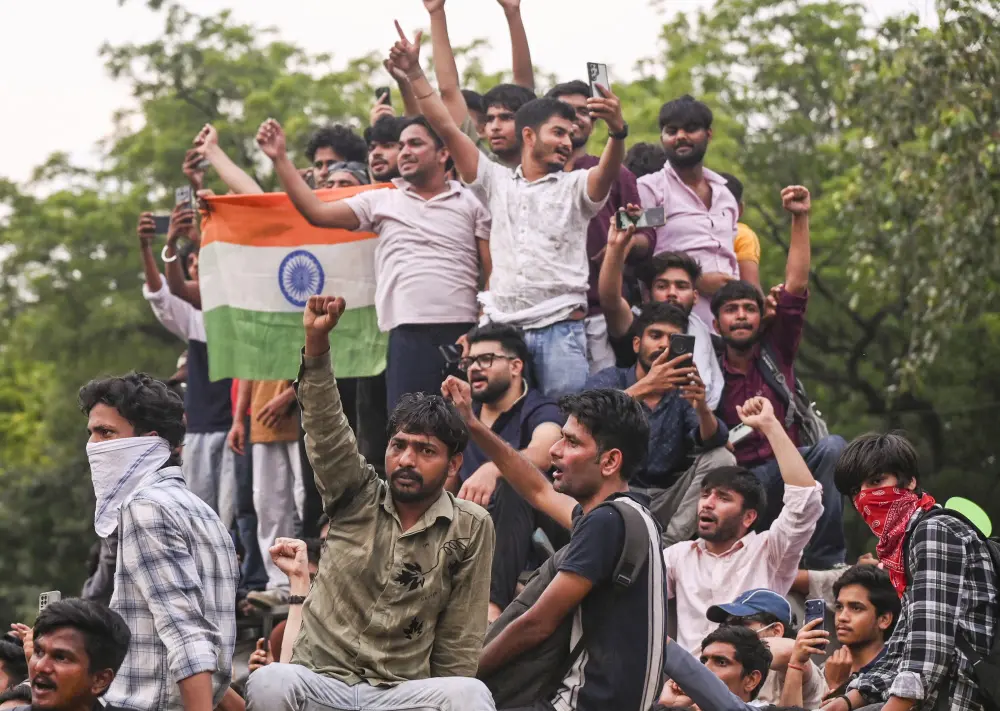
What seemingly began as a spontaneous nationwide outpouring of anger over examination irregularities looked, for a brief moment, as though it possessed the rare quality that every government dreads. It was becoming larger than its organisers. Students who had never heard of one another were rallying around a common grievance, and social media was amplifying their outrage at a speed that political parties could neither manufacture nor entirely control.
More importantly, the movement had begun to attract the attention of the opposition, which sensed that this might become one of those defining moments when public frustration could be converted into sustained political pressure. Then, almost overnight, the atmosphere changed. Sonam Wangchuk, who had sustained a fast for weeks, almost conveniently chose to end it just as Parliament assembled. And the symbolism was impossible to ignore. After holding out through the most difficult phase, the fast ended not with a bang, but with a whimper, without the movement’s headline demands having been fully realised. The image of Wangchuk accepting lime juice from BJP president J.P. Nadda was politically more consequential than the act itself.
Politics often lives in photographs long after facts have been forgotten. Around the same time, the Prime Minister appeared in a pair of unusually informal selfie-style videos speaking about examinations, students and aspirations. Whatever one thought of the presentation, the messaging was unmistakable. The government had entered damage control mode. Then came the decisive blow. Institutional action followed.
The education minister, Dharmendra Pradhan, resigned, and senior officials associated with the examination system were shown the door. Suddenly, the conversation was no longer about whether the government would act, but about how boldly it had acted. And, for the opposition, that changes everything.
Governments rarely fear protests simply because people gather on the streets. They fear protests that begin attracting political entrepreneurs. Every successful agitation eventually reaches a point where established political parties arrive, not necessarily to strengthen it, but to inherit it. That process had already begun, and Rahul Gandhi had entered the conversation. Other Opposition leaders were circling.
Left unattended, the agitation might well have evolved into something much larger than a campaign against examination irregularities. The BJP appears to have recognised that danger before its opponents fully exploited it.
There is an important distinction here that deserves emphasis. None of this establishes that the movement itself was engineered by the government, or that its prominent faces were acting at anyone’s behest. Those are serious allegations that require serious evidence, and, publicly, such evidence does not exist. What does exist is something equally important in politics. Incentives. A government confronted with a rapidly expanding protest has three options. It can suppress it, ignore it, or absorb it.
While suppression would carry political costs, ignoring it would allow the opposition to define the narrative. Absorption is usually the most elegant solution. Concede enough to satisfy public sentiment while simultaneously ensuring that the credit for those concessions accrues not to the protesters but to the government itself. That seems remarkably close to what has unfolded.
The movement’s greatest strength also became its greatest vulnerability. Being decentralised, it possessed enormous moral legitimacy but very little political discipline. It had no universally accepted leadership capable of deciding when victory had been achieved or what should happen next.
Leaderless movements excel at generating outrage, but often struggle to manage success. Once the government’s principal concessions arrived, the movement finds itself now without an agreed strategy. Should it continue, or escalate, or declare victory? Who would decide? In politics, indecision is rarely a neutral condition. It creates a vacuum, and vacuums are invariably filled by those who understand narrative better than organisation.
The BJP has spent decades mastering precisely that craft. Ironically, many of the party’s own greatest political successes began as grievances that gradually acquired a life of their own. Sparks became embers and embers became flames. Eventually, the flames altered governments and reshaped national politics. It would have therefore been surprising if the BJP failed to recognise the same pattern emerging against itself.
That may explain the speed with which the government shifted from appearing defensive to appearing decisive.
Some observers point to other circumstances that naturally invite questions. The relatively restrained official handling of certain prominent faces associated with the agitation, Sonam Wangchuk’s own references to conversations with constitutional authorities, the timing of his decision to end the fast, and the carefully choreographed public messaging that followed. Individually, none of these proves coordination, but collectively, they are sufficient to provoke legitimate political curiosity. But again, curiosity is not proof. The more persuasive explanation is that the government recognised a movement that had begun escaping its original boundaries and moved swiftly to prevent it from becoming the opposition’s rallying point. If that was indeed the strategy, it has produced an immediate dividend.
The opposition now finds itself celebrating a victory that may ultimately strengthen the very government it sought to weaken. Having demanded accountability, it must now explain why accountability, once delivered, should remain politically unacceptable.
That is not an impossible argument, but it is a far more difficult one. The BJP, meanwhile, has acquired something invaluable. It can plausibly argue that it acted decisively, removed those responsible and cleaned up the system. Whether that narrative survives public scrutiny is another matter. But politics is often decided long before historians begin examining evidence.
There may yet be another calculation. Punjab will soon return to the centre of political attention, and allegations surrounding examination irregularities there have already become contentious. If the BJP chooses to contrast its own response with the handling of similar controversies by its opponents, it will have transformed a national embarrassment into an electoral talking point. That is not merely damage control, but political jujitsu.
Perhaps the student movement will recover. Genuine public anger seldom disappears simply because one minister resigns. Another examination scandal could revive the protests overnight.
History offers many examples of movements that appeared exhausted before suddenly returning with greater force. But history also teaches another lesson. Governments do not always defeat movements by crushing them. Sometimes they defeat them by embracing just enough of their demands to make continued mobilisation seem unnecessary. Whether by instinct, strategy or simple political survival, the BJP appears to have understood that lesson. The Opposition may have won the argument, but the BJP may have won the ending. And in politics, endings usually matter more.
(The author is a National Award winner for Best Narration and an independent political analyst. Views expressed are personal)