Will Gurukkal be out?
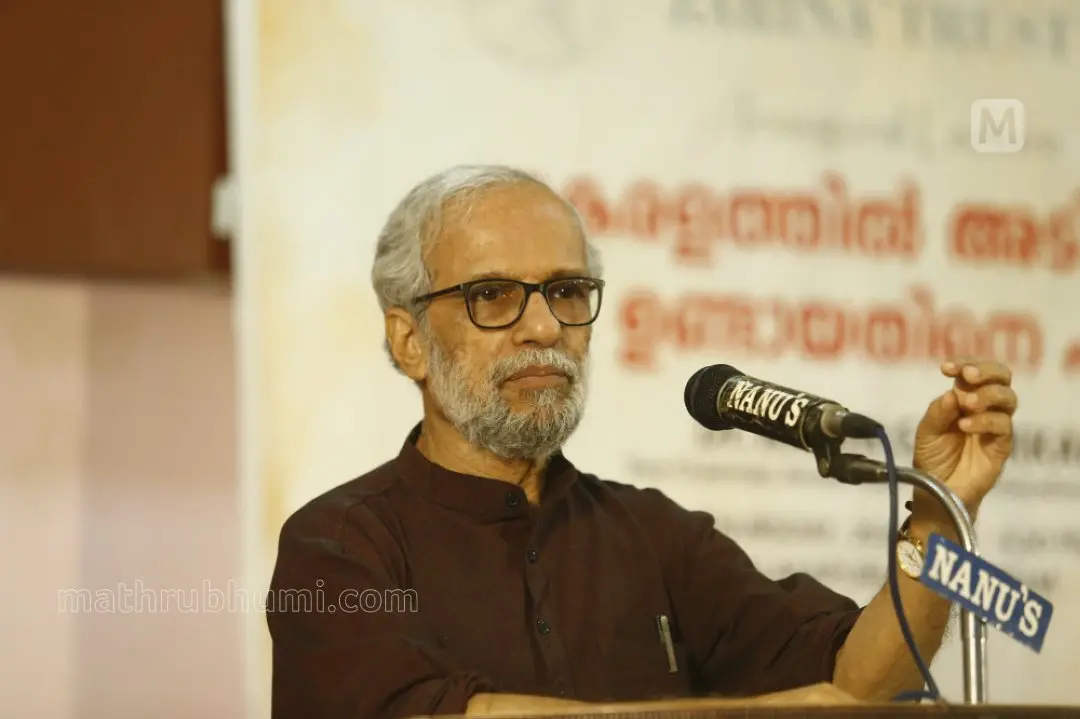
Author and former diplomat TP Sreenivasan was publicly slapped when he tried to reform Kerala's education sector in his capacity as the vice chairman of the state Higher Education Council. Will the present incumbent, Dr Rajan Gurukkal, eminent historian, be shown the door for his attempts to reform?
Dr Gurukkal has stirred a hornet's nest with his admission in a recent interview that Kerala’s higher education sector is in a pathetic state. He held the mediocre teaching and the stubborn clerical communities as most responsible for the rot in the system as they collectively resist any attempt to reform or change. The brunt of this is borne by Kerala's students, who have been pushed into the abyss of mediocrity and rendered incapable of competing with their counterparts elsewhere.
Coincidentally, Gurukkal's remarks preceded the news that 75% of the students in 22 of the state’s 128 engineering colleges flunked the final B Tech examinations held by the Kerala Technical University. Two years ago, it was revealed that barely 1.08% of Kerala’s students made it to the IITs, whereas the average rate for most states was 8-10%. This is despite that the University of Kerala and 13 colleges of the state won the highest grading (A++) from National Assessment and Accreditation Council (NAAC), last year. Only two colleges had this grading three years ago. However, less than 15% of the more than 1500 colleges attended by 13 lakh students have even basic NAAC grading.
Gurukkal’s comments have come against the backdrop of an unprecedented rise in the number of youngsters leaving Kerala for other states and abroad for higher studies and the state government and the Council's new reforms initiated in the higher education field. However, one glaring omission from Gurukkal’s otherwise comprehensive critique, in which he also slammed the union leaders, was the critical culprit—the political leadership that patronises and protects the vested interests in the system.
Though what Gurukkal said has been widely known for many years, people in authority rarely say it openly, at least until they leave their offices. The reason is also no secret. Why antagonise the establishment run by the organised political parties, teachers, employees and students? The fate of those who question the entrenched powers too is quite well known. Only those who no longer vie for favours or very few who don’t bother about the consequences dare to open up. Many former vice-chancellors often lamented how they failed during their tenure to effect even minor changes before the collective opposition from teachers, employees, students and their political masters.
Gurukkal expressed apprehensions that even the primary reforms proposed by the Shyam Menon Committee to improve the system, like the presently initiated shift of the undergraduate programmes to the four-year format with changes in curricula, would be sabotaged from within. The simmering opposition to these changes among a section of teachers and the administrative staff in the higher education directorate is no secret. Gurukkal lamented how the administration of the universities and the Higher Education directorate was in the clutch of clerks.
One news report noted that many of his critics felt that Gurukkal was going ahead with reforms over the head of R Bindu, the Higher Education Minister. As always, the “status quoists” have evoked the usual ideological bogey that he was implementing the “fascist” Central government’s New Education Policy in a “secular and progressive” state like Kerala.
As usual, Gurukkal's highly significant points in his analysis were lost in the din over the teachers' wounded sentiments. What ruffled the feathers most was his scathing comments against the deplorable standard of teachers and students. Most of our teachers were least interested in enhancing their academic armour once they landed their jobs and indulged in the long-outdated “spoon-feeding” of the students, which nipped their creativity in the bud. Though a proclaimed Leftist and CPI(M)’s fellow traveller, Gurukkal pointed out that real scholars and respected academics should lead universities, including syndicates and senates. Though he said people’s representatives should be in these forums, he dared to say another unspeakable truth- “Universities will not grow if union leaders come to occupy all those bodies by proclaiming themselves to be scholars”.
What’s more needed to stir the hornet’s nest in Kerala? Expectedly, his comments badly hurt the pride of teachers and some of their union leaders. Many of them openly came out against Gurukkal’s intransigence to insult the teaching community. Media reports that the teachers’ unions, irrespective of political affiliations, have protested severely against Gurukkal’s comments at the meeting to assess the preparations for implementing reforms like the four-year underground course. The report says that the Higher Education Minister, R Bindu, has sought clarification from Gurukkal. According to the report, while organisations aligned with the Opposition sought Gurukkal’s resignation, the pro-government groups lamented that the vice chairman should not have stooped to the level of those who propagate everything is terrible in the education sector. Gurukkal dismissed the allegations to the media, saying he was misquoted, and a newspaper pulled his comments out of context to create a misunderstanding.
Even teachers who were not part of unions were miffed by Gurukkal. Prof. Achuthsankar S Nair, an academic not aligned with the Left and a trenchant critic of the Left unions' meddling in universities, posted on Facebook. “The jist of his critique is that most students of Kerala are mannunnis (morons) who learn through spoon-feeding (and teachers also emerge from such morons) and that only those with foreign education are good. A statement like this from one who heads the State Higher Education Council will only help agencies like Santa Monica (recruiters for foreign universities). These agencies already enjoy clout in university administration, which is unavailable even to Dr Ajaya Ghosh, the winner of the Indian Nobel, like the Infosys Prize. Gurukkal’s comments will only - unwittingly- increase the young generation’s outward migration for education. Everything is not good in higher education. But he should have been more discreet in his criticism and should correct”. However, Nair’s criticism also appears to have stemmed more from the new report on Gurukkal’s comments than a reading of his interview. Gurukkal neither called the students mannunnis nor said only those with foreign degrees were good. He also did not condemn the entire teaching community but mentioned that many are deeply involved in learning more and sharing their new knowledge with students. “But their colleagues, officials and the system see them as “nuts” and push them out”, he lamented.
The ruckus over Gurukkal’s comments erupted when India Today magazine’s annual Survey of India’s Best Colleges was published. Ever since the magazine conducted it's annual survey in 1997, no institution from Kerala has topped among the 10 best colleges in any of the 14 disciplines featured in the survey. The story is no different this time also. This year, 1779 colleges from all over the country participated. Delhi colleges have come first in ten streams with Hindu College topping in both arts and sciences. Among the remaining four toppers, two have gone to colleges in Bengaluru and one each to Roorkee and Mumbai.
However, four Kerala colleges have found a place among the country’s ten best colleges in three streams. The best performer among the Kerala colleges in the entire survey is Rajagiri College of Social Sciences, Kochi which emerged the second among the top ten in social science. The others among the top ten are the following.
Social Sciences: Loyola College, Thiruvananthapuram (9th).
Law: National University of Advanced Legal Studies (NUALS), Kochi (9th)
Mass communication: Manorama School of Mass Comm, Kottayam (9th). National Institute of Fashion technology (NIFT), Kannur has been ranked 4th among the 10 best emerging colleges in fashion technology.
Kerala’s next best achiever in the survey is Kochi’s Government Model Engineering College, which topped the list of the best engineering colleges in South India. Thiruvananthapuram, Kochi and Kottayam have been listed as emerging destinations for arts, science and mass communication streams.
However, Kerala’s various private and government colleges have figured among the country’s top ten in different streams for the lowest fees and value for money. They include the All Saints, Thiruvananthapuram, Vimala, Thrissur, St Joseph's, Irinjalakkuda, St Thomas, Thrissur, Government Dental, Thiruvananthapuram, Believers Church Medical, Thiruvalla, TKM Engineering, Kollam, Bishop Jerome, Kollam, Pazhassiraja, Pulpally, Safi Institute of Advanced studies, Malappuram etc.