When Cricket turns into a proxy war
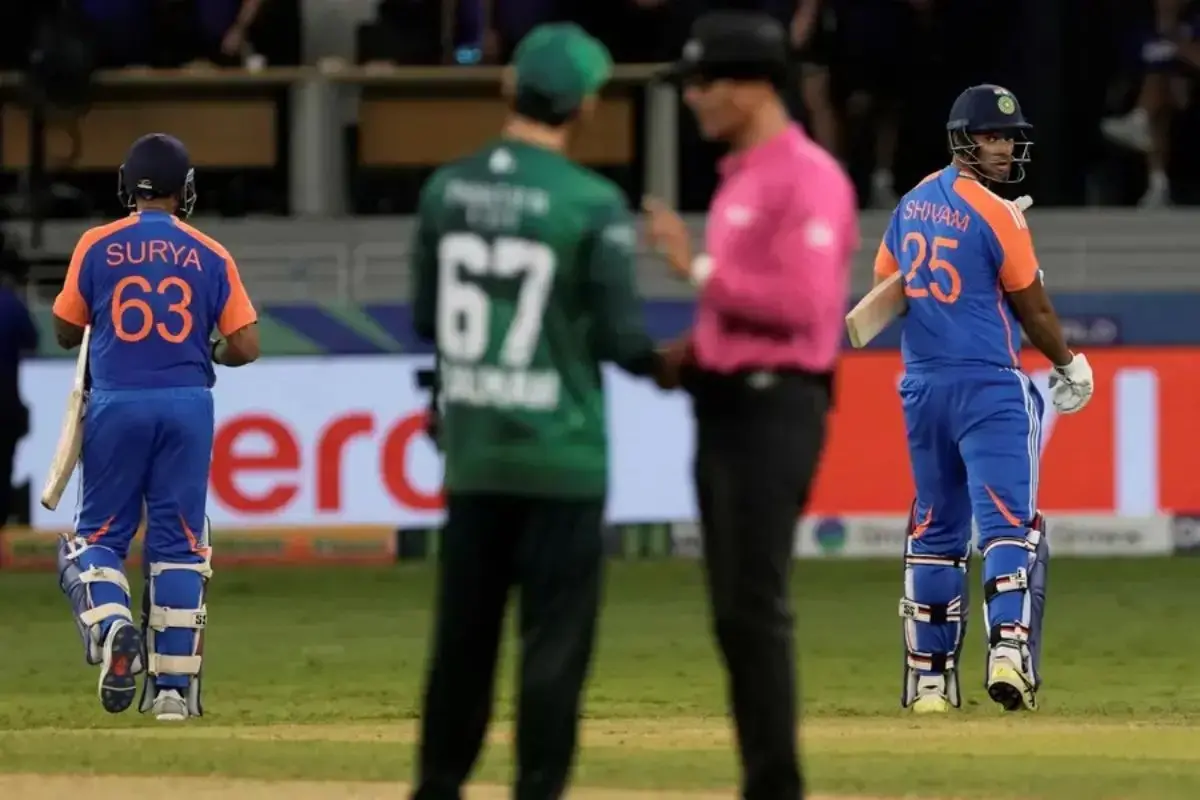
Captain Suryakumar Yadav’s majestic sixer that sealed India’s emphatic victory over Pakistan in the Asia Cup match on September 14 was a stroke of authority and elegance. What followed, however, was anything but elegant. Yadav’s refusal to take part in the customary post-match handshake with Pakistan’s captain Salman Ali Agha was among the most inappropriate gestures ever seen from an Indian sportsperson. His remarks, echoed by coach Gautam Gambhir—dedicating the win to victims of the Pahalgam terror attack and to the army for Operation Sindoor—made clear the reason. Cricket had been reduced to a stage for political messaging.
India-Pakistan matches have always inflamed nationalist passions. Fans, players and the media from both countries alike have often indulged in ugly displays of hostility. Yet there have also been moments of grace when rivals congratulated each other with warmth. Never before, however, had an Indian team officially expressed such petty jingoism on the ground.
It is true the Pahalgam attack, which claimed 26 innocent Indian lives, was heinous, and equally true that its roots lay across the border. But does that justify carrying our rightful rage into the arenas of sport and art? Should hostility towards Pakistan extend to all its people, condemning our shared neighbourhood to a permanent cauldron of hate?
Some defended Yadav’s act as retaliation for the silence of Pakistani cricketers on the Pahalgam killings. But if that were the logic, would not refusing to play altogether be the honest choice—rather than abandoning sportsmanship after the game? And is there not a sweeter revenge than defeating Pakistan on the field itself?
The danger lies in the precedent. Had India lost, would Yadav and Gambhir have accepted responsibility for dragging the nation into national humiliation? That few Indian voices spoke against the incident, unlike in the past, speaks about the shift in the country's dominant social values. Even Sunil Gavaskar, who once condemned Shiv Sena activists for digging up cricket pitches to block Indo-Pak matches, didn't find it fit to condemn. Clearly, few dare antagonise the BCCI, the world's richest cricket body today and headed by Jay Shah, son of the powerful Union Home Minister Amit Shah and a team coached by a former BJP leader. Who wants to be branded anti-national for daring to comment on such an incident on the cricket field?
Sports and politics have always intertwined. The Olympics of the last century saw Nazi racism, Cold War boycotts, terrorism in Munich, and apartheid bans. The darkest example was the Munich Olympics of 1972, when Palestinian militants attacked the Israeli team, killing 11 athletes. The United States boycotted the 1980 Moscow Olympics to protest against the Soviet invasion of Afghanistan marking the largest boycott in Olympic history. In retaliation, the Soviet bloc kept away from the next Games in Los Angeles.
Most international sports bodies like the International Olympic Committee (IOC) and the International Cricket Council (ICC) have, at times, officially enforced bans on countries for political reasons. The longest of them was the ban imposed from 1964 to 1992 on South Africa for its policy of apartheid. In 2024, the IOC banned Russia from competing in the Paris Olympics under their country’s name or flag because of its invasion of Ukraine. Yet the IOC faced accusations of double standards, as there was no such ban against Israel despite the bombings in Gaza.
Cricket, however, perhaps because it is played by only a few nations, has largely been free from turning into a political battlefield—except in the Indian subcontinent. Few sporting contests carry the weight of unfinished history like those between India and Pakistan. Born from Partition, hardened by wars, and inflamed by politics and terrorism, every cricket match between the two nations has been treated as a proxy battle. Defeat is often cast as humiliation, victory as vindication of national pride. India has officially decided not to play against Pakistan in bilateral matches since the Mumbai terror incidents of 2008. Since then the two teams have played against each other only in multi-nation tournaments.
Matches between Pakistan and Afghanistan too have often flared up beyond the realm of sport, charged by political rivalries and historical grievances. Likewise, Sri Lanka for years remained a hesitant host, with many teams reluctant to tour the island because of its long civil war and terror strikes. Yet, ironically, the only international cricket team to physically bear the brunt of terrorism was Sri Lanka itself—when its players were attacked in Lahore in 2009 by suspected militants of Afghan origin. Six Sri Lankan cricketers were injured in the ambush, while six Pakistani policemen and two civilians lost their lives.
Besides the fans, prominent players of both India and Pakistan too have often been carried away by emotion and bitterness. This has increased mostly since the late 20th century with militant nationalism and live television amplifying every gesture: Javed Miandad mocking Kiran More like a frog in 1992; Amir Sohail gesturing arrogantly to Venkatesh Prasad in 1996, only to be bowled the very next ball; Shoaib Akhtar’s wild glee in Kolkata in 1999; countless altercations involving Gambhir, Afridi, Harbhajan, and others. The crowds too have erupted dangerously—the worst being Kolkata in 1999, when Eden Gardens fans rioted after Tendulkar’s dismissal, forcing play to halt.
The Shiv Sena’s vandalism of pitches in the 1990s remains another disgraceful chapter.
Yet the rivalry has also produced unforgettable moments of grace. The best took place in the 1999 Chennai Test, after Pakistan won by 12 runs, Wasim Akram’s team braced for hostility was pleasantly surprised to see the entire Chepauk crowd rise in a standing ovation. “It brought tears to my eyes,” Wasim later said. “We had been told Indians hated us. But here was a stadium applauding us.”
In 2004, when India toured Pakistan, the streets of Lahore and Karachi brimmed with Indian flags. Families hosted visiting fans. Pakistani crowds applauded Sehwag’s triple century in Multan. These glimpses remind us that even bitter rivals can still honour the spirit of the game.
There have always been players, writers, and voices of reason from both the countries—Gavaskar, Imran Khan, Kapil Dev, Wasim Akram, Dravid, Kumble, Ramachandra Guha, Najam Sethi, Rajdeep Sardesai—who have urged mutual respect and sporting spirit. Unfortunately this tribe seems to be on a decline now.
That is why the Chennai moment of 1999 shines brighter than Yadav’s sixer of 2024. One embodied dignity, the other disdain. Cricket can survive sledging, defeats, even boycotts—but if it becomes nothing more than a theatre of hate, it will lose what makes it beloved: the possibility that, for a few hours, sport can rise above politics. India and Pakistan may never shake hands as nations. But their cricketers must—if cricket itself is to retain its soul.
Though narrow-minded nationalism thrives on both sides, one often hears the question in India: why blame us more? The answer is simple. India and Pakistan were born of two very different legacies. Pakistan’s foundation rested on sectarian identity, while India’s was laid on the ideals of pluralism and harmony. When we clamour to crush Pakistan by imitating its narrowness, we do nothing but turn India into a mirror image of our neighbour.