Stone statue in a glass cage: How Kerala forgot its Guru
“The difference between an admirer and a follower still remains, no matter where you are. The admirer never makes any true sacrifices. He always plays it safe. Though in words, phrases, songs, he is inexhaustible about how highly he prizes Christ, he renounces nothing, gives up nothing, will not reconstruct his life, will not be what he admires, and will not let his life express what it is he supposedly admires”
_ (Soren Kierkegaard)
What the 19th century Danish theologian said about Christ is equally applicable to Sree Narayana Guru. Today, there seems to be a consensus among Malayalis, ranging from the Right to the Left of the ideological spectrum, about who our greatest idol is. It's Guru. As long as the person remains an "idol" or a "saint" on a pedestal, their life is a spectacle to be admired from afar and not to be followed. We extoll Guru's dictums but compete with each other on how to disobey them in total. It's easier to be an admirer than a follower. We make him into stone statues and put them inside glass cages.
A few days ago, I found myself in a court in Thiruvananthapuram—as a defendant in a case that has dragged on for eight years. Its origins lay in an afternoon when a four-member gang stormed into the newsroom I then headed, shoved aside the security guard, shouted slogans, placed a funeral wreath at the reception, and walked out after issuing a symbolic death threat.
Their provocation was a programme we had aired on the torture of elephants in Kerala’s festival circuit.
The programme documented, in disturbing detail, how over a hundred elephants had died after being forced to walk long distances on scorching roads, transported in cramped trucks, paraded for hours amid deafening fireworks and blazing lamps, and routinely deprived of food and water. It exposed how elephant ownership had evolved into a lucrative industry, feeding a nexus of owners, brokers, festival committees, and, inevitably, political and religious patronage.
The attack on our office was only the culmination of a barrage of abuse and threats—directed not just at me, but also at the woman journalist who produced the show. A year earlier, our reporters had faced similar hostility at Thrissur Pooram for a campaign—tellingly titled after Guru’s dictum “Kariyum venda, Karimarunnum venda”—against the excessive use of elephants and fireworks.
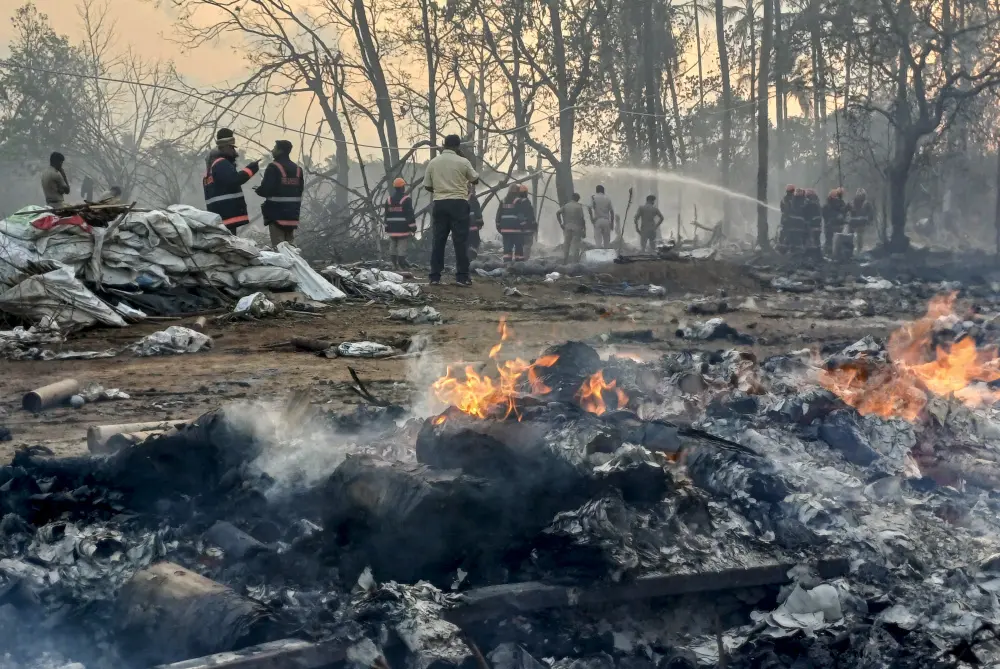
I recall these incidents today in the shadow of yet another tragedy: the recent explosion on April 22 at an unauthorised and temporary firecracker-making unit linked to this year’s Thrissur Pooram, which claimed 14 lives. By most counts, this is one among dozens of such accidents in Kerala over the years, together killing hundreds. Three days earlier, 25 people had died in an explosion at a firecracker factory in Virudhunagar, Tamil Nadu.
Significantly, the present tragedy has come on the 10th anniversary of the country's worst firecracker disaster that occurred at the Puttingal Devi temple in Kollam district, which killed over a hundred and injured about 400. The temple authorities had conducted the ill-fated pyrotechnics despite the district administration's denial of permission for the fireworks display.
Immediately after the tragedy, the Kerala High Court banned the display of sound-emitting firecrackers after sunset in all places of worship in the state. Notably, the trial in the Puttingal case began only last year, nine years after the disaster. As many as 13 of the 59 accused have died during this period.
According to former judge P.S Gopinathan, who headed the judicial commission that probed the Puttingal incident, the present disaster could have been averted if his recommendations had been strictly implemented. R. Venugopal, former Joint Chief Controller (Explosives), Petroleum and Explosives Safety Organisation (PESO), said the disaster was the result of illegal fireworks manufacturing practices and similar to the explosion that occurred before Thrissur Pooram in 2006.
As usual, a judicial investigation will be launched soon into the latest incident; reports will be filed urging stern action; political parties and the media will cry hoarse for a little longer. This may follow some minor action against some small fries; some new rules will be framed, but everything will be forgotten until the next tragedy strikes, when all the dramatics will be repeated without fail.
Even in the immediate aftermath of death, Thrissur Pooram organisers publicly declared that any restriction on fireworks would “offend the gods” and hurt local sentiment until the government ordered against the fireworks this time. Can there be a better case for booking such braggarts under preventive detention and for insulting gods, the families of those who lost their lives and the local people? But then, it is meaningless to say this where no top official has ever even been suspended for their failure to prevent such blatant rule violations that cause repeated tragedies.
For a society that prides itself on literacy, rationalism, and a long lineage of social reform, Kerala today presents a striking paradox. The very landscape, once reshaped by reformers who fought ritual excess and superstition, is now witnessing an unmistakable resurgence of both—often led not by the unlettered but by the educated middle class.
This is not a simple return to the past. It is something more complex—and perhaps more revealing.
The 19th and early 20th centuries saw a wave of reform movements across Kerala's communities that sought to tame religion. Sree Narayana Guru challenged caste-bound ritual exclusion with a radical spiritual egalitarianism. Chattampi Swamikal interrogated scriptural authority and Brahminical dominance. Within Christianity, priests such as Abraham Malpan and Kuriakose Elias Chavara pushed for universal education and discouraged unthinking ritualism. Reformist leaders like Makthi Thangal and Vakkom Maulavi within Kerala Islam, too, periodically questioned shrine worship and syncretic practices, calling for a more text-based faith.
The cumulative effect of these movements was not the decline of religion, but its domestication. Ritual was trimmed, access was widened, and education became the new moral currency.
Yet, a century later, Kerala’s public life is saturated with religion in its most visible, performative forms. Temple festivals have grown into high-decibel spectacles, with competitive displays of wealth, fireworks, elephant parades and orchestration. The annual pilgrimage to Sabarimala has expanded into one of the largest religious mobilisations in the world—managed with modern logistics, yet anchored in deeply traditional practices.
The controversy following the Sabarimala verdict—which allowed women of menstruating age to enter the temple—revealed something deeper than a legal dispute. It exposed the limits of reform in the face of emotionally charged ritual belief, with large sections of Kerala’s educated society defending tradition over constitutional equality. Similar trends are visible in other religions as well, with respect to dress codes, ritual observance, or public expressions of faith.
Even courts and political parties that swear by secularism and progressive ideologies dare not question rituals and superstitions, fearing to offend religious orthodoxy. Supreme Court judges keep wondering during the trial related to the women's entry into the Sabarimala shrine as to why religious rituals should be questioned, or progressive political leaders being evasive about bringing restrictions to elephant parades and firecracker shows at festivals, even after the Thrissur disaster!
What explains this?
First, the social context that produced reform has itself changed. Reform movements emerged in a hierarchical society where access to religion—and to knowledge—was tightly controlled. They succeeded in democratising both with an unintended consequence: it has turned religion into a field of mass participation. What was once restricted is now performed by more people, often with higher intensity.
Second, there is the changed role of religion. Religion today goes beyond beliefs. It offers identity and belonging in a world unsettled by migration, economic flux, and the erosion of older community structures. Kerala’s long history of migration has produced a society both mobile and anxious. The return migrant, with new wealth but fragile roots, often finds in ritual a reaffirmation of continuity.
Third, institutions have adapted. Temples, churches, and other religious bodies are no longer merely spiritual centres; they are economic and social hubs. The Travancore Devaswom Board’s management of major temples, the vast resources controlled by church dioceses, and the organisational networks of Muslim bodies all point to one fact: religion is now deeply institutionalised. Ritual generates revenue, sustains livelihoods, and reinforces authority. There is, therefore, a structural incentive not just to preserve ritual, but to expand and spectacularise it.
Fourth, the media has transformed faith into spectacle. From live-streamed temple rituals to televised church conventions and viral sermons, devotion is now curated and amplified. The quiet interiority that many reformers valorised stands little chance against the visual power of mass ritual in the age of the smartphone.
And then there is politics. The mobilisation around Sabarimala showed how quickly ritual can become a political flashpoint. At the same time, minority communities, feeling the pressure of majoritarian assertion at the national level, often respond with their own forms of assertive religiosity. The result is not secularisation, but competitive visibility. Ostensibly to prevent religion-driven political parties from monopolising the community's spiritual realm, secular parties vie with them for control of temple and church committees, only to end up as even more fervent devotees of rituals and rites. The result is a greater spread of hyper-religiosity within society and the erosion of secular values that form the cornerstone of the republic.
The new religiosity is not anti-modern; it is deeply intertwined with modernity, the seeds of which were embedded in our Renaissance itself. The same middle class that values education, healthcare, and global mobility also invests in temple tourism, church retreats, and codified piety. This is not a contradiction they necessarily feel compelled to resolve. Community organisations like the NSS, SNDP, or the Yogakshema Sabha, which were born at the beginning of the last century to oppose archaic ritualism within their castes, are today the self-proclaimed guardians of outdated rituals and customs. So are the once reformist groups within other religions as well.
Kerala's renaissance leaders sought to cleanse religion of excess and inequality. They did not seek to abolish it. In that sense, they succeeded. But they may also have underestimated religion’s capacity to reinvent itself. This is not accidental. Kerala’s modernity was built alongside religion, not against it. Reform never fully secularised society; it only rearranged religious authority.
What we are witnessing today is not the failure of reform, but its afterlife. Religion has survived critique, absorbed change, and returned in forms that are at once modern and archaic—rational in organisation, but often irrational in content. The real question, then, is not whether ritual has returned. It clearly has. The question is whether the ethical core that reformers fought to foreground—equality, dignity, and reason—can endure within this new, resurgent religiosity.
Kerala’s answer to that question may well determine whether its celebrated modernity remains substantive, or becomes merely a surface beneath which older certainties quietly regroup.