Is Nilambur a bellwether?
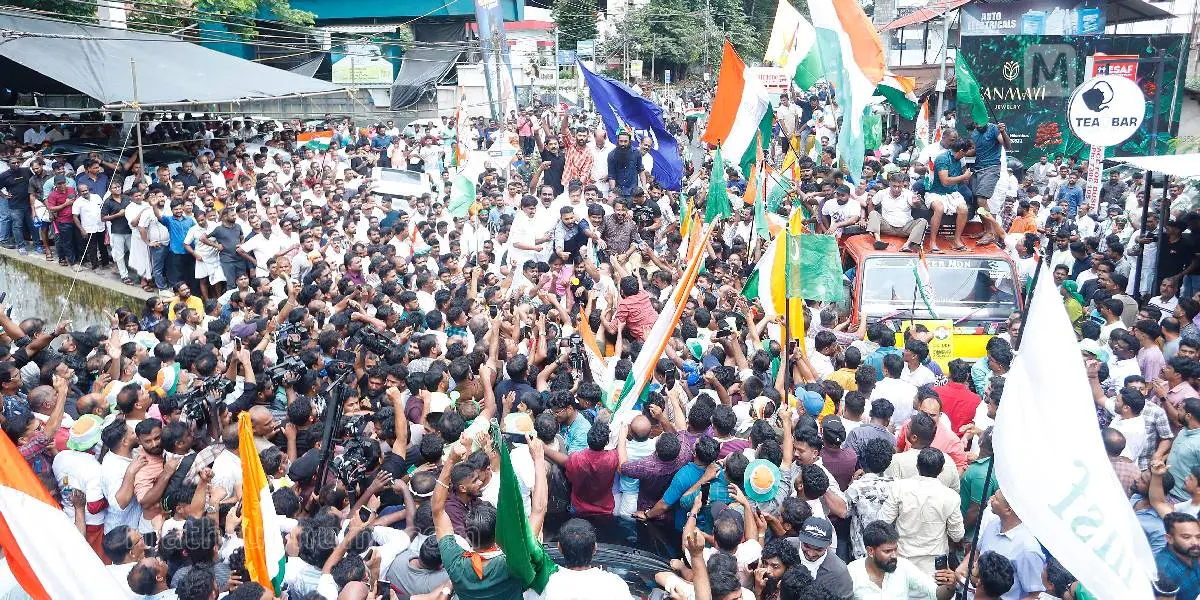
Is the UDF’s impressive win in the Nilambur by-poll a trailer for the 2026 assembly polls? Has it sealed the LDF’s chances of a consecutive third term in power, referred to as “Pinarayi 3.0”?
Surely, barring last year’s Lok Sabha polls in which it was trounced, the Nilambur defeat is the biggest blow suffered by the LDF since it came to power in 2021. Why? Though it was vanquished in three of the four by-elections held in the past four years, Nilambur is the only sitting seat from which the ruling LDF has been ousted.
This drubbing carries added significance as it could serve as a curtain-raiser for next May’s assembly elections — a battle that may determine whether the century-old Indian Communist movement can retain power in its last remaining stronghold.
What were the factors that prompted the Nilambur result? At the beginning of the campaign, both the UDF and the LDF had held that the election would be a referendum on the government. While the UDF warned that the result would be an indictment of the government’s failures, the LDF claimed it would be an endorsement of its achievements. However, within days, the campaign gave way, (as usual in most elections), to emotional and volatile issues rather than a rational analysis of the government’s performance. Even that highly critical issue affecting Nilambur - the human-animal conflict- which has been haunting a large number of voters was relegated to the back burner. This shift was triggered by the support declared for the UDF and LDF, respectively, by two numerically minor outfits- the Jamaat-e-Islami-led Welfare Party of India and the People’s Democratic Party (PDP). Though these organisations had done the same in the 2024 Lok Sabha elections too, UDF and LDF accused each other of allying with Islamic communalism. This received even more traction when Opposition leader VD Satheesan and CPI(M) state secretary MV Govindan attempted to justify their respective alliances. While Satheesan claimed that the Jamaat Islami was no longer a fundamentalist organisation since it had abandoned its Islamic State project, Govindan certified PDP as a victim of oppression. This turned the campaign almost wholly around the question, which front was more communal? In the process, this helped the WFI and PDP to get what they wanted: a political visibility disproportionate to their real strength. The campaign received yet another twist with Govindan’s statement in an interview about CPI(M)’s association with the RSS during the Emergency. While to some, this was yet another no-brainer from Govindan, some others, like Satheesan, saw it as a wily attempt to woo Hindus.
Nevertheless, though the Nilambur campaign was centred on communalism, the anti-incumbency sentiment that mirrored the result could hardly be ignored. Otherwise, how could the LDF fall behind in even areas where it had a traditional sway? Clearly, the LDF was constrained by the dearth of any remarkably positive achievements of the government to present to the voters. Their claims on the development front, like building the National Highways, etc, hardly impressed the electorate. Why? Building roads, bridges, schools, or hospitals are always taken for granted by the people as the routine business of any government, even though they may blame it for every pothole on the road. Secondly, every election is driven by emotions and not a rational analysis. A recent neuroscience study in Britain reconfirms that during an election campaign, voters are driven by fear and emotion rather than by rational arguments. It also said that voters are more susceptible to messages that stress the negative than the positive. This appears to be a universal trait of voters everywhere.
Even as the LDF had nothing remarkably positive to show, it was haunted by a spate of negative aspects. In times of economic hardship, people always blame the government first. Though the LDF keeps blaming the central government for every economic difficulty, it is natural for the people to direct their rage and disaffection more towards the government that they see in their immediate vicinity. A report on the aforementioned British study says, “Political parties that have presided over significant financial downturns get blamed in elections. Voters change their minds based on recent economic performance, even if the economic downturn is beyond the control of the government.”
Voters get more infuriated when they see the government indulging in profligacy or having unfair priorities, even in times of financial strain. Election time is the ordinary person's only opportunity to hit back against a brazen government which doubles the already bloated salaries of the partisan members of the Public Service Commission even when the poor people's destitute pensions remain unpaid, or neglects the protracted agitation for livelihood wages by the impoverished ASHA workers.
This government is now largely seen as lacking in compassion and consideration. Worsening this image further are the corruption charges against the Chief Minister’s family, along with the allegations of nepotism and favouritism rampant within the government and the ruling front, etc. Though previous Left-led governments had faced allegations of inefficiency, misuse of power, or partisan conduct, none of them had suffered such severe erosion of moral and ethical credibility as the present one. What is even more staggering than the gravity of the charges is the sheer insensitivity and dismissiveness with which leaders have brushed them aside. In an age dominated by television and social media, the arrogance and hubris of the leaders do not go unnoticed—and are increasingly resented.
Despite everything discussed above, the question posed at the outset remains: Does the Nilambur result clearly signal the LDF’s likely defeat in the 2026 assembly elections? Not necessarily.
Here are my reasons. Though Nilambur was LDF’s sitting seat, it has always been a traditional UDF bastion where Congress had won 10 of the 14 elections held since 1967. The only exceptions were in 2016 and 2021, when Anvar, a former Congress leader, fought as an independent backed by the CPI(M), and succeeded in tearing into traditional UDF votes. Hence, there is no point in claiming too much about wresting Nilambur from the LDF.
The LDF defeat hardly looks crippling enough given the serious allegations it faces. Besides, it was opposed by a rainbow coalition of forces ranging from the extreme Right to extreme Left, almost all religious groups and also interrogated regularly by nearly the entire media.
Aryadan Shoukath’s over 10,000 vote victory margin, though decent, hardly appears big enough to call it a pronounced anti-incumbency verdict against a decade-long rule by the LDF in a traditional UDF fortress. Yet, the Nilambur margin was even less than what UDF gained in most other by-elections or far less than Nilambur’s share in Priyanka Gandhi’s whopping majority in the 2024 Lok Sabha elections. Moreover, the Congress and Muslim League have never fought so unitedly before. Aryadan Mohammad was always a League baiter for whom the unity had never had worked wholesomely.
Neither the LDF’s fielding its best possible candidate, nor the splitting of the anti-incumbency vote, can justify the mediocre margin. That the LDF’s votes didn't fall too much from last time, too, underscores the point.
Then there is another factor which problematises the Nilambur result. The relatively weak presence of the BJP in Nilambur prevents it from being a trend-setting, bellwether constituency that indicates a state-wide voting behaviour. An unprecedented feature of Kerala’s recent political landscape is the LDF’s sustained dominance in assembly elections. This trend began not just in 2016, when the front embarked on its current decade-long rule, but can be traced back to 2011, when the UDF last won—by a wafer-thin margin of two seats. UDF’s scrape-through was made possible only by the bitter rivalry in the CPI(M) between VS Achuthanandan and Pinarayi Vijayan. This internal feud has disappeared with VS’s virtual retreat from active politics. However, the LDF’s electoral hegemony is not only on account of the ending of factionalism. It owes much to the emergence of the BJP as a third force in Kerala politics, which had remained bipolar until the turn of the 21st century. Leaders like EMS Namboodiripad used to hold that the Left in Kerala would stand no electoral chance if the entire anti-Left forces stood united. One of its earliest proofs came in the 1960 elections when the Communists were defeated even after having led a great government and were undemocratically dismissed by the centre. Hence, most of EMS’s political strategies had since focused on splitting the anti-Left brigade. Though most Left victories were facilitated by this pre-election tactic (except in 1987 when EMS launched an anti-communal political front), a structural and seemingly permanent divide in the forces opposed to the Left came into being only after the emergence of the BJP as a significant player. Today, BJP commands more than 15 to 30% votes in over 80 assembly seats. At least for now, the primary beneficiary of this saffron spread and the consequent triangular contests happens to be its sworn enemy, the Left. The situation is unlikely to be different in the 2026 assembly elections too, unless new issues come up in the next ten months to radically transform the political equations.