From Louvre to Sabarimala: Holy gold, unholy theft
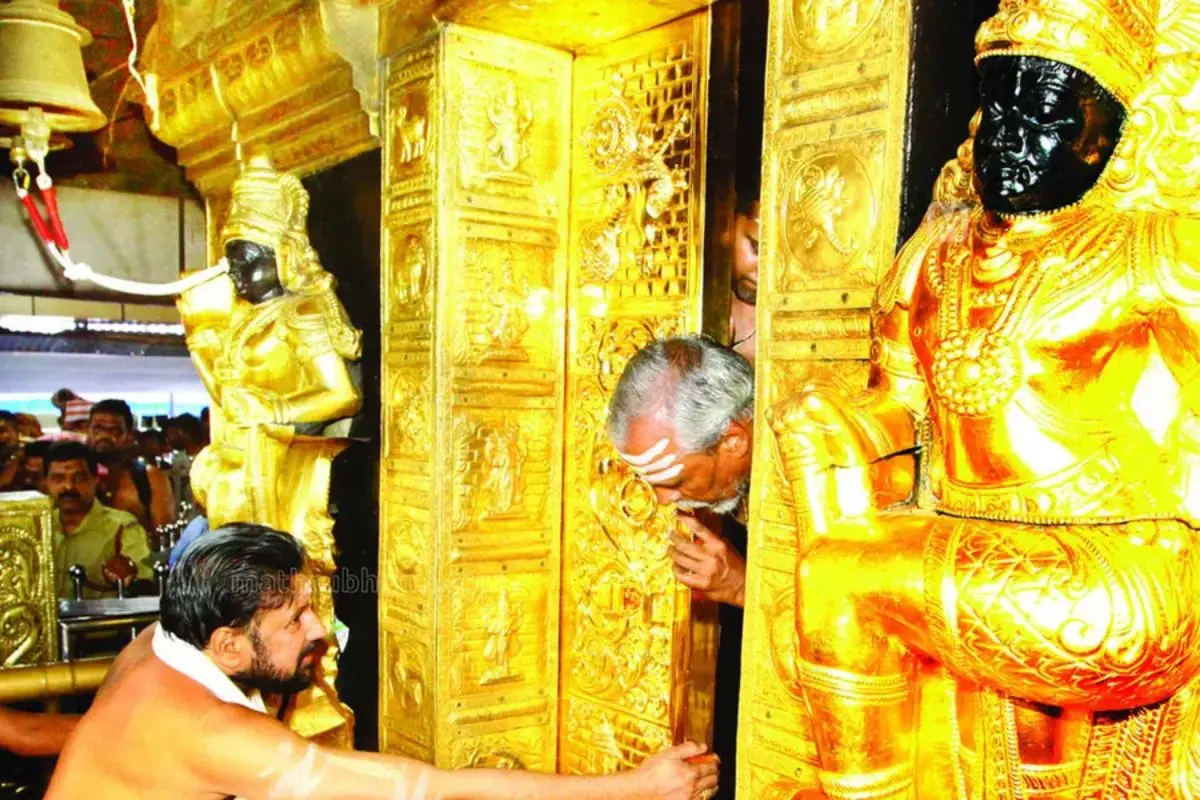
It was a brilliant piece on the American online portal, Substack, written by Maisa on the stunning recent heist at the famed Louvre Museum of Paris that first set me thinking. She had called the theft “a performance piece about how nothing sacred is as safe as it pretends to be.” The phrase lingered like incense. What if the Louvre were replaced by Sabarimala? What if the stolen French crown jewels were the Lord’s own gold? Suddenly, the parallels shimmered — both places thronged by pilgrims, both obsessed with divinity and display, and both robbed not just of treasure but of illusion.
The daytime heist at the iconic Louvre -the most visited and the single largest museum on earth- occurred on October 19, shocked the world. Four men, dressed as workmen, broke in through an upper floor window using a ladder on a moving truck. They cut into glass cases with an electric saw and made off with over $100 million worth of royal jewels, gifted by the 19th Century Emperor Napoleon III to his two wives. The entire operation conducted at the 232-year-old and 6,52,000 square feet-large museum which had more than 8 million visitors last year, lasted barely seven minutes.
The Substack article said; “The Louvre is not a jewellery shop. It’s a cathedral of curated ownership, a palace turned archive where value is as much about story as it is about carats. Everything inside is a public artifact and also an assertion of power: crowns gifted, ornaments accumulated, empires represented in polished metal. To breach that temple and walk out with its ornaments is to stage a tiny, chaotic critique. Someone took a centuries-old performance of status, interrupted the choreography, and in doing so revealed something obvious, the things we call untouchable are usually just unguarded.”
For what unfolded at one of India's largest attended shrine too was no mere burglary. It was a perfect tragicomedy of our times — an exposé on faith, property, and that most fragile metal of all: belief. Maisa called the Louvre heist as a “live critique of property and power”. Wasn't the Sabarimala chori too of the same league?
The celibate lord who could not bear the presence of women between ten and fifty in his sacred precincts had, in his infinite wisdom, allowed petty thieves to plunder his ornaments. The self-proclaimed guardians of celibacy and chastity proved far less efficient at guarding lockers and ledgers. The atheist government that once thundered against religious ritual suddenly became its most zealous custodian — and then its most embarrassed accused — when the keys went missing and the gold went walking.
Among the key culprits held is Unnikrishnan Potti, one belonging to the temple priest community. And there was Murari, a hard-core Ayyappa bhakt from Perunna, a proud functionary of the NSS which once led namajapa marches against women’s entry to the temple. Together they turned from devotees into debtors of faith, stealing the lord's treasure. And who knows how many more guardians-turned-gobblers are to be booked in the coming days.
And what of the gold itself? That shimmering metal was born not of piety but of sin — minted from the money of a narcissistic billionaire whose empire was built on liquor, vanity, and desire. The man loved his beer, his beauty queens, and his bragging rights as Ayyappa’s foremost devotee. He would jet in for poojas, donate his weight in gold, and then jet out to his mansion to be photographed with bikini-clad models.
When his empire collapsed and he fled the country, he took with him not just money but metaphor. The gold he had offered at Sabarimala — the symbol of his redemption — became the very object of temptation. It was as through the sins he sought to wash away returned in glittering form to expose everyone — the devotees, the priests, the politicians, and the bureaucrats — all equally human, all equally hungry.
Like Vijay Mallya’s tainted gold, the Louvre treasure too has a shady past as it mostly consisted of those looted and plundered by Napoleon and the Nazis. Writes Maisa; “The Louvre is meant to be the pinnacle of human achievement, a temple of beauty, empire, and theft (the classy kind, institutionalized and written about in French). Everything inside it was already stolen once, repackaged under glass and called culture. So when someone strolls in and liberates a few ornaments, it feels — and forgive me for this — like karmic symmetry. A tiny cosmic refund”.
The political class formed the chorus in the cosmic farce at Sabarimala. The Marxists, who once mocked blind bhakthi as feudal hallucination, now guarded the deity like a district committee asset. The BJP which hailed itself as the saviour of tradition, found another “suvarnavasaram” (literally) to embarrass the secularists for the lord's loss. The Congress, master of the “golden” middle path, wept piously and waited for both sides to drown in molten metal. The Nehruvian secularists hit the streets with Viswasa samrakshana yatra. A Revolutionary Socialist, clad in the pilgrim black, thundered against the two young women, one of them a Muslim, for having dared to enter the celebate’s shrine after indulging in a blasphemy - eating Porotta and beef! Each party swore loyalty to the lord; each had its own cut in the contract of faith.
If there was ever a moment when Kerala’s famed sense of irony met its match, it was this. The god of renunciation became a hoarder of ornaments. The Marxists became temple trustees. The moralists turned burglars. And the believers, as always, kept chanting.
Wrote Maisa of the Louvre heist; “They saw a gap between myth and maintenance, and they exploited it with taste. That’s what the Louvre heist really is, a performance piece about how nothing sacred is as safe as it pretends to be.” Replace Louvre with Sabarimala and what could be more appropriate !
Which brings us to the temple’s own cosmic punch line: the Vedic mantra that adorns its sanctum — Tatvamasi. Thou art that. For centuries it was read as a message of divine unity. But perhaps we’ve been reading it wrong.
The thieves, the priests, the police, the politicians — all seemed to have taken it literally. Each saw the gold, felt the calling, and murmured, I am that. The Marxist minister who once denounced superstition, the saffron crusader sworn to protect it, the centrist opportunist who floated between both — all united, finally, in the great Advaitic truth. Never before had the Vedic ideal of oneness found such an earthy expression.
In that sense, the Sabarimala gold heist was Kerala’s most profound spiritual experiment. It proved that faith and fraud, politics and piety, could merge seamlessly — like Ghee in fire, like belief in bullion. When the gold vanished, it wasn’t theft; it was theology in action.
Tatvamasi, said the walls.
And the faithful — from the temple to the Secretariat — nodded wisely.
Yes, we are that and His is ours.