Prosenjit Chatterjee: 50 years, 300 films, 1 Padma Shri
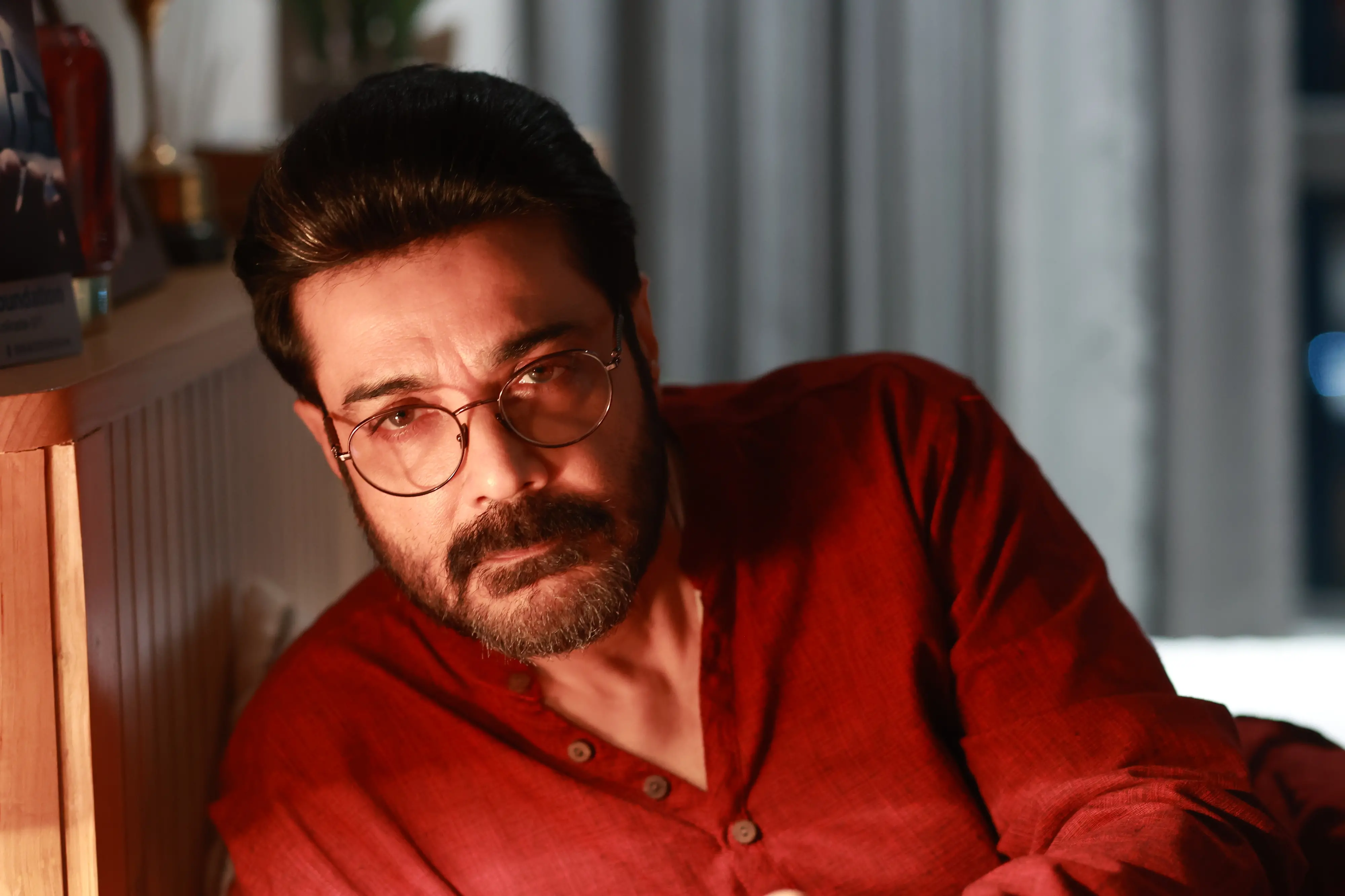
Prosenjit, the uncrowned emperor of Bengali cinema for more than three decades, has finally been recognised for his rich and long-standing contribution to Bengali cinema, He has been bestowed with the Padma Shri this year, the only Bengali actor this year to be so recognised. “I am very happy with this honour and it has come as a very pleasant surprise” was his first reaction when he heard about the award from someone else. But to many of those who have known him closely and watched his evolution as a versatile actor over time, it has been long overdue.
With a roster of more than 300 films in his kitty, he slowly and steadily shifted to the balancing act between mainstream and off-mainstream films. This director’s actor comes across as an epitome of modesty. Biswajit is the only Bengali star who made it so good in Bollywood that he never came back into Bengali films. Biswajit made his debut in Mumbai with Bees Saal Baad, a murder mystery with Waheeda Rehman opposite him. It turned out to be a very big hit and Biswajit became a star overnight.
When asked, “You have just completed almost 50 years in cinema. What does it feel like?” He promptly says, “It feels great. It is amazing the way the Bengali audience has accepted me across two generations. I would not have lasted this long if the audience did not want me. The years helped me discover and reinvent myself, to explore areas I have not been able to explore before. I am not in competition with anyone – in Bengali cinema or Hindi cinema.”
The word ‘hero’ for Prosenjit, transcends the borders of the screen, the cinema theatres and the Bengali audience to embrace everything contemporary mainstream Bengali cinema stands for – pulling in the mass audience, crossing the rural-urban divide of viewership, and fashion statements among young men who wish to emulate their icon. Prosenjit’s grip over millions who are completely enthralled is without parallel. He has been around for nearly fifty years in more than 300 films. He has evolved into an institution. The intellectual set of Bengalis who stuck up their snooty noses at the mere mention of his name in their inner circle was forced to sit up and take notice when he stepped into off-mainstream films.
“I am my audience when I face the camera and before a shoot begins, I derive the character from real life characters I have encountered along the journey of life. Sometimes, it is an interesting amalgam of several real-life persons with say, a mannerism attached, or, a way of speaking. You must have found this in Srijit’s film, a thriller named Baishey Srabon where my character is modelled along the lines of Runu Guha Niyogi, former Assistant Commissioner of Police in Calcutta during the 1970s. He was involved in the brutal torture of Archana Guha, a schoolteacher who was arrested and tortured for nearly a month in 1974 because her brother was suspected of being a Naxalite. I put on a completely unkempt look, hair uncombed, cigar in hand, perennially drinking, staying alone and throwing around abuses and invectives a sailor will blush at left, right and centre. In brief, I had never ever done this kind of role before,” Prosenjit smiles.
Prosenjit says that he finds it easier to portray the flesh-and-blood characters he did in Swapner Din, Chokher Bali, Utsab and Dosar than the larger-than-life exaggerations he did for commercial cinema. “It is easier to calculate a character that has a realistic human element in it than trying to infuse credibility into an unrealistic one. I try to catch the scale of the script. For instance, in Utsab and Dosar, the films were low-key and understated. So, my character had to be low-key and understated as well. I am open to working with new directors with novel ideas of presenting me differently on screen. I wish to sign only five to six films a year and experiment a lot not only in terms of my roles but also in terms of the Bengali film industry as a whole,” is how he elaborates his way of exploring his roles.
“Chokher Bali was the turning point in my career as hero and is also a milestone. It changed the way my audience looked at me – a successful hero of mainstream Bengali cinema. Surprisingly, my audience accepted me in a character I had never even attempted before. It was a period film based on a Tagore classic and Mahendra’s character had varied complex shades. The response at Cannes too was fascinating. From that point on, I decided that I must allow myself to explore my potential as an actor in other kinds of films,” said Prosenjit.
But he staunchly refuses to admit that some of his mainstream films were really very bad. His response is, “I do not agree about my mainstream film roles being stereotyped. I have tried to put in variations in every character through costume, make-up, dialogue and perhaps, a tag-line that becomes the character’s signature. Most of them have been challenging in their own way. Otherwise, the audience would have rejected me outright. It is mainstream cinema that has got me here where I have had the opportunity to work with the best directors in the industry,” he says. His back-breaking work at Kushtia and North Bengal for Gautam Ghose’s Moner Manush showed up in his looks. He lost a lot of weight, looked lean and his face was touched by weariness. But it vanished as if touched by a magic wand the minute he faces the camera.
About Moner Manush, he said, “It was a character I have never ever played in my life before. Playing Lalon Phokir was not just dedication and commitment which every character demands. It was meditation. For four to five months, I cut myself completely from any and every social interaction. I handed over the family expenses for the period during which I would be away. I slept on the floor on a thin mattress. I kept away from fish and meat for an entire month. I was mentally away from home even before I stepped out for the shooting. North Bengal was not that difficult but when we shot in Bangladesh, we were constantly in the move and had to live, shoot, eat and sleep in the most unbelievable conditions. At times, we slept on straw matting under a tin roof that barely covered our heads. What we had for lunch or dinner I cannot even recall, so immersed was I in the work at hand,” he reminisced.
For those distanced from Bengali music and culture, Lalon Phokir is regarded as the Baul of Bauls. Bauls are wandering minstrels of Bengal who sing their own songs in praise of the Lord. He was probably born in 1774 in the part of Nadia district now in Kushtia, Bangladesh, and died in 1890. He lived an amazingly long, productive and devout life, gathering disciples and composing hundreds of songs. Lalon rejected the division of society into communities, protesting and satirizing religious fundamentalisms of all kinds.
“The industry in West Bengal makes it financially difficult for any actor to devote six months of shooting exclusively for a single film. But Lalon in Moner Manush demanded this. The two hours of make-up helped me to slip into the character. At the same time, I had to be able to sustain an objective distance and judge myself playing the role as an actor. It is difficult and involves a lot of emotional drainage but Gautam is happy with the results and so am I. It was a war I fought with myself every single day,” he elucidates. He told his family to take care of the responsibilities he usually did. He asked his directors to cooperate. “I must say that these five months of complete sanyas would not have been possible without support from my family friends and colleagues in the industry,” he adds.
While playing Lalon, he learnt walking on stilts, playing the ektara – the single-stringed instruments of bauls and phokirs and even fight with lathis. “It changed my world-view and my philosophy. I learnt that under the apparent restive spirit and wandering, under his repertoire of spiritual songs he composed, set to music and sang, lay the basic philosophy of humanity that he held above everything else. The bauls and phokirs are secular. They do not believe in any socially sanctioned institutionalized relationships. They did have their female consorts but it was just like a basic biological desire like hunger for food. Lalon believed that emotional ties would take him away from his ultimate destination, finding oneness with the Almighty. It took some time for me to come back to ground level after I came back,” says the actor.
Autograph, his first film with Srijit Mukherjee, then making his directorial debut, was a tribute to Satyajit Ray’s Nayak. Under the surface layer of narrating the story of the birth, growth and evolution of a super-star is a triangular love story that involved a super-star, the director of his latest film that is a remake of Ray’s Nayak and the director’s girlfriend. Indraneil Sengupta played the director and Nandana Sen played the girlfriend who gets introduced to the super-star when she approaches him for his autograph. “This is the first time I am playing a superstar. My character dominates the film industry and is known to be a dark, self-centred man. Is he really what the others think he is? Srinandita, the starlet, discovers the true man behind the veneer,” said Prosenjit who wore two faces in the film. One as Arun Chatterjee, the super-star and the other as the hero he enacted in the remake of Nayak.
Prosenjit, a director’s actor, comes across as an epitome of humility, even as his latest release keeps the cash registers jingling away, running a constant race with films starring the much senior Mithun Chakrabarty and the much younger Jeet. The competition keeps his adrenalin up and flowing all the time. Prosenjit talks about his childhood as a star-son, the influence of his parents on his growth, and some interesting anecdotes that spell out the journey from anonymity to the marquee.
“My nickname, Boomba, is what my father fondly christened me with. I carry it with me like an heirloom to this day. Stardom has not been able to strip it off me. Almost everyone I know within the industry call me either Boomba or Boomba-da. When I was tiny, I would often make gurgling sounds like ‘boom’ ‘boom.’ Father would be so thrilled that he would immediately say, ‘ba ba’ meaning ‘very good.’ So, everyone began to call me Boomba and I would respond at once to this call,” he says, taking a trip back into his past. But he and his mother had a long struggle when his father left the family and shifted to Bombay. “It was very difficult for me to get a break in films because I was Biswajeet’s son and he was famous and everyone knew he had left us. But my mother struggled with me going from door to door till I finally got a small break.” Ironically. It was his father who first introduced him in 1967 as a four-year-old hungry to meet his mother in the film Chhotto Jiggasha.
Is there a difference between a hero and an actor? With time, the hero whose selling power depends almost solely on mass hysteria and adulation and not necessarily on his acting talent metamorphoses into an actor without detaching himself from his ‘hero’ tag. When the hero feels trapped within his own screen image, having done masala roles in masala films year after year, he wants to explore alternative avenues of self-expression. He wants to tap his potential as an actor, because he has finished exploring his market value as hero. This theory is backed by Amitabh Bachchan and Uttam Kumar’s career maps. Now, it is Prosenjit’s turn.