Winds of change … and destruction
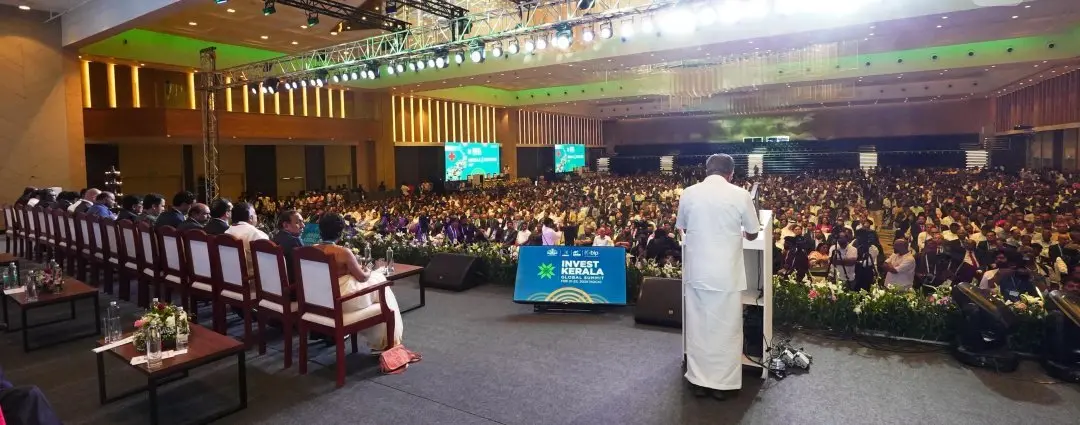
The government says the Invest Kerala Global Summit held recently in Kochi has been a great success and will change the face of the industrial sector in the state.
According to officials, expressions of interest for investments worth Rs 1.53 lakh crore have been obtained. This includes 24 information technology (IT) companies that have expressed interest in expanding operations in the state.
Whether it proves right, only time will tell. But the most memorable image from the event was the picture of Central Minister and BJP leader Piyush Goyal, Kerala Chief Minister and CPI(M) leader Pinarayi Vijayan, Opposition Leader of the Congress party V.D. Satheesan, and Kerala Industries Minister P. Rajeeve standing united on the stage.
More than the promise of an investment summit, what brings hope was that rare moment of unity on the issue of economic development in a state known for its deep political divides.
But it is premature to call this a genuine shift in Kerala’s political culture as most will see it merely a well-choreographed moment for the cameras. The cynics, ever watchful, dismiss all this and say such bonhomie seldom outlasts the event itself.
during the Invest Kerala Global Summit 2025 | ANi
Even before this debate could settle, another intriguing event unfolded. The Democratic Youth Federation of India (DYFI), the youth wing of the ruling CPI(M), organised a technology summit – an unprecedented move for a group that was at the forefront of protests against computerisation not too long ago.
But this was no token event; the MAWAZO Youth Startup Festival was well-planned, attracting numerous startups eager to pitch their ideas. Surprisingly, the usual political theatrics were absent, and there was a genuine energy – a space where young entrepreneurs were given a stage. The startups showcased impressive ideas, and some even walked away with substantial cash prizes.
Whether this will translate into long-term gains for these businesses remains to be seen, but it provided a crucial stepping stone – proof of merit that they can present to investors.
This brings us to a crucial question: Is Kerala witnessing a true transformation in its approach to development, with politicians setting aside their differences for the greater good of society and youth organisations changing with the times? Or is this merely a prelude to the electoral battles ahead – a brief interlude before familiar fault lines and slogans return?
History does little to inspire optimism. Political opportunism has long been the death knell of ambitious projects in Kerala. When the Congress-led government proposed a highway project two decades ago, the CPI(M)-led opposition launched fierce protests, effectively scuttling the plan.
Years later, when the CPI(M) proposed a high-speed rail corridor in 2020, the roles reversed, and Congress-led groups staged mass demonstrations that have virtually derailed the plan. The pattern is clear: when in power, parties advocate for development; when in opposition, they obstruct it.
Anyone who doesn’t play by that rule becomes an outcast. Consider the case of Shashi Tharoor, the Thiruvananthapuram MP, who found himself in hot water simply for advocating an objective debate on development during the anti-railway protests.
More recently, his article highlighting Kerala’s business progress under the current administration invited ire from his own Congress party, despite his criticism of the CPI(M) in the same article for opposing progress whenever it is out of power.
This knee-jerk opposition to anything associated with political adversaries has been one of Kerala’s greatest stumbling blocks.
Yet, could the tides be shifting? Could the idea that development transcends party lines finally be gaining traction? There is reason for cautious optimism, as recent events suggest, but experience tempers expectations. Kerala has seen brief moments of political unity before, only for them to collapse under the weight of old rivalries.
At the DYFI technology summit, entrepreneur Densil Antony ended a panel discussion by invoking a popular romantic song from the KPAC stable, Ponnarival Ambiliyil, and held out hope that events like MAWAZO will see the rise of a new golden moon over Kerala soon. The song had echoed the aspirations of a bygone era when Kerala’s nascent communist movement took root in dreams of progress.
As the famous lines from Alexander Pope’s poem say, "Hope springs eternal in the human breast." But lines from another popular KPAC song from the same era serve as a cautionary tale for Kerala:
Oru kodumkattinte kaikalil thatti
Karimukil engo maranju
Avalude vaarmudi kettil ninnurunnu
Mazhavillin thenmalar vaanil
It speaks of farmers watching eagerly as rain clouds gather over their parched land, only for the winds to carry them away, leaving behind nothing but a rainbow.
Kerala stands at a crossroads, and the winds of change are stirring everywhere. But will the political leaders of Kerala work together to seize this golden opportunity, or will they continue to blow away these chances with their never-ending squabbles, leaving the people once again staring at a distant rainbow?