Top performances 2024: Malayalam cinema's finest moments ranked from 'Aadujeevitham' to 'Aavesham'
Although 2024 may not have been the most remarkable year for Malayalam cinema, especially when compared to the exceptional standards set by previous years, the industry still managed to weave its magic on the silver screen. Innovative storytelling, thought-provoking ideas, captivating music, and outstanding performances marked this year's cinematic offerings. As we reflect on the year's cinematic highlights, we share our ranking of the best performances in Malayalam cinema for 2024. From powerful portrayals to memorable performances, our list celebrates the talented actors who brought magic to the big screen.
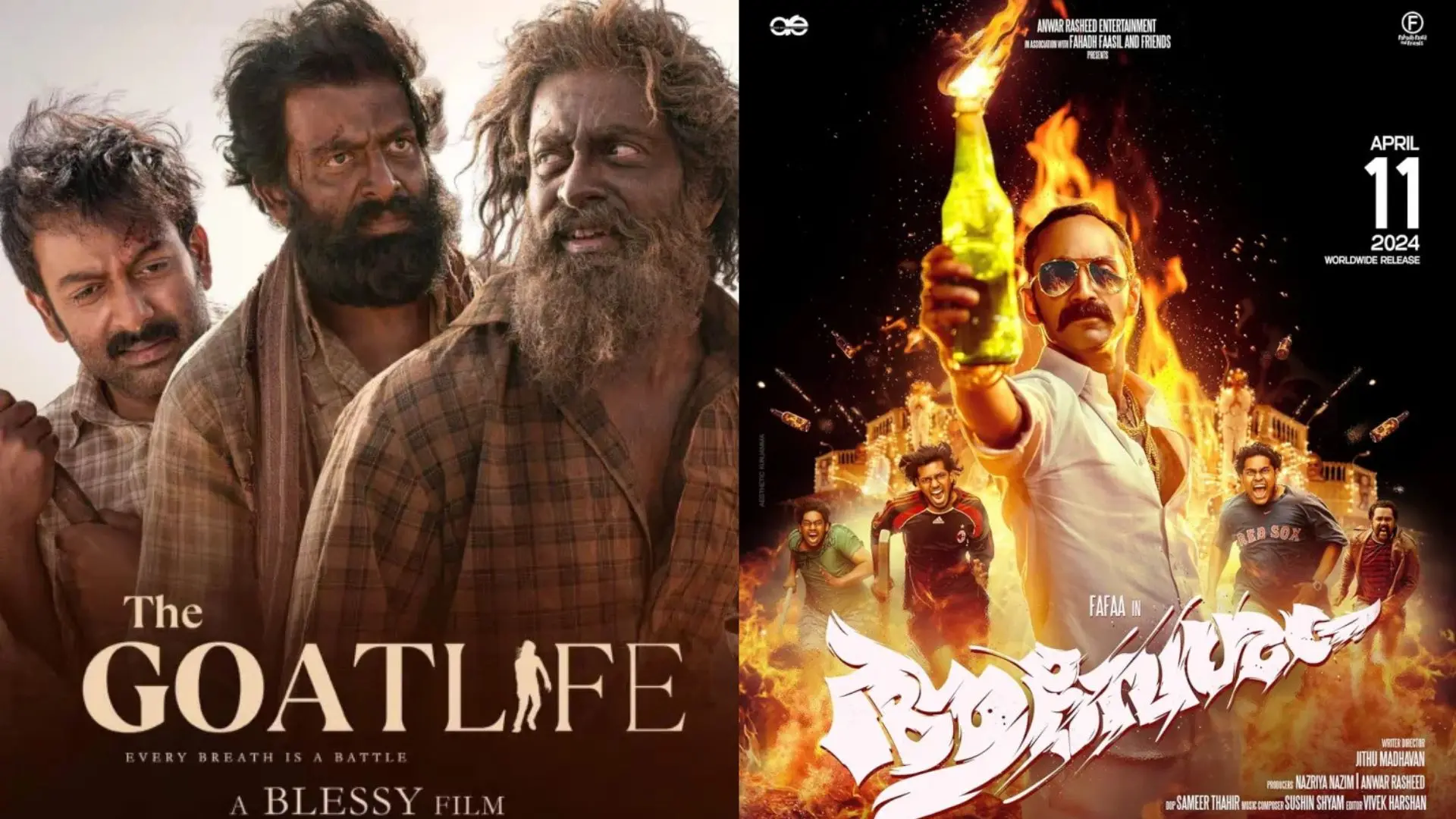
8) Prithviraj Sukumaran (Aadujeevitham)
Simply on the merit of his unwavering dedication and impressive physical transformation Prithviraj took to play Najeem, the performance deserves mention. He played an immigrant who was forced into labour as a goat tender in the desert. And the remarkable metamorphosis of shedding weight and adopting a gaunt, weathered appearance was nothing short of exemplary. Since the external transformation took care of the major bulwarks to essay the harsh realities of the character’s existence, it can be called a winner. So even though his emotional investment was less convincing, the sheer magnitude of his physical transformation and the challenges he overcame to achieve it earn him a well-deserved spot on this list.
7) Zarin Shihab (Aattam):
Anjali in Anand Ekarshi’s Aattam, that pivots around a flourishing drama troupe in the city, is an architect who also moonlights as a theatre artist. As the lone woman in the 12-member group, Anjali navigates her relationships with ease, considering her colleagues as family. She is also dating one of the leading actors and has kept it under wraps for his sake. What’s refreshing about Anjali is her directness and carefree spirit, which is beautifully portrayed by newcomer Zarin who brings a joyful energy to her role. As Anjali’s story unfolds, Zarin seamlessly conveys the complexity of her character’s emotions. When she is faced with the daunting task of confronting her colleagues after being groped at a party, her performance is poignant and powerful. It helps that her arc is well-developed, thereby making us invested in her journey with ease. Two scenes stand out: When she realizes her boyfriend’s betrayal, along with the crucial scene when she is cornered by the men at the dining table. Zarin is raw, real, and utterly captivating.
6) Jyothirmayi (Bougainville):
Reethu’s fragility is tangible in this Amal Neerad film as her retrograde amnesia renders her incapacitated to deal with the world around her. Her days are blended in a haze of furiously painting bougainvillea clusters on canvas, punctuated by bouts of rage and howls, and she is helplessly dependent on her spouse (Kunchacko Boban). She has haunting hallucinations of having children in her house and this pervasive confusion worsens her distress. But as the narrative unfolds, we are aware of the treachery lurking beneath the surface, compelling us to form an unusual bond with this tortured soul struggling to stay sane. But once we realize the crippling impact of her years of abuse and pain, Reethu takes shape in front of you, leaving her unable to react or stand up for herself. Jyrothirmayi absorbs Reethu with such naked intensity that we feel a heartbreaking kinship with her struggles. Take the scenes where she mirrors her angst and helplessness around her illness to her spouse or unleashes unexpected anger upon encountering strangers in her home: In these, the actor lives the part. Neerad masterfully captures Reethu’s minute expressions and confusions, bathing her journey in such endearing warmth that Reethu’s story becomes an immersive experience, drawing us into her world.
4&5) Urvashi and Parvathy Thiruvothu (Ullozhukku):
Leelamma is a devout mother to her chronically ill son and a benevolent mother-in-law to Anju (Parvathy Thiruvothu). A widow who has learned to negotiate with patriarchy, she expects her daughter-in-law to compromise with her son’s destiny. Though not explicit, her expectations towards her daughter-in-law are rooted in societal norms. But the day she finds out that Anju is carrying her lover’s child, Leelamma feels betrayed, but her displeasure soon gives way to compassion, as the women reach out to each other and forge a bond out of the pain they had internalized for years. Urvashi brings dignity and depth to Leelamma, conveying a powerful silence that speaks volumes while Parvathy Thiruvothu brings forth the complexity and struggles of a young woman who is fighting for her agency after being forced into a marriage against her will. The two actors engage in a compelling dual performance, complementing each other with remarkable chemistry. It’s the performances that truly create a poignant and thoughtful cinematic experience.
3) Vijayaraghavan (Kishkindha Kandam):
Appu Pillai, a retired army official, now lives with his son in a secluded Bungalow in a forest, infested by monkeys. From the outset, Pillai is shown to be crabby and distant, reluctant to even communicate with his son’s new bride. Despite his dementia, he seems to be an authoritarian father who drove his elder son away. The younger one seems to have come to terms with his parent’s toxicity and doesn’t rise to the bait even when the father bullies his son. It’s a performance that requires an actor of Vijayaraghavan’s gravitas and he gets it to the T, especially in how expertly and consistently he internalises Pillai’s conflicts, conveying the turmoil beneath the gruff exterior. The actor’s tryst with dementia is another brilliant detail, capturing the full range of symptoms associated with the disease. The whole aspect of the character carrying a dark secret was channelised skillfully by the actor, keeping the audience guessing, hinting at the truth without revealing too much.
2) Fahadh Faasil (Aavesham):
Ranga’s arc is so expertly and ingeniously crafted that it culminates in one of the most exciting moments on celluloid this year. From the time, the boys bump into him at a shady bar, we are baffled and intrigued by this chit of a guy attired in white, gold chains and Ray-bans. Their initial skepticism soon dilutes into begrudging respect as they witness the awe this Kannada-speaking gangster with a mindboggling backstory generates. Ranga is a complex, layered character, akin to a Secret Santa gift— quirky, fun, and unexpectedly multifaceted. One can easily term this as Fahadh’s biggest image-breaking act as he brings Ranga to life with a perfect blend of flamboyance, loudness, and emotional depth, while skillfully navigating a heavy Kannada-infused Malayalam dialect. What’s endearing are those fleeting moments of humour he shares with his trusted aide Amban, as well as his reactions to Bibi’s mother’s phone calls. It is especially when Bibi’s mom casually wonders if he is happy that we detect the chinks in his armour, leaving Ranga defenseless. It is said that Fahadh’s artistry is sharpened when his characters display varied shades of insanity, but here he pushes the envelope further. Here the eccentricity is just one shade of his personality, as the actor seamlessly swings between emotional turmoil and fun, without ever dipping the quirky meter. Ranga is reminiscent of Mammootty’s Bellari Raja (Rajamanikyam)—tough to pull off which he executes with flying colours.
1) Mammootty (Bramayugam):
Mammootty’s entrance as Koduman Potti in Rahul Sadasivan’s Bramayugam is a masterful subversion of his typical superstar introductions. With the aid of a walking stick, wearing mundu and a cloth casually flung over his shoulder, he strides in, exuding an air of nonchalant authority. As he sits on the antique wooden armchair and instructs the Thevan (Arjun Asokan) to look up, in that deep baritone, we are being introduced to this belligerent old man, his stained teeth glinting through a wry, unsettling grin. From that point, it’s an absolute masterclass to witness Mammootty embodying the complexity, madness, and villainy of Potti, a goblin who has inhabited the body of an elderly patriarch. And it’s a triumph of nuanced acting, marked by unpredictability, subtle little details, and immaculate voice control. His eye movements, laughter, and tonal shifts are so skillfully calibrated that each time, they evoke an uneasiness. Take this scene where Potti ravenously bites into a piece of meat, and you feel an eerie sense of fear and disgust. Or his startling (and scary) shift in expressions as Thevan talks about God. And that penultimate scene that reveals Potti’s goblin form as he puts up a fight.
A lesser actor would have easily turned it into a joke. In a way Potti reimagines the horror genre, relying on stealthy, minute expressions and voice tonalities to create a sense of eeriness.