A Cardinal for a changing world
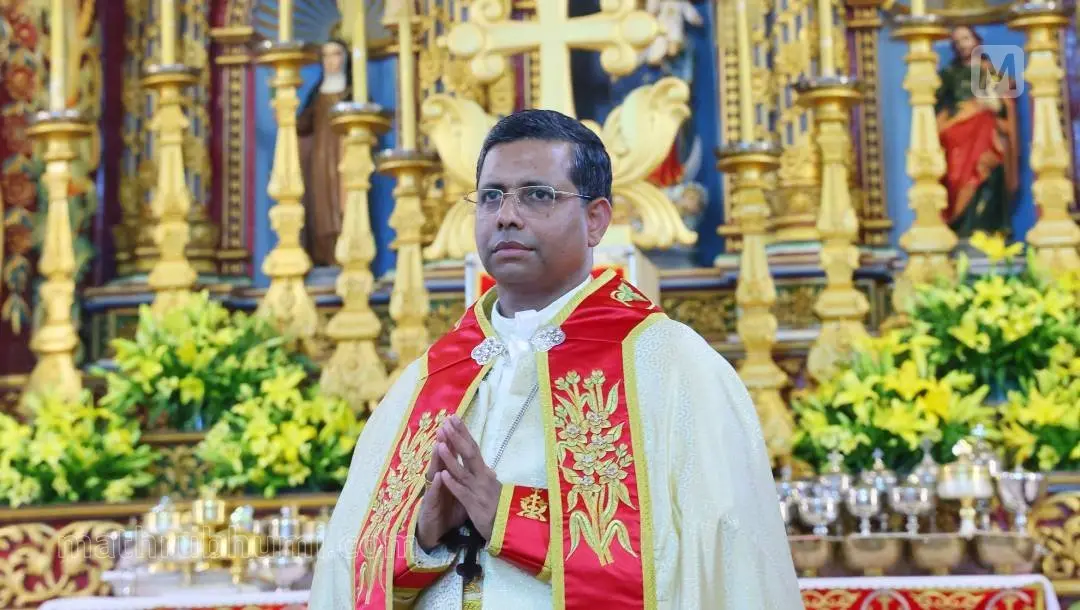
Just before Christmas, I had the great pleasure of participating in a grand welcome in the small central Kerala town of Changanassery for India’s newest Cardinal – and, at 51, the world’s youngest – George Jacob Koovakkad. Then, on Christmas Eve in Thiruvananthapuram, I attended a Midnight Mass conducted by him at the historic Lourdes Church in the state capital. The new Cardinal is a soft-spoken, understated man, but there was no underestimating the devotion and passionate commitment to his faith that burns behind his sombre eyes.
Born on 11th August 1973 in Changanassery, Cardinal Koovakad has had an illustrious career in the Catholic Church. His journey from a humble parish in India to the College of Cardinals is a testament to his dedication, scholarship, and service to the Church. During his undergraduate days as a chemistry student in Kerala, he served as the president of the Catholic Students’ Movement, showcasing his quietly effective leadership skills from an early age. After switching to ecclesiastical and theological studies, he quickly excelled, pursuing advanced studies in canon law at the Pontifical University of the Holy Cross in Rome. He completed his doctorate in 2006 with a thesis titled "The Obligation of Poverty for Secular Clerics in the Codes of Canon Law." His concern with the experience of poverty – and the obligation of service to the poor – have marked him since.
After routine priestly duties in Kerala, he prepared for service in the Holy See’s diplomatic corps, the Vatican’s “foreign service” that posts clerics around the world to deal with governments and the faithful. From 2006, when he entered the diplomatic service, to 2020, he served the Church in five countries. Strikingly, these were two Muslim-majority countries (Algeria and Iran), two Catholic-majority countries (Costa Rica and Venezuela), and one mixed Buddhist and Christian (South Korea), in addition to his own pluralist land of India, where Christians are a 2.2% minority, and his headquarters in Italy, a country where they are a 85% majority. It’s a profile almost made for inter-faith dialogue and diplomacy. “Blessed are the peacemakers, for they shall be called the children of God,” says the Bible (Matthew 5:9). Cardinal Koovakad is one of the Church’s top peacemakers.
In July 2020, Cardinal Koovakad was appointed as an official in the Secretariat of State of the Holy See. By 2021, he had taken on the significant responsibility of organizing papal journeys. Under his coordination, Pope Francis undertook important visits to Canada, the Democratic Republic of the Congo, South Sudan, and an extensive trip to Indonesia, Papua New Guinea, Timor-Leste, and Singapore. Koovakad excelled so considerably in his work of promoting the Church’s global presence and impact, that a stunningly rapid elevation followed. Without having put in the “hard yards” of years as a Bishop and then Archbishop, George Koovakad was elevated directly to Cardinal in a dizzying series of consecrations in October and November 2024.
This is no small distinction. He is the first priest from the Syro-Malabar Church to be directly elevated to the cardinalate – and indeed the first ever from India. (Traditionally, only the Major Archbishop of the Syro-Malabar Church or of its local equivalents, the Roman or Latin Catholic and Malankara Catholic churches, has been made a cardinal.) He is just one of six Indian Cardinals, and one of 253 in the world, of whom just 140 (who are under the age of 80) are eligible to vote for the Papal succession. And he is young enough to exercise the right for nearly three decades. Remarkably, the College of Cardinals that elected Pope Francis in 2013 was 64% composed of prelates from Europe and North America -- in other words, it was overwhelmingly white, as it has always been since the inception of the Church. Thanks to Francis’ appointments from Asia, Africa and Latin America in the eleven years since, the College of Cardinals is almost exactly half “Southern” now. The Church is changing, and George Cardinal Koovakad, as I told him at the welcome event, is a Cardinal for a changing world.
And the world is changing. The planet is undergoing rapid and unprecedented transformation, driven by advancements in science and technology. New capitalist forces are investing heavily in areas like space exploration, quantum computing and biotechnology. While these developments hold immense potential, they often proceed without ethical considerations, raising critical questions about their impact on humanity and the planet. Visionaries like Elon Musk are investing in areas from space exploration to earthbound travel, often overlooking ethical concerns, prioritizing profits and progress over the welfare of humanity and the environment. (Even as I write these words, Sunita Williams' prolonged and unplanned presence in space symbolizes humanity’s entrapment in the pursuit of technological milestones without fully understanding the consequences.) Biotechnological innovations like in-vitro fertilisation by three persons rather than two, and the creation of new plant and animal species in labs, raise profound ethical questions. There is a growing tendency to push scientific boundaries without addressing moral implications. In this era of relentless scientific growth, religion can play a pivotal role as an ethical force to ensure that advancements serve humanity, our planet, and all living beings sustainably. The youngest Cardinal acquires his red hat at a time when religious values are all the more needed to provide a moral framework to guide policymakers and scientists in balancing progress with responsibility.
That the Cardinal is an Indian has its own significance in these turbulent times. In our country, societal divisions have deepened due to the rise of intolerance, with people in positions of power and influence sowing hatred and mistrust among communities. These divisions threaten democracy, secularism, freedom, and development. To counter this, interfaith dialogue and efforts to rebuild trust among communities are essential. Cardinal Koovakad, with his global influence and deep understanding of the challenges facing humanity, can play a significant role in fostering unity and peace. His elevation to the College of Cardinals positions him as a leader capable of bridging divides, promoting interfaith harmony, and advocating for inclusive development.
His doctoral thesis on poverty and his rootedness in the Kerala soil are assets in this endeavour. Despite his global responsibilities, Cardinal Koovakad has maintained close ties to his roots. In 2024, he visited India to lead Holy Week services at his family’s home parish, Lourdes Mata Parish in Changanassery. He will stay connected to the land whose passport he proudly carries, and to the family and friends in Kerala who still hail him as their own. He is not some deracinated high-flyer who looks down at the world from an exalted perch in the Vatican, but a priest of the people, who has clearly never forgotten where he comes from.
The rapid pace of scientific progress demands a strong ethical foundation to prevent misuse. Religion, as a moral compass, can guide humanity toward sustainable development, ensuring that science serves the common good. At the same time, a leader like Cardinal Koovakad, and an institution like the Catholic Church, have a unique opportunity to promote peace, unity, and justice in a world rife with conflict and division. By prioritizing inclusivity and fostering interfaith dialogue, they can help us build a future where science and humanity, North and South, rich and poor, technology and compassion, can all coexist in harmony. As a Hindu myself who has benefited from a Christian education in India, I wish George Cardinal Koovakad well in this historic task.