Cinema should mirror life: Adoor’s powerful tribute to Ghatak at KIFF
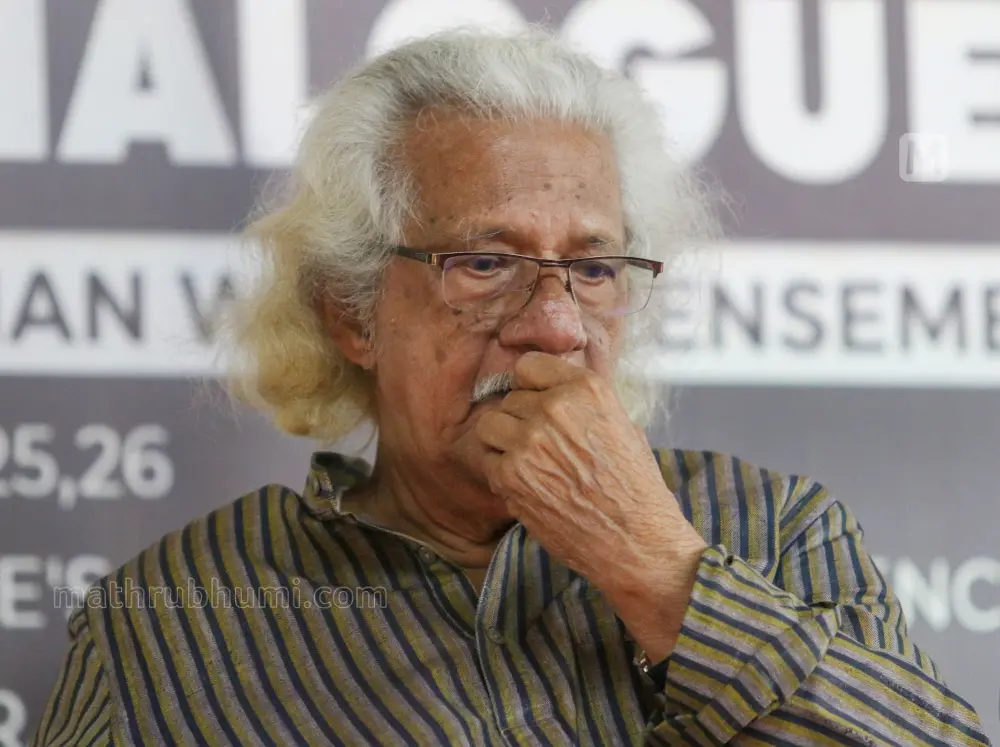
Introducing this talk on Ritwik Ghatak as a tribute to his centenary, Adoor Gopalakrishnan reminisced his introduction with his Film Institute teacher of direction Ritwik Ghatak. “He introduced us to a gentleman and pointing out to him, told us, ‘here is the man who turned into the sacrificial goat at the altar of cinema.” The man was a producer of a Ghatak film which never earned commercial success. “This is what briefly summarises the man Ghatak.”
Adoor Gopalakrishnan, perhaps the most outstanding filmmaker today in the country, was a special guest at the 31st Kolkata International Film Festival to deliver an address as a tribute to the special programme curated to celebrate the centenary of Ritwik Ghatak. He remains ever faithful to Ghatak and his memories having studied under him at the Film Institute in Pune.
He was bestowed the Dadasaheb Phalke Award for his rich contribution to cinema in 2004, besides the Padma Shri (1984) and Padma Vibhushan in 2006. In 1984, he won the National Award for Best Writing in Cinema for a collection of essays on cinema under the title Cinemayude Lokam. In 2003, the French Government honoured him with Commandeur Des Arts et Lettres order for his outstanding contribution to international cinema. The Order of the Arts and Letters established in 1975 honours distinguished personalities in the fields of arts and letters and their contribution to the dissemination of culture in France and worldwide. His film Nizhal Kuttu (Shadow Kill) was co-produced by Artcam, a French company.
At 86, Adoor carries himself quite well with his white mane of hair giving away his age. Incidentally, he was a direct student of Ritwik Ghatak who taught direction at the Film Institute in Pune (the ‘and Televsion’ was added much later) and he shared with the houseful audience his reminiscences of his experience with both Ghatak and Satyajit Ray. Adoor countered much of the stories spread around about the ‘unfriendly’ relationship between Ghatak and Ray as “trash.” He added that the difference in their approach to cinema was probably rooted to Ray’s background in fine art and Ghatak’s in theatre. “I also came from theatre where I wrote plays, directed them, acted in them and it gave me a beautiful experience leading me on to cinema,” he said.
“Ray and Ghatak were very appreciative of each other’s work and expressed this many times over. In fact, the story goes that when Ghatak had fallen on very bad days for want of work in Kolkata, it was Ray who spoke to Indira Gandhi to fetch something for Ghatak and this brought him to the Film Institute to teach direction. He never lectured on theory but spoke and explained everything about how he made films, even showing how he worked. Yet, he always advised us to follow what we felt was right and never to imitate someone else. The story about he being an alcoholic is also something I find difficult to believe because not once during his lectures did we see him drunk.”
Adoor lauded Ghatak’s enriching of the significance of the sound track in cinema. He threw up the example of the sound of the whiplash in Ghatak’s Meghe Dhaka Tara when Neela, dying, says, “Dada, I want to live.” “The whiplash was extraneous to the situation and to the characters involved and yet he used it to enhance the tragedy of her wanting to live. What a tremendous impact it makes on everyone watching the film,” yet went on to add, “I have never used any sound in any of my films that was extraneous to the scene or the character or the story.” He further said that he never allows his actors to read the script of the film because he feels it may not only spoil their spontaneity but may also present the character differently from what he had conceived.
He has never compromised with market pressures or audience demands for mainstream entertainment. He has held on to his own language, style, approach, story and plot and is a name to reckon with on the map of International Cinema. He has made relatively few films during his long span as filmmaker. His first film Swayamvaram (1972) came ten years after he graduated from the FTII, Pune. It was the second Malayalam film after Chemeen to have won the National Award. Followed Kodiyettam (1979), Elipathayam (1981), Mukhamukham (1984), Anantaram (1987), Mathilukal (1989), Vidheyan (1993), Kathapurushan (1995, Nizhalkuthu (2002), Naalu Pennugal (2007),Oru Pennum Randaanum (2008) and Once Again.
Add to this some 30-odd short and documentary films on around 30 short films and documentaries, most of them focusing on, and feeding off, his lifelong passion for the performing arts. The short films and documentaries, he laughs, helps in keeping the home fires burning while feature films are being 'explored and thought about.' Jokes apart, he adds that his documentaries on Kathakali and Yakshagana performers and dance styles evolve into a learning process for him. “This is one opportunity for me to learn about them in depth and also get inspired by them. It is a great, refreshing experience. I get really charged for the next project that is my feature film. In a very strange, indirect way, it invigorates me. I get greatly enriched. It expands my understanding of my culture, my living and ultimately, myself.”
When this writer first met Adoor at the Hyderabad Filmotsav in 1986 and asked him what he does between films, since he makes so few of them, his pat answer was, "I think about making films," just like that. During the making of Vidheyan, starring Mammooty in a negative role, he said, "I make my films for everyone. Not everyone may understand them in the same way, but that is something I crave for. I am no fireside raconteur. As a filmmaker, it is my duty to respect the audience's intelligence. They can understand a film the way they wish to. I try to be as cost-effective as I can. Vidheyan was planned at a cost of Rs.27 lakhs. I completed it within Rs.25 lakhs. I do not believe in going over-budget to stress a point."
“I interact with the medium of cinema by choosing a human being placed in a certain situation. It may be a village simpleton, a disillusioned political worker or a writer as the case may interest my creative instincts and me. It is their existential situation that my film explores. None of this can be summed up through a slogan," he added.
“I do not approve of direct political statements because they are one-dimensional. A metaphor offers me more potential to be creative. Through it, I can comment more effectively about the senseless violence around us today. My objective is to draw the maximum out of the film medium. This exploration does not presuppose a signification, though it does not exclude suggestions, gestures. If it renders itself to an identifiable social message, it is for the reader who may have read it. I did not mean it. If someone finds Mathilukal a plea for jail reforms, or Vidheyan a critique of the brutality of feudalism at its naked worst, I cannot help it. In my way of looking at things, all I can say is that they often mistake the incidental for the essential," he says.
Adoor does not accept that Mukhamukham is a political film. But viewers feel that the film is a subtly handled political film. It is a subtle comment on the Marxist movement in Kerala. But Adoor said that it is neither a political film nor is it a value judgment on the Communist Party of India. “It is about the search for the self by a revolutionary, his transformation into an image and the ‘demands’ made on that ‘image’ by the people. This is a common truism in Indian politics. In an important scene in the film, I have used Lenin’s quotation: ‘The proletarian movement passes through several stages of growth. At every stage, a set of people stagger, stop and are unable to continue the forward march.’ The film depicts one such movement. There is a revolutionary concealed within every individual. At some point of time, this spirit vanishes. I thought it would be worthwhile searching for that spirit,” said Adoor.
What is lacking today among filmmakers he feels “is that they are all concerned with the commercial aspects of their films and have begun to feel that cinema should be as distanced from real life as possible. But I always believe that cinema should be close to real life and then alone can we call it cinema. Today’s mainstream cinema is no entertainment, it is a horror.” He also lamented the decline in theatres in Kerala which was dangerous not only for the film industry, or for the creative form of art called ‘cinema’ but was also not the right way to approach and treat cinema.
For him, “Filmmaking is not just about story telling. That's a minor excuse, a simple but significant excuse to keep an audience engaged in a cinema theatre. More than that, I am making them experience and also look for many things within and without themselves, and around themselves. I am talking about my kind of cinema. This, I think is the function of the art, any art for that matter -- to make you aware, to make you think and disturb you positively and creatively, to make you excited about it, to make you responsive to things.”