Guru Dutt at 100: Why Kaagaz Ke Phool still haunts Indian cinema
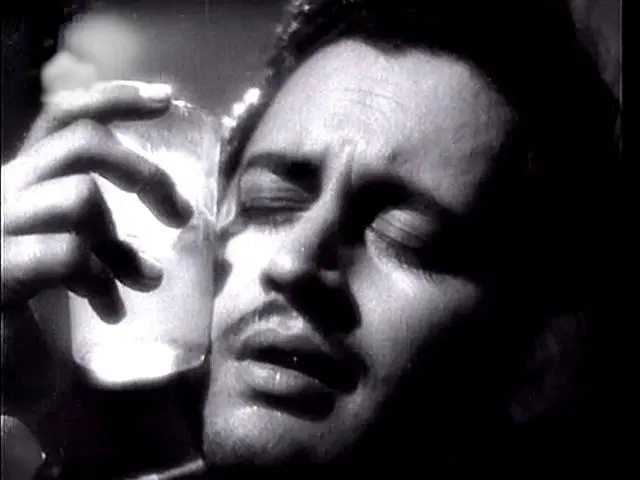
Guru Dutt was born on July 9 1925. This means that on this July, we will be celebrating his centenary. As a filmmaker, though it is posterity that brought him global fame for his last trilogy, Pyaasa, Kaagaz Ke Phool and Sahib Bibi Aur Ghulam, looking back at his career as producer, director, actor and writer, we cannot box him in any specific genre though his earlier thrillers were no less unique than the trilogy. The story goes that he did not wish to play the protagonist in films he directed himself but was somehow forced to take up the challenge when the hero he had originally banked on, refused or backed out of the film.
His Kaagaz Ke Phool (Paper Flowers) is a self-reflexive film, perhaps the first such in Hindi cinema that focused on the life and death of a director and not an actor. What is a self-reflexive film? It is a film-within-a-film where the audience is privy to the inside story of the film industry through the lives and loves of its actors and creators, the details of how a film is being shot, how actors and actresses behave on and off the sets, what the technical crew has to deal with and so on. These insights are woven into a larger story which forms the main film which is actually narrating and showing ‘the story-within-the-story.’
Self-reflexivity means the inclusion of cues within the film reminding the viewer that it is, indeed, a film. The motivation for this is to make the audience aware of the constructed nature of the film, thereby acknowledging the subjectivity of the filmmaker. A reflexive film is a film that makes the audience aware of the filmmaking process. Reflexivity is defined by such devices as looking into the camera, taking advantage of two-dimensionality of the screen, or simply making a film about making a film. In other words: a reflexive film is a film with self-awareness.
A year before Kaagaz Ke Phool reached the theatres, a film featuring Nutan in the title role named Sone Ki Chidiya, was released in 1958. The name was strongly suggestive of the life of a young orphan Lakshmi (Nutan) who was forced to step into the film industry and not only became very famous but also became the scapegoat of her relatives, friends and even the young man she fell in love with. Though the film was directed by the talented filmmaker Shaheed Latif and produced and written by his famous wife Ismat Chughtai, the film flopped miserably. But it was a good film with beautiful music and Talat Mahmood, who played a negative role, sang some outstanding songs under the baton of the then-young O.P. Nayyar.
Self-referential films offer different aspects of cinema such as film-making, (Kaagaz Ke Phool, Samar, Mrinal Sen’s Akaaler Sandhane), movie stars, (Sone Ki Chidiya, Rangeela, Akele Hum Akele Tum, Halla Bol, Bhumika, Billu, Heroine), institutions of the film industry (Zubeidaa, Guddi, Luck by Chance, Khoya Khoya Chand), movie theaters (Akele Hum Akele Tum, Traffic Signal), a film being shot on location or in the studios (Bade Miyan Chhote Miyan, Samar), the audience (Mast, Fan), one special film, (Darmiyaan, Guddi), etc. Madhur Bhandarkar’s Heroine and Zoya Akhtar’s Luck By Chance reveal Indian filmmakers’ obsession to unfold some stories within the industry. But unlike Kieslowski’s Camera Buff, or Guru Dutt’s Kaagaz ke Phool, for most filmmakers, a film-within-a-film need not be autobiographical.
Cinema-within-cinema also draws the attention of the spectator to filmic codes, e.g. camera angle, montage, colour, music, sound and so on. The presence of cinematic items, objects and other paraphernalia, such as the movie camera, the boom, the lights, the make-up, the costumes, the make-up room, huge posters of films and film stars, the back office of a studio classify a self-reflexive film as a special genre.
Kaagaz Ke Phool (1959)
While Guru Dutt maintained that the film was an ode to his mentor, Gyan Mukherjee, who he assisted when this director was making Kismet, a super-duper hit with Ashok Kumar in the lead and beautiful music, many viewers and critics felt that the film is autobiographical to a large extent based on the widely written-about alleged relationship between Dutt and his protégé, Waheeda Rehman. Dutt was married to singer Geeta Roy (later Geeta Dutt) at the time, and his heavy drinking and the rumours of his passionate romance with Rehman didn’t help.
Kaagaz Ke Phool (1959) is one of the most moving, self-reflexive films made in India. It is a fine and subtle tribute to the glorious days of the studio era, using its history from about the 1930s to the 1940s as its backdrop. The film tracks both the introspective and retrospective journeys of Suresh, a once-celebrated film director who is currently going through a bad patch both professionally and personally. He is estranged from his wife and daughter, while Shanti, the leading lady who he had groomed to fame and glory, and had subsequently fallen in love with, has drifted away. He discovers that the studio floors are his last recourse, and seeks refuge there, tracing back his journey. He finally comes to terms with the reality that fame and success are as ephemeral as life itself. By then however, it is too late.
Kaagaz Ke Phool has strong autobiographical elements. It is almost like a celluloid elegy Dutt wrote for himself with his screenplay, his images, his music and his lyrical pacing of the film. He is said to have had an intense relationship with Waheeda Rehman, one of his leading ladies, as shown in the film. This brought about phases of estrangement with his wife Geeta Dutt from time to time. He began to drink when he was not working. He suffered from long periods of depression. He became a chronic insomniac. Bimal Mitra, the original author of Saheb Bibi Aur Ghulam wrote an entire non-fictional book entitled Binidra (Bengali),meaning “the sleepless one” that described his close relationship with Guru Dutt during his long phase of insomnia as they discussed the strategy of turning the novel into a film script and stayed together for months at a bungalow some distance away from Mumbai.
It is said that his premature death by suicide was foreshadowed in the film. The film was a failure. Now it enjoys a cult following in India and France where it was commercially released in the 1980s. Strangely however, one finds that Shanti functions as the sacrificing woman who falls desperately in love with him but fails to rescue him from a tragic death. Suresh is in love with Shanti the actress and not Shanti the woman. Waheeda Rehman stepped out of his life to perform some of the best roles of her career in Guide, Khamoshi, Teesri Kasam, Abhijaan and Lamhe. Yet, they never express their love in so many words right through the film.
An early shot in the film reveals Suresh leaning from the balcony of a cinema hall where Vidyapati, (1937), an unforgettable musical romance, is playing to a full house. The films that Suresh is shown making or having made in the film are films that actually exist in the archives of Indian cinema.
Dutt weaves his film-within-a-film story of Kaagaz Ke Phool with Devdas, which is the film being directed by Suresh. He manages to persuade his producer to cast Shanti, an orphan girl he had met one day when she walked into the sets within the camera frame, to play Parvati in the film. The entire sub-text happens in a series of coincidences and accidents. Not once does one get to see Devdas actually being shot in this film. But there is this strong sense of intercutting between Devdas and Suresh with Suresh taking to the bottle and losing out on life, family, and love. Towards the end of the film, the only retreat for Suresh is the studio where he shot many successful films.
Here, with his cameras, his arc lamps, his backdrops, his sets, his technicians and his actors, the director can create and control his own world of make-believe and beauty. But the space grants him only the metaphorical consolations of a fictive universe. When he loses his favourite actress in this space and his daughter in the courtroom, he begins to drink, as if with a vengeance, and becomes homeless. He returns to the space all over again after having lost his family, his career and his audience. “By now, he defines the space as an indoor space that has evolved into a private sepulchre for himself,” writes Nasreen Munni Kabeer in Guru Dutt – A Life in Cinema, 1997.
As a film about the film industry and largely set within the locale of a film studio, it allowed for elaborate set pieces that capitalized on a ‘behind-the-scenes’ atmosphere of movie-making. However, it has been suggested that this elaborately self-reflexive sensibility is precisely what was responsible for the film’s inability to find commercial success.” Dutt actually asked two of his cinematographers, his earlier one called V. Ratra and his current one V.K. Murthy to appear in the film in person as camera persons within the film! Murthy would fondly recall the film as Guru Dutt’s gift to his (Murthy’s) craft. Being the first cinemascope film, it was a definite technical challenge and the nature of the narrative demanded certain experimentation with light in all its aspects.
Some film scholars say that the behind-the-scenes realities of film-making define the mystique of cinema that is better kept away from the actual film than allow the technical, other private and personal relationships to tumble out of the cupboard that hides lots of skeletons and this exposure of the mystique that cinema keeps away from the audience may have led to the failure of this film.
Guru Dutt’s suicide in 1964 five years after the debacle Kaagaz Ke Phool left behind is foreshadowed through Suresh Sinha’s death at the end of the film when he reclines, wearily, on his old chair in the spacious but empty studio floor, lit strategically and magically by Murthy’s amazing capacity to turn the camera into a character. Suresh’s image is dwarfed in the largeness of the space of the empty studio floor. Suresh’s death is also a kind of metaphorical suicide marking his death in the place he was passionately in love with and could not live without. The studio floors with the cranes, the microphones, the paraphernalia create a kind of parallel world within the larger world Suresh lives in, content only when he is shooting or giving directions or whatever.