Sunlight on forehead of Sri Ram Lalla: Here's how Indian Institute of Astrophysics made it possible
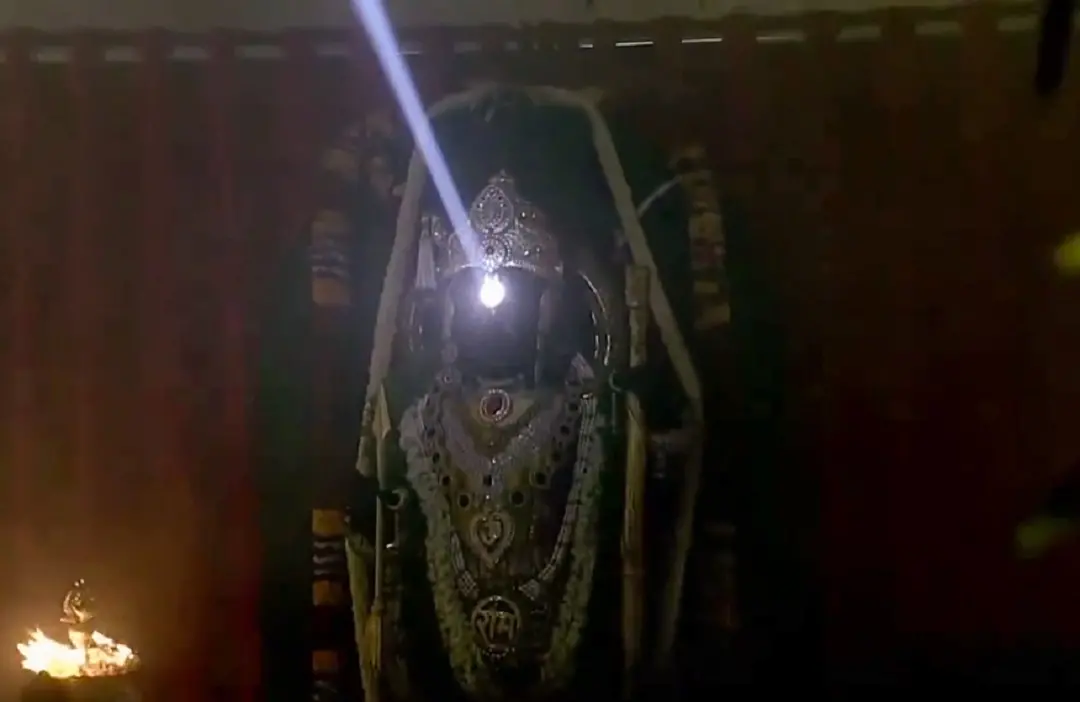
The Indian Institute of Astrophysics (IIA), an autonomous body under the Department of Science and Technology, played a crucial role in the Surya Tilak Project at Ayodhya. The project aimed to bring sunlight onto the forehead of Sri Ram Lalla at noon on Sri Ram Navami in the Chaitra month. The IIA team handled sun position calculations, optical system design and optimization, and on-site integration and alignment.
The English calendar date of the Sri Ram Navami festival changes annually as it follows the Lunar Calendar. Hence, the sun's position in the sky also varies each year on Sri Ram Navami. Detailed calculations reveal that the English calendar date of Sri Ram Navami repeats every 19 years, necessitating expertise in astronomy to determine the sun's position.
The IIA team spearheaded the calculation for identifying the calendar days of Sri Ram Navami for one 19-year cycle and its subsequent repetitions. They also designed an optomechanical system to direct sunlight from the temple's top to the idol's forehead, ensuring sufficient light for about six minutes. The team optimized the design and conducted simulations for the opto-mechanical system's functionality.
Due to the temple's incomplete status, the IIA experts adjusted the design to fit the existing structure and conducted image optimization. This design, comprising four mirrors and two lenses, was implemented for the Surya Tilak on April 17, 2024. The IIA technical experts participated in testing, assembly, integration, and validation at the site. Crucial alignment of mirrors and lenses was performed during trial runs in the Ram Mandir before the event.
The opto-mechanical system's implementation at the site was carried out by CBRI, with the device manufactured by Optics, Bangalore. The final design with four mirrors and four lenses will be implemented once the temple is fully constructed. The mechanism accommodates a shift of 1-2 days in the Ram Navami calendar date and requires manual adjustment of the first mirror annually before Ram Navami. The lenses and mirrors are easily accessible for periodic cleaning.
Dr. DP Kanungo, Chief Scientist at CSIR-CBRI, Roorkee, stated, "As planned, the Surya Tilak of Ram Lalla was executed at 12:00 pm."
In collaboration with the Indian Institute of Astrophysics (IIA), Bangalore, the CSIR-CBRI, Roorkee team developed a mechanism to direct sunlight from the temple's third floor to the 'garbha griha.'
A detailed design for bringing sunlight to the 'garbha griha' was devised by CBRI, with IIA providing optical design consultancy.
The system underwent testing by scientists on Tuesday.
Dr. S K Panigrahi, a scientist at CSIR-CBRI Roorkee involved in the project, highlighted the primary objective of the 'Surya Tilak' project: focusing sunlight on the forehead of the Shri Ram idol every Shri Ram Navami day.
Sunlight will be directed onto Lord Ram's forehead at noon on Shri Ram Navami in the Chaitra month annually under the project.
Department of Science and Technology Secretary Abhay Karandikar stated, "The team led by @IIABengaluru carried out calculations of the Sun's position, designed and optimized the optical system, and performed integration and alignment at the site."
"As the temple is not fully completed now, the IIA experts modified the design to suit the existing structure and performed image optimization. This design, with four mirrors and two lenses, was executed for the Surya Tilak," he posted on X.
PTI, PBI