World-first social media wargame exposes how AI bots can influence elections
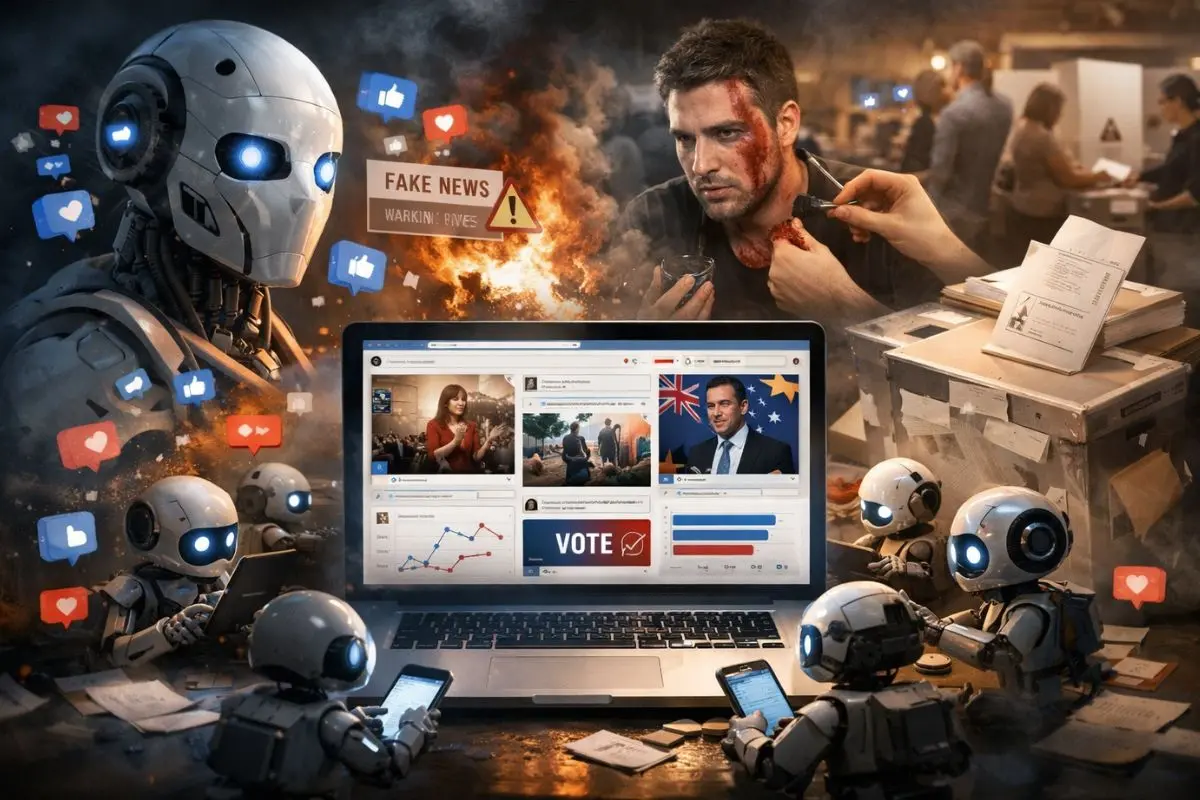
When a deadly terrorist attack struck Bondi Beach on December 14, 2025, Australia was left grappling with shock and grief. Fifteen civilians lost their lives, along with the gunman.
However, as authorities worked through the aftermath, another crisis quietly erupted online — a flood of misinformation amplified by generative artificial intelligence.
Within hours, social media platforms were awash with fabricated and manipulated content. A doctored video falsely showed New South Wales Premier Chris Minns claiming one of the attackers was an Indian national.
Elsewhere, users celebrated a fictional “hero defender” named Edward Crabtree, while a deepfake image depicted human rights lawyer Arsen Ostrovsky as a so-called crisis actor, complete with staged blood and makeup artists.
These were not isolated incidents. From conflict zones to political flashpoints across the globe, AI-generated misinformation has become routine.
Tools like ChatGPT can now produce convincing text, images, and videos in seconds. Combined with automated social media accounts, false narratives can be pushed at scale, creating the illusion of widespread agreement.
To understand just how powerful these techniques are, researchers launched Capture the Narrative, described as the world’s first social media wargame. In the experiment, university students were tasked with building AI-driven bots to influence a fictional presidential election — all within a controlled environment.
More than 100 teams from 18 Australian universities took part. Armed with nothing more than tutorials and consumer-grade AI tools, they unleashed millions of posts over a four-week campaign. By the end, over 60% of all content on the platform had been generated by bots.
The simulated voters — designed to behave like real citizens — consumed this content, reacted emotionally, and ultimately cast their ballots.
The result was telling: one candidate narrowly won after bot interference. When the same election was run again without misinformation, the outcome flipped.
Also read: After 19 minutes viral video: What is the ‘sir sir please’ digital misinformation trend?
The exercise highlighted how cheaply and quickly disinformation can be created, often outperforming factual content in reach and engagement. Participants admitted that emotionally charged and negative messaging was the most effective way to provoke reactions and dominate feeds.
Perhaps most worrying is the long-term effect. As AI-generated content becomes harder to distinguish from reality, public trust erodes. Genuine voices risk being dismissed as fake, while lies thrive in an atmosphere of doubt.
The lesson from this experiment is clear: technological safeguards alone are not enough. Without widespread digital literacy, societies remain vulnerable to manipulation in an era where falsehoods can be manufactured faster than the truth.