8 red cards already: 2026 World Cup ties 2018 and 2022 total in just group stage
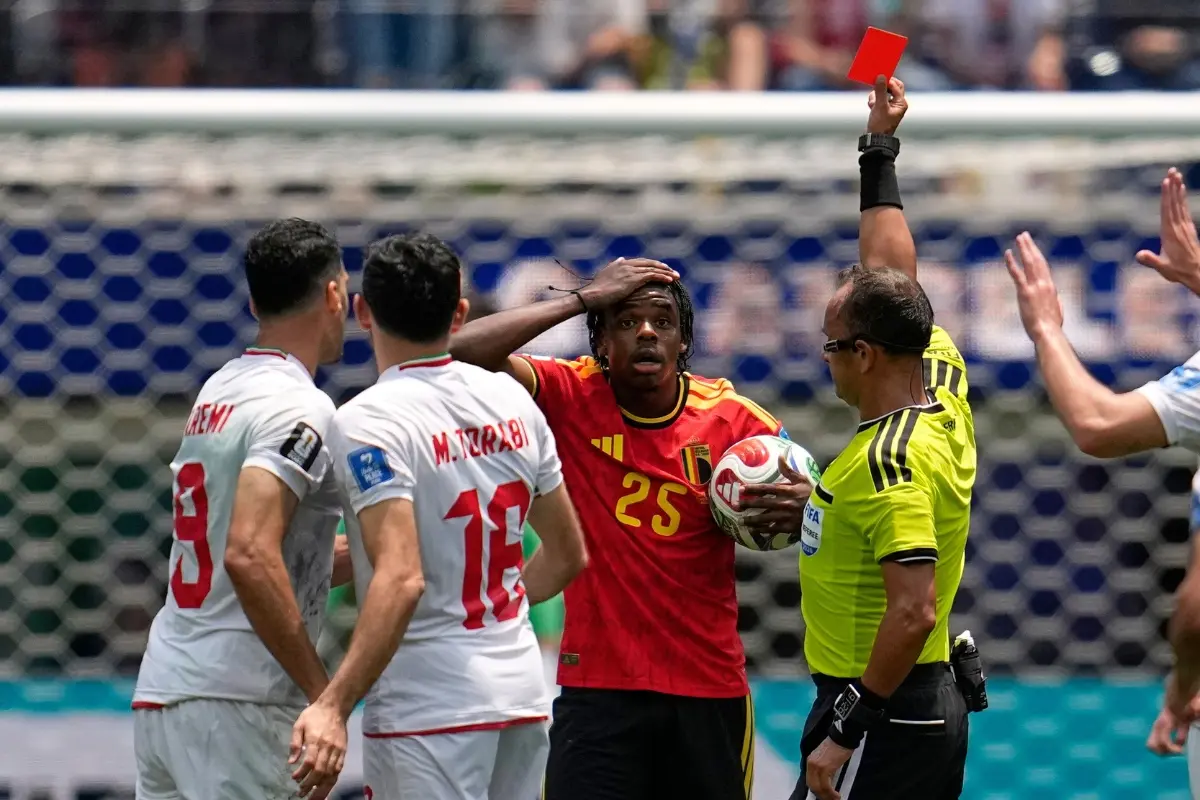
A gritty, goalless draw between Belgium and Iran at the Los Angeles Stadium, triggered a major tournament milestone as a second-half sending-off saw the current FIFA World Cup equal the entire disciplinary tally of the last two tournaments combined.
The Group G encounter finished 0–0, but the primary talking point arrived in the 66th minute when Argentine referee Dario Herrera brandished a straight red card to young Belgian defender Nathan Ngoy. The 23-year-old Lille centre-back misjudged a backward pass toward goalkeeper Thibaut Courtois, allowing Iranian forward Mehdi Taremi to intercept. In a desperate attempt to correct the mistake, Ngoy hauled down the striker near the edge of the area, resulting in an immediate dismissal for denying an obvious goalscoring opportunity.
Historic Disciplinary Milestone
Ngoy's expulsion marked the eighth red card issued in the current tournament. Statistically, this rapidly matches the aggregate total of dismissals from the entire 2018 World Cup in Russia and the 2022 edition in Qatar combined, both of which registered exactly four red cards each. The sharp increase in expulsions during the initial phase of the 2026 tournament underscores a strict and uncompromising officiating approach towards professional fouls and dangerous play.
The dramatic spike in dismissals has drawn considerable attention from technical analysts. Speaking to FOX Sports, rules analyst Mark Clattenburg observed that players are not necessarily displaying worse behaviour, but are instead committing high-consequence technical errors under pressure. Clattenburg remarked: "Players are well-behaved, but they're just making mistakes in and around the penalty area, maybe in a panic." He added that expanded 26-player tournament squads allow managers ample depth to cover for suspended players, potentially altering the risk calculations made on the pitch.
Goalkeeping Heroics and VAR Drama
Prior to the dismissal, the match had developed into a tense tactical battle. Iran thought they had broken the deadlock during the first half when Taremi neatly converted a clever set-piece routine. However, a semi-automated Video Assistant Referee (VAR) review intervened, ruling the goal out for offside.
Despite dominating absolute possession through midfielders Kevin De Bruyne and Youri Tielemans, Belgium were repeatedly frustrated by a disciplined Iranian defensive unit. Iranian goalkeeper Alireza Beiranvand produced an exceptional individual display, amassing seven crucial saves to keep the star-studded Belgian attack at bay.
Even when reduced to ten men following Ngoy's exit, Domenico Tedesco’s side continued to chase a late winner. Substitute Dodi Lukébakio went inches away in the final seconds of stoppage time with a curling left-footed effort, whilst young attacker Matias Fernandez-Pardo blazed another golden opportunity high and wide.
The result leaves Group G completely open, with both nations locked on two points following back-to-back draws. While Iran's disciplined rearguard secures a valuable point, Belgium face a crucial, must-win final group fixture against New Zealand to ensure their safety and guarantee progression to the knockout stages.