A devoted football fan, Pope Francis gave up watching television over 30 years ago
Vatican City: In Italy, there is a well-known saying about the papal conclave: "He who enters the conclave as pope, comes out a cardinal." The adage serves as a reminder not to be overly confident, even in matters of apparent certainty—especially when it comes to the election of a new Pope. The events of March 2013 proved this saying accurate yet again, when Cardinal Jorge Mario Bergoglio of Argentina, who was not among the frontrunners, was elected as Pope Francis.
As white smoke billowed from the Sistine Chapel chimney, the world watched in surprise. The name announced defied all expectations. For many Argentinians, this was celebrated as “the second divine intervention” in the country’s history—the first being Diego Maradona’s infamous "Hand of God" goal against England in the 1986 World Cup. While Maradona claimed that goal as the work of divine intervention, Francis would, through his words and actions, go on to prove that he was indeed a man chosen to guide the Catholic Church and the world onto a new path.
Throughout his papacy, Pope Francis took strong and clear stance on a range of international, social, and environmental issues. But one often-overlooked aspect of his personality was his enduring love for sport. He believed in sport’s power to shape society, foster human connection, and nurture values rooted in fraternity and humility.
For Pope Francis, sport was not merely recreation—it was a way to stay connected with God and fellow human beings. The virtues of life, the sense of community, and the discipline needed to win and lose gracefully—he learned all these not in grand seminaries, but on the streets of Buenos Aires, where he played football and basketball as a child. Like most Argentinians, Pope Francis was a devout football lover. He was a lifelong fan of San Lorenzo, one of Argentina’s prominent football clubs. He shared in their victories and mourned their defeats with the passion of any die-hard supporter. He was even an honorary member of the club.
Before becoming Pope, Francis served as the Archbishop of Buenos Aires and lived near the San Lorenzo club’s headquarters. His love for football was more than symbolic—it was deeply personal and rooted in a life of learning from the pitch. The joy of triumph, the pain of loss, and the power of togetherness were lessons he imbibed from sport, long before he led the global Catholic community.
As pontiff, he carried these values into his teachings. His involvement in sport was not confined to Argentina or the Vatican—it resonated globally. At every major sporting event, from the Olympic Games to the FIFA World Cup, Francis used his voice to send powerful messages of unity, peace, and human dignity.
Prior to the 2022 FIFA World Cup in Qatar, he addressed the global footballing community with a message of goodwill. He wished the teams, players, fans, and spectators well, expressing hope that the tournament would become an opportunity for harmony among nations and fraternity among peoples.
Yet, Pope Francis did not watch Argentina's eventual World Cup triumph. Thirty years ago, he made a personal vow to Our Lady of Mount Carmel that he would stop watching television. It was a promise he has kept. Despite this, his ties with Argentine football legends, both past and present, remained strong. He shared a close rapport with both Maradona and Lionel Messi.
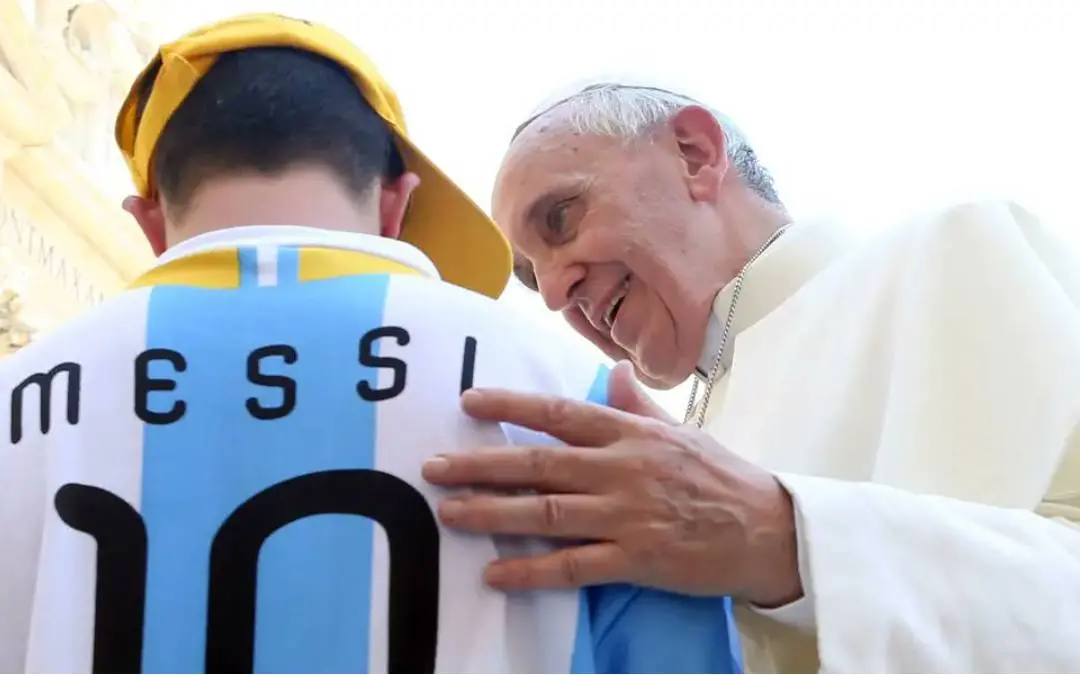
Maradona once famously declared that he was Pope Francis’s “greatest fan.” In 2015, the football icon met the Pope and offered his support for Francis’s educational initiatives for underprivileged children. In 2013, players from both the Argentine and Italian national teams visited the Vatican. Messi, the then captain of Argentina, and Gianluigi Buffon, captain of Italy, together presented Pope Francis with an olive tree sapling—a symbol of peace. The Argentine players also gifted him the national team jersey. During the meeting, the Pope urged them to protect their humanity and remain humble despite their fame and success.
Ahead of the Paris Olympics last year, Pope Francis issued another heartfelt message. He spoke of sport as a bridge between peoples, a means of breaking down walls and cultivating peaceful relations.
“Sport is not just a way for individuals to showcase talent,” he said. “It is a social force, a tool that helps shape communities. It teaches us the value of fraternity.”
His message was warmly received, including by International Olympic Committee President Thomas Bach, who lauded the Pope’s consistent advocacy for the moral and unifying power of sport.
Like in every other sphere of life, Pope Francis’s absence will be deeply felt in the world of sport too. His departure marks a profound loss—not only to the Catholic Church but to the global sporting fraternity that found in him a humble yet powerful voice for unity, dignity, and shared human values.