World Cup evolution: How football’s biggest tournament transformed over a century
Like the big event in any sport, the World Cup football had a humble beginning. It then rose to become one of the most popular sporting ventures in the history of sports. Today, the format has expanded to allow 48 teams to compete for the FIFA trophy. Winning it is the high point of any football-loving nation.
But when it all started way back in 1930, FIFA could manage just 13 teams to take part. Uruguay, the then Olympic champion, was given the opportunity to begin the series by hosting the inaugural event.
ALSO READ: FIFA World Cup 2026: Major VAR and Rule Changes Explained
As the celebrated British football writer Brian Glanville put it in his much-publicised book 'Story of the World Cup':
"Like so many of the best ideas in football, that of the World Cup was conceived in France."
Two Frenchmen set everything in motion: Jules Rimet, the FIFA President, and Henri Delaunay, who ran French football from 1908. Looking back, they are now considered the pioneers of French football, European football, and the World Cup. They realised that football could not remain in the confines of the Olympics, which was meant for amateurs, at a time when professional players had begun to rise, particularly in Europe.
Meanwhile, Uruguay was showing its potential in the Olympics, where it retained its titles. So, in 1928, FIFA adopted the resolution to launch the World Cup. But the question was: where?
As it happened, Italy, Holland, Spain, Sweden, and Uruguay showed interest. Among the lot, Uruguay had a proud footballing tradition and showed a certain keenness. Besides, the country was to celebrate its hundred years of independence in 1930—the exact year FIFA decided to kick off the World Cup programme.
ALSO READ: FIFA World Cup 2026: The Complete List of Qualified African Teams
So Uruguay it was, but it was not easy. No European country other than France entered the contest when just months remained for the start time. Because of this, the Latin American Federations threatened to withdraw from FIFA.
But things opened up in due course. Belgium and Romania agreed to make the trip, and soon Yugoslavia followed. Suffice it to state that 13 countries formed the field. This included:
- Latin American countries: Host Uruguay, Argentina, Chile, Mexico, Bolivia, Brazil, Peru, and Paraguay.
- North America: USA.
- Europe: Four countries (France, Belgium, Romania, and Yugoslavia).
Thus began the World Cup in 1930, with Uruguay emerging as the first champion by beating Argentina in an all-Latin America final.
ALSO READ: FIFA World Cup 2026 Schedule IST
European Domination & The Wartime Halt (1934–1950)
Four years was the cycle. The next two editions in 1934 and 1938 brought Italy to the fore as Europe’s domination came out loud and clear. Italy won in both of those years. It must be an irony of sorts that after many years from then on—as we await a fresh World Cup with an enhanced field—Italy does not find a place among the contestants!
Back to history, the World Cup run came to a halt with the coming of the World War. It was not until 1950 that the next edition unfurled.
Brazil hosted it, and for the first time, England came into the field. By now, the popularity of this quadrennial fixture had picked up, as had the competition and rivalry. Uruguay was to win. A standout feature was that the final was witnessed by around 200,000 fans—a record at that phase of World Cup history.
ALSO READ: FIFA World Cup 2026 group stage explained
Icons, Mascots, and Milestones (1954–1966)
The 1954 edition went back to Europe, with Switzerland hosting it. A change this time was that the event was televised for the first time. West Germany was to win for the first time.
Four years later, the World Cup was conducted in Europe again, with Sweden being the host. The newcomer this time was the Soviet Union. This edition brought a talent to the world who was to take the football world by storm: none other than Pelé, the Brazilian genius. Fittingly, he helped Brazil win its first crown.
Brazil was to win the next tournament too, held in Chile in 1962. However, they did this without Pele, who entered the injured list early.
Four years later came the big moment for England. This was also the first time that marketing came into the picture, introducing a mascot and a logo. Variety was added by an unusual incident where the trophy got lost, only to be found a week later by a dog named Pickles! England won its first and only title to date.
ALSO READ: Official FIFA World Cup 2026 Groups
The Era of Expansion & Global Growth (1970–1986)
In the seventies, the 1970 World Cup was hosted by Mexico. This marked the first time the event moved to North America from its regular homes in Europe and South America. The field remained more or less the same, with 16 teams contesting in Groups. Brazil won. Since it was their third Cup win, the Jules Rimet Trophy was handed over to them for permanent keep.
Germany hosted the 1974 edition. A highlight this time was the ‘total football’ concept introduced by the Netherlands, though they ended up losing to Germany in the final.
The next cycle saw Argentina as the host. By now, the competitive spirit of countries worldwide has gone up. There were 95 countries vying for the 14 available slots (as the holder and runner-up were automatic entrants). Iran and Tunisia were first-time participants. Tunisia also became the first African team to win a World Cup game when it beat Mexico in its opening encounter.
In 1982, Spain took over as host. FIFA also decided to expand the field to 24 teams, creating six groups of four teams each. African teams began coming in a bigger way.
Argentina hosted the next tournament four years later in 1986. This edition is remembered for the emergence of the legend Diego Maradona, who led his country to triumph.
ALSO READ: 2026 FIFA World Cup Host Cities Guide
Modern Milestones & The Technological Age (1990–Present)
In the nineties, Italy hosted the 1990 event, where the rise of Cameroon was a major highlight. They became the first African nation to reach the quarterfinals. Eventually, it was West Germany which emerged as the title-winner.
The USA hosted the next edition in 1994. It was a World Cup remembered for Maradona’s ban for testing positive for cocaine, and for 42-year-old Cameroon player Roger Milla's goal, making him the oldest player to score. The competition attracted an overall attendance of over 3.5 million fans, which stands as the biggest in World Cup history.
The 1998 edition in France saw the field expanded again, this time to 32 teams. Japan and Iran qualified from Asia. Sepp Blatter was the FIFA chief at that time. The increased field made many feel that the quality was affected, even as the total number of games grew.
On to the millennium. The year 2002 saw the World Cup come to Asia for the first time, with Japan and Korea jointly hosting it. This was also the first time that the event was hosted by two countries. Incidentally, four-time winner Brazil added one more title to their name—their last one to date!
The 2006 edition went back to Europe with Germany as the host. Four years later, for the very first time, the World Cup went to Africa, with South Africa hosting it.
The 2014 event went to Brazil. A brand new happening was the introduction of goal-line technology.
In 2018, the tournament was hosted by Russia, moving the competition to Eastern Europe for the first time. There was also another first in technology: the Video Assistant Referee (VAR) system.
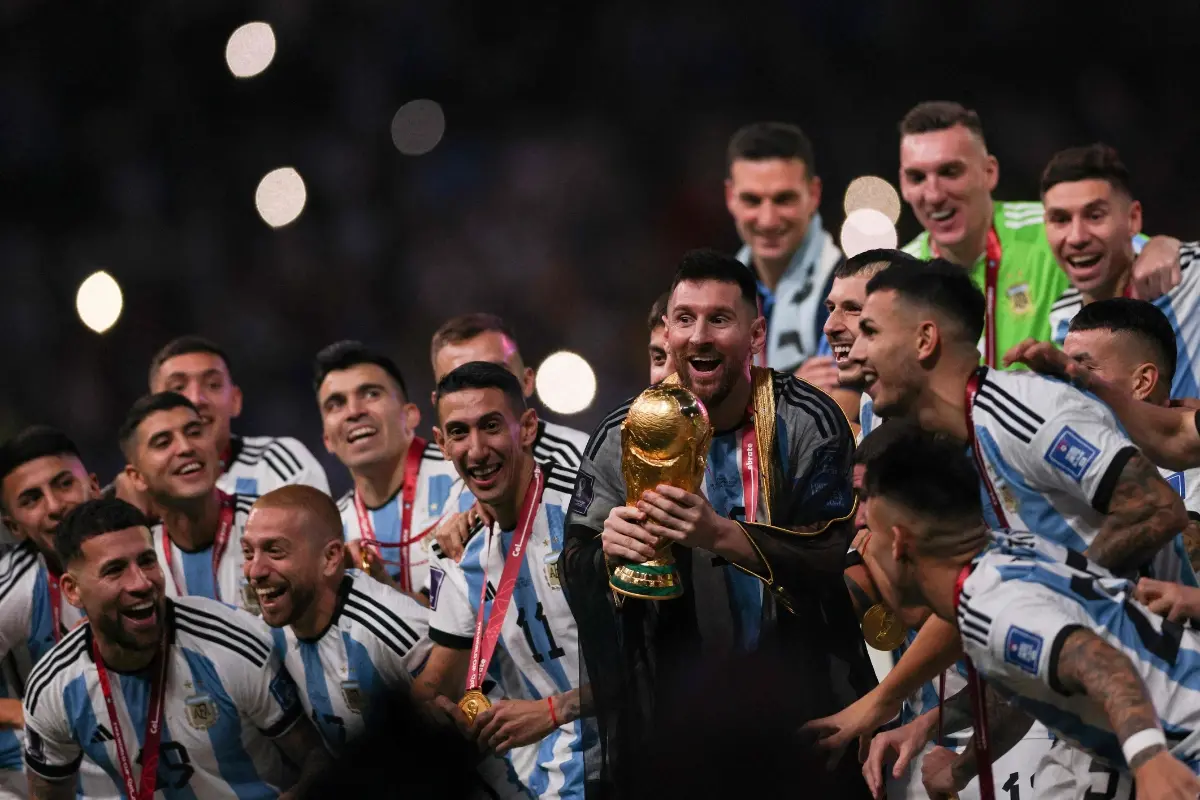
At the last World Cup held in Qatar—the first time it was held in the Middle East—Argentina triumphed, boosting Lionel Messi, the world’s best player. The event also marked the last time that exactly 32 teams were in the fray.