Cape Verde story: A LinkedIn recruit, a former Man United flop and a World Cup dream
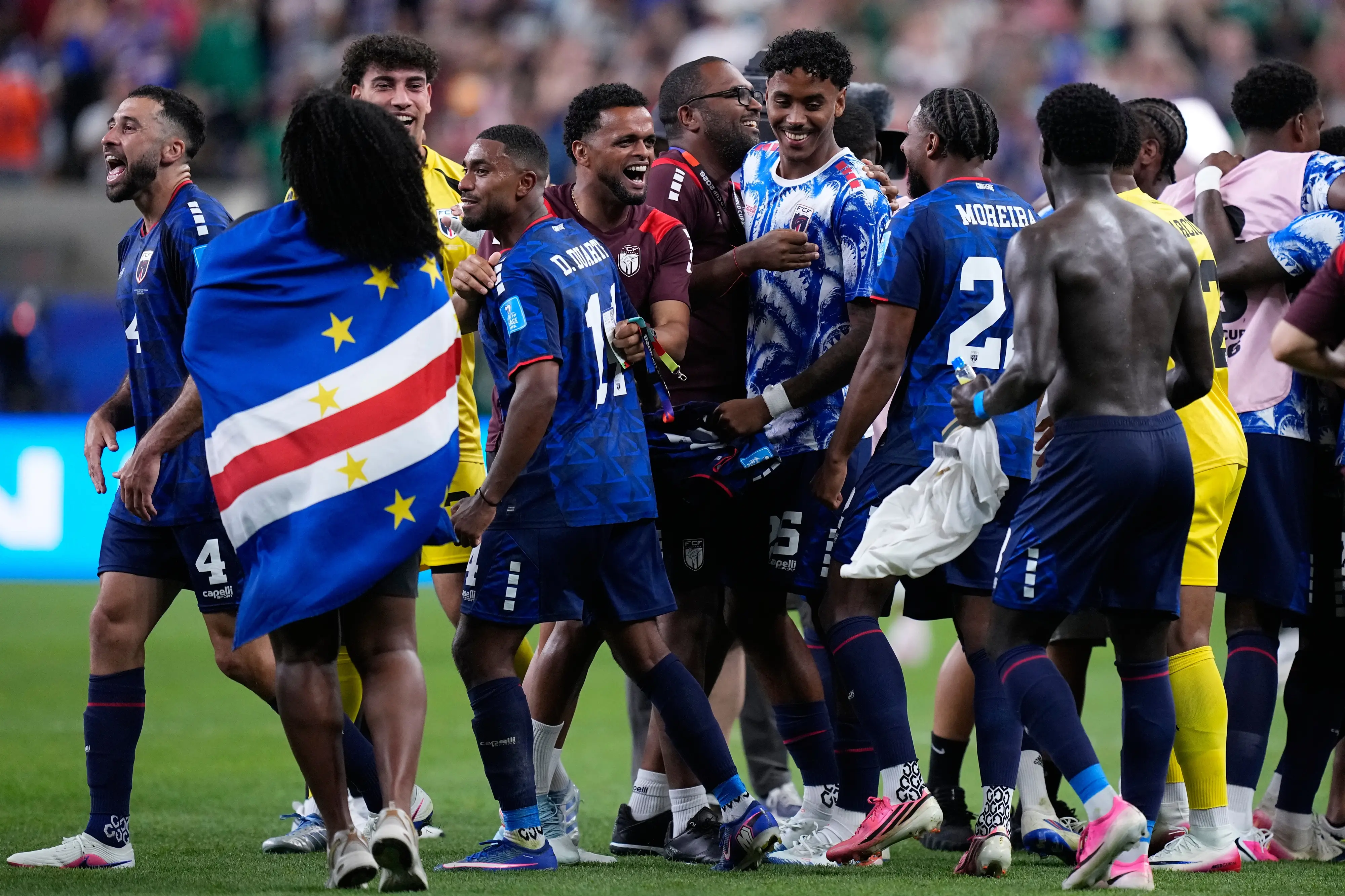
There are football nations that spend decades building academies, investing billions and producing generations of world-class talent in pursuit of World Cup glory. Then there is Cape Verde.
A tiny Atlantic island nation with a population of just 530,000, Cape Verde has become the smallest country ever to reach the knockout stage of the FIFA World Cup. In a tournament featuring global powers with millions of registered footballers, the Blue Sharks have rewritten football history.
Now comes their biggest challenge yet. A Round of 32 clash in the FIFA World Cup 2026 against defending champions Argentina and Lionel Messi. Whether their extraordinary journey ends there or continues, Cape Verde has already become the tournament’s greatest underdog story.
The smallest nation with the biggest dream
Cape Verde’s population is smaller than that of many cities competing at this World Cup. Located around 600 kilometres off Africa’s west coast, the country consists of ten volcanic islands scattered across the Atlantic Ocean. The nation gained independence from Portugal in 1975 and has spent decades building one of Africa’s most stable democracies despite having limited natural resources.
Football has always been loved there. Success, however, has been much harder to find. The national team played its first international match in April 1978, losing 1-0 to Guinea. After joining FIFA and the Confederation of African Football in 1982, Cape Verde spent decades trying to establish itself among Africa’s elite.
Their first Africa Cup of Nations qualification campaign came in 1992. Their first World Cup qualification campaign arrived only in 2003. Now, just over two decades later, they are making headlines across the globe.
History written in Group H
Almost nobody expected Cape Verde to survive Group H. Drawn alongside Spain, Uruguay and Saudi Arabia, the Blue Sharks were tipped by many to finish bottom.
Instead, they stunned everyone. Cape Verde finished second behind Spain to qualify for the knockout stage, edging out two-time world champions Uruguay and 2034 World Cup hosts Saudi Arabia.
The defining moment came in a tense goalless draw against Saudi Arabia. Willy Semedo twice came close to scoring. Kevin Pina narrowly missed from a distance. Laros Duarte was denied by Saudi goalkeeper Mohammed Al Owais late in the game.
When the final whistle sounded, celebration erupted. Cape Verde had become the smallest nation ever to qualify for the knockout rounds of a FIFA World Cup. Even more impressively, they joined an exclusive group by becoming only the third African nation to remain unbeaten during the group stage on their World Cup debut.
A team built across continents
Cape Verde’s success has not happened by accident. With such a small domestic population, the country’s football federation realised years ago that its greatest resource lived overseas.
Large waves of migration during the 20th century created thriving Cape Verdean communities across Portugal and the Netherlands, particularly in Rotterdam. The federation embraced its global identity.
Fourteen members of the current 26-man World Cup squad were born outside Cape Verde. Six players grew up in Rotterdam. Many were developed in European academies before choosing to represent the land of their parents and grandparents.
Forward Dailon Livramento, born in the Netherlands and fresh from a strong season with Portuguese club Casa Pia, scored the decisive goal against Cameroon during World Cup qualifying. The Blue Sharks are proving that national identity is not defined solely by birthplace.
The LinkedIn call-up
Perhaps no story better captures Cape Verde’s unique journey than that of defender Roberto Lopes. The Dublin-born centre-back had never imagined playing international football for Cape Verde.
Then came an unexpected message. In 2019, he received an approach through LinkedIn asking whether he had Cape Verdean heritage and would consider representing the country.
It sounded almost unbelievable. But it was genuine. Lopes accepted. Years later, he is helping write one of football’s greatest underdog stories. Few World Cup squads can claim to have recruited a key defender through a professional networking website.
Experience meets belief
Cape Verde’s squad is full of unlikely heroes. Their goalkeeper is 40 years old. Former Manchester United winger Bebé, once regarded as one of football’s great mysteries after Sir Alex Ferguson signed him without ever seeing him play, has also worn the Blue Sharks shirt after previously representing Portugal at the youth level. The team’s blend of experienced veterans, technically gifted midfielders and fearless young attackers has made them one of the tournament’s most organised sides.
Meanwhile, much of the credit belongs to head coach Bubista. A former Cape Verde international defender, he took charge in January 2020 and has transformed the national team into one of Africa’s most disciplined outfits.
Rather than relying on individual brilliance, Bubista has built a team defined by structure, tactical organisation and collective belief. The foundation was laid during the 2023 Africa Cup of Nations.
Cape Verde shocked Ghana, drew with Egypt and reached the quarter-finals, announcing themselves as one of Africa’s emerging football nations. The World Cup has simply taken that progress onto an even bigger stage.
The Blue Sharks
Cape Verde is affectionately known as the “Tubarões Azuis” — the Blue Sharks. The nickname perfectly reflects their identity. They may not dominate possession.
They rarely attract global headlines. But they remain patient, organised and ready to strike whenever opportunities appear. Against stronger opponents, they defend with discipline before attacking with pace and precision. It has carried them further than anyone imagined.
Now comes Messi
The reward for their historic campaign is the biggest match in Cape Verdean football history. Standing in their way are the defending champions, Argentina, led by none other than football's greatest icon, Lionel Messi.
On paper, the contest looks hopelessly one-sided. Argentina possess world-class talent across every position, enormous tournament experience and arguably the greatest player of all time.
Cape Verde has none of those advantages. But then again, they were not expected to qualify. They were not expected to survive World Cup qualifying. They were not expected to finish above Uruguay.
They were not expected to become the smallest nation ever to reach the knockout stage. Every prediction has already been shattered.
From Senegal shocking France in 2002 to Morocco's historic World Cup semi-final run and Leicester City's fairy-tale Premier League title, football has repeatedly proved that underdogs can defy the odds, and Cape Verde now dream of doing the same.
The Blue Sharks understand that Argentina will dominate possession and create chances. But knockout football often belongs to teams that defend bravely, stay organised and seize one defining moment.
With a fearless squad, a coach who has built an extraordinary team spirit and an entire nation believing, Cape Verde have already achieved the impossible once. Whatever happens in Miami, Cape Verde’s World Cup has already become one of the greatest underdog stories football has ever witnessed.
For a nation of just 530,000 people scattered across ten volcanic islands, history has already been made. Now, they dare to dream of one more miracle.