MBIFL 2025: Remembering the IPS officer who never let fear dictate his life
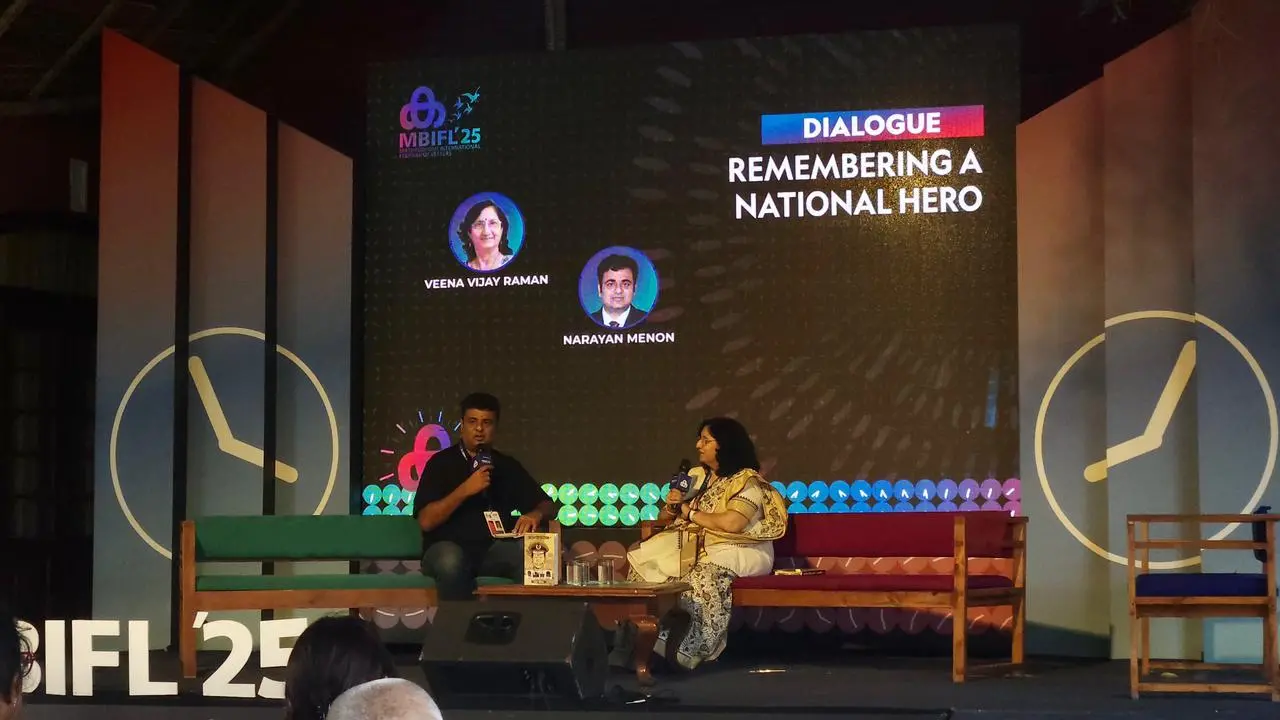
Thiruvananthapuram: The legacy of the valiant IPS officer Vijay Raman was commemorated at the sixth edition of the Mathrubhumi International Festival of Letters, where his widow, Veena Vijay Raman, reflected on his extraordinary career and personal journey. The session, moderated by Narayan Menon, was titled "From Kerala to Kashmir," tracing Raman’s life from his early years to his high-stakes encounters as a police officer.
A 1975-batch IPS officer of the Madhya Pradesh cadre, Vijay Raman was best known for leading the grueling 14-hour-long encounter in which athlete-turned-dacoit Paan Singh Tomar was killed on October 1, 1981. His tenure as Special Branch SP in 1984 is remembered for his critical role in rescuing and assisting victims of the Bhopal Gas Tragedy. From 1985 to 1995, he served as Assistant Director and Deputy Director of the Special Protection Group (SPG), overseeing the security of four Prime Ministers -- Rajiv Gandhi, V.P. Singh, Chandra Shekhar, and P.V. Narasimha Rao. He was also instrumental in securing the surrender of notorious dacoits Phoolan Devi and Malkhan Singh.
In 2003, Raman led a 10-hour encounter in Srinagar that resulted in the elimination of Ghazi Baba, the mastermind behind the 2001 Parliament attack. His final posting was as Additional Director General of Police (ADGP) in the Central Reserve Police Force (CRPF), where he spearheaded anti-Naxal operations.
During the session, Veena Raman shared personal anecdotes, revealing the ethos that shaped her husband’s fearless approach to law enforcement. She recalled an incident from his childhood when a teacher once told him, "Medals should be earned," a lesson that stayed with him throughout his life and ultimately led to his gallantry medal from the President of India.
His journey as an IPS officer began in Chambal, then a stronghold of dacoits, where he faced his first major operation—leading the encounter against Paan Singh Tomar. Recalling the moment from his diary, she quoted him:
"See, now that the drama starts, just imagine the type of things a young police officer has to face. It’s all very easy to say—no third degree, no this, no that. I am a young officer, fresh out of the academy, with just one year of service, facing a ridiculous group of subordinates who want to kill. And I am still carrying the commitment to uphold the law, protect human rights, and behave as the Constitution expects me to. Was it possible? Before my eyes, some of them were clearly getting ready for violence. Fortunately, there were some senior constables, some inspectors classified, and they protested."
Veena also shared a lighter moment from his early days in Chambal, where villagers doubted his ability to take on dacoits because he was young and lacked a mustache—a symbol of masculinity and authority in the region. However, one local defended him, saying, "He must have something in him—he once beat up lawyers in college over an issue. That shows bravery!"
His reputation for fairness and integrity was further cemented when dacoit Malkhan Singh and his gang insisted on surrendering only under his leadership, pleading for him to stay in Chambal until their surrender was complete.
Beyond his daring encounters, Raman was known for his deep respect for his subordinates. Veena recounted a poignant moment from one operation:
"Vijay asked his subordinate to step on his shoulder to get a better view and take aim. Later, when that subordinate was promoted and visited him, he arrived in full uniform, proudly displaying the Indian emblem and Ashok Chakra on his shoulders. The bond they shared in battle was something beyond words."
His toughest moment, however, came when one of his informers was brutally killed, with the dacoits leaving a chilling note on the body: "This is my present for you."
Vijay Raman played a key role in fortifying India’s border defenses against infiltrations in Kashmir. His most dangerous mission involved tracking and eliminating Ghazi Baba, the mastermind of the 2001 Parliament attack. He also had a narrow escape in a terrorist attack.
Despite his successes, Raman believed his fight against Naxals did not yield the results he had hoped for. Veena encouraged the youth to read his memoir, 'Did I Really Do All This? Memoirs of a Gentleman Cop Who Dared to be Different', emphasizing that true learning comes not just from victories but from failures as well.
Life as the wife of a fearless officer was not without its challenges. Veena recounted an incident when a death threat was issued against their only child. While she was overwhelmed with fear, Vijay simply tore up the letter, believing that fear should never dictate their lives.
The session concluded with one of Vijay Raman’s most powerful quotes, encapsulating his life’s philosophy:
"Winning without a challenge is victory, but winning with a challenge is history."