MBIFL 2025 on communism, political islam, and more
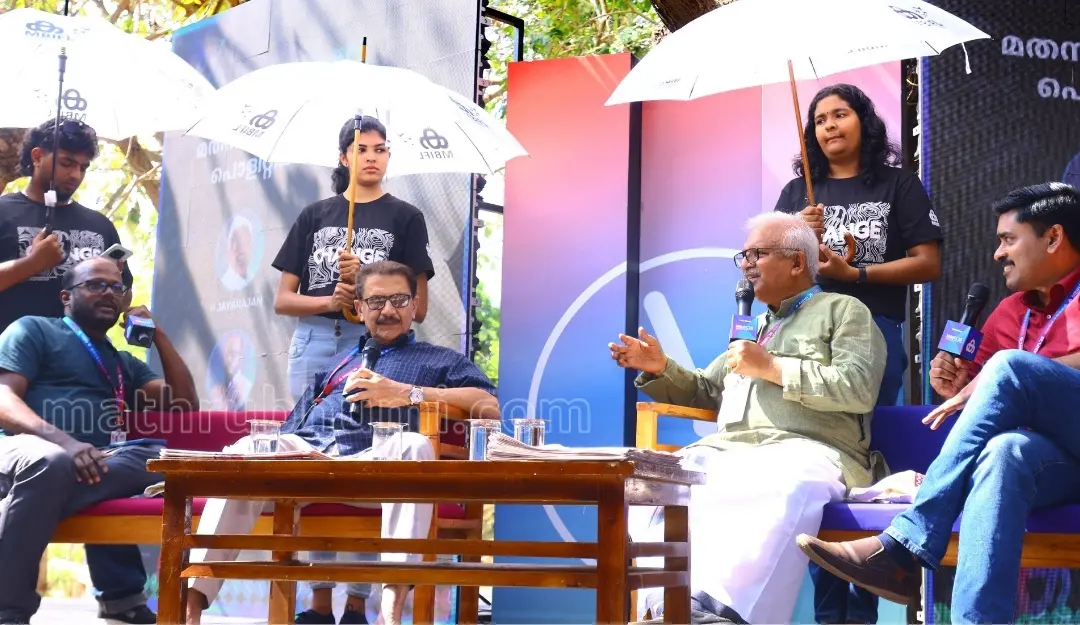
Can we exist without politics? Day 2 of the Mathrubhumi International Festival of Letters (MBIFL’25) was charged with intense political discussions, spanning from Kerala to Kabul and from Communism to Political Islam.
One of the key sessions, ‘Political Islam in Secular India’, revolved around the book ‘Keralam, Muslim Rashtreeyam, Rashtreeya Islam’ by CPM leader P Jayarajan. The debate centred on the term ‘Political Islam,’ with Jayarajan asserting that he approached the topic from a communist perspective. He argued that the extremist stance taken by Jamaat-e-Islami is completely against democracy.
However, C Dawood, Jamaat-e-Islami leader and Managing Editor of MediaOne TV, countered this claim. He accused the CPM of opposing Jamaat-e-Islami only after the latter withdrew electoral support for the party in 2019. “When we supported the Left, we were not considered untouchable. Now, the stance has changed,” he remarked. He also objected to categorising Islam into different forms such as Sufi Islam, Political Islam, and Cultural Islam, arguing that Islam is rooted in humanity and cannot be fragmented in this way.
Jayarajan and fellow panellist Hameed Chennamangaloor, acclaimed writer and political critic, rejected these assertions. Chennamangaloor pointed out that Jamaat-e-Islami’s founder, Maududi, once claimed that democracy, secularism, and nationalism were against Islam. “Now, they say those views no longer apply. This is not an Islamic organisation but an Islamist one,” he asserted.
The discussion then turned to whether the CPM’s opposition to Jamaat-e-Islami was politically motivated. Moderator Abhilash Mohan questioned if the CPM found the organisation acceptable when it served their interests but rejected it when it did not. Jayarajan dismissed this claim of political convenience, insisting that the CPM has always opposed religious extremism – whether from minorities or majorities – though their approach may differ.
“Our stance is shaped by societal changes, not political alliances. Yes, Jamaat-e-Islami supported us in the past, and we did not reject it. But we cannot endorse their religion-nation ideology,” he stated. However, when the discussion shifted to political violence, Jayarajan deflected, instead highlighting the Sangh Parivar’s targeting of Muslims.
While political leaders used ideological arguments to defend their positions, another session focused on the relevance of Communism today. CPM politburo member M A Baby, CPI state secretary Binoy Viswam, and thinker B Rajeevan, moderated by M G Radhakrishnan, debated the future of communist movements.
Baby maintained that communism remains central to the fight for labourers’ and farmers’ rights. However, he reignited a long-standing dispute between the CPM and CPI over the split of the undivided Communist Party and its foundation day. Binoy Viswam responded that internal disagreements should not weaken the movement, as it would only benefit political opponents.
Despite past shortcomings, the panellists agreed that communism and Marxism remain vital in addressing social issues. They acknowledged the need for these ideologies to evolve in a creative and scientific manner.
Hey, will they be AI-driven? That remains to be seen, as ideologues are still tasting the tech-political concoction to reach a conclusion!