MBIFL 2025: Admiral Harikumar navigates through 'India and her seas'
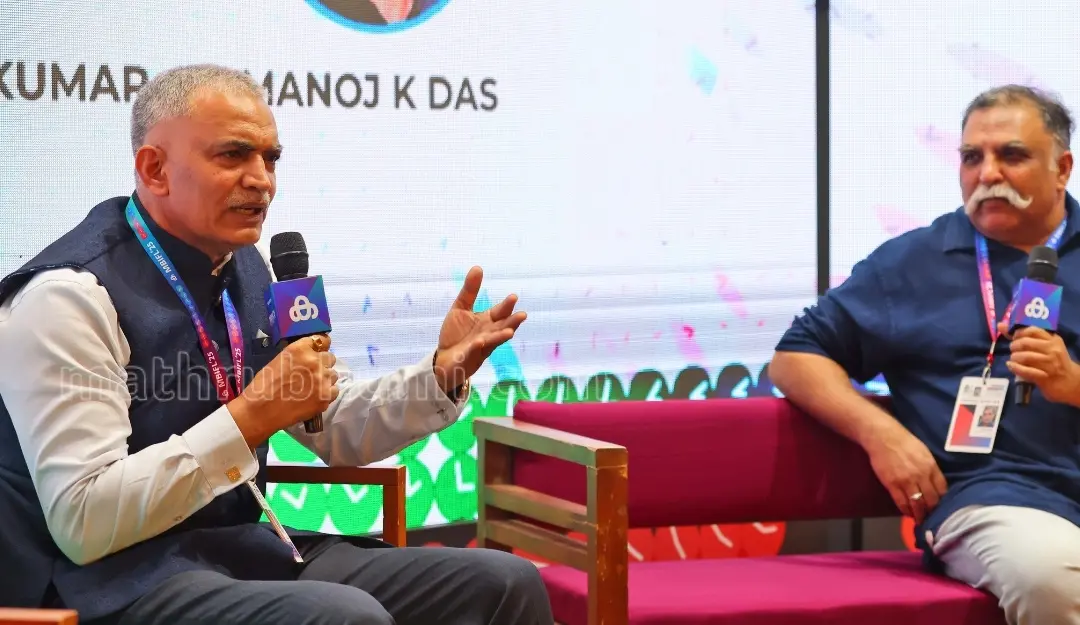
The third day of the Mathrubhumi International Festival of Letters (MBIFL) 2025 saw a riveting conversation between former Chief of the Naval Staff (CNS), Admiral R Harikumar, and Mathrubhumi Editor-Daily and Digital, Manoj K Das. The session, titled 'India and Her Seas', navigated through the depths of maritime strategy, naval dominance, and India’s evolving role in securing global trade. With a wealth of experience under his belt, Admiral Harikumar delivered a masterclass in maritime geopolitics, security, and economic imperatives.
The oceans: An unseen powerhouse
Opening the discussion, Admiral Harikumar underscored the sheer magnitude of the oceans’ impact on global affairs, introducing an eye-opening principle: "There is something called the 66-70-80-90 rule. What does that mean? It tells us that 66% of global wealth is generated from maritime regions, 70% of the planet is blanketed by water, 80% of the population resides in coastal areas, and a staggering 90% of the world’s trade is conducted via the sea. And if that wasn’t enough, 99% of the world’s internet traffic is coursing beneath the ocean through undersea cables.”
With trade arteries running through the seas, even a minor disruption can trigger a domino effect of economic instability. He cited the infamous Suez Canal blockage:
“A single vessel getting wedged in the canal brought global trade to its knees, causing billions in losses. If ships have to reroute around Africa, it adds nearly 12 days to their journey—driving up fuel costs, insurance, and, ultimately, consumer prices.”
The admiral also shed light on the biggest maritime security challenge -- piracy. The hijacking of vessels in the waters off Somalia can send shockwaves through global insurance markets, spiking premiums and escalating shipping costs, he said.
Forging a mighty Navy
When quizzed about India’s naval prowess compared to global superpowers -- particularly China -- Admiral Harikumar responded with measured confidence. "Since independence, we have charted a course towards becoming a ‘builder’s navy’ rather than a ‘buyer’s navy.’ We started small, but today we are crafting state-of-the-art warships, aircraft carriers, and destroyers. At present, we command a fleet of 130+ vessels, projected to expand to 170 within the next decade, with 60 more already in the pipeline.”
India’s commitment to self-sufficiency is unwavering, Admiral Harikumar said, adding, "By 2047, the Indian Navy will be entirely indigenous—designed, built, and engineered within our shores, and, where possible, exported to the world.”
Women in the Navy: Shattering the glass ceiling
One of the most compelling discussions revolved around the induction of women into the Indian Navy. Admiral Harikumar recalled an anecdote from his youth that deeply shaped his views on gender parity. He said, "I remember seeing a woman in a field, pulling a plough while the man stood on it. That moment stuck with me -- it made me realise there is absolutely no reason why women should be held back from taking on challenges."
Historically, women were excluded from serving on warships, citing logistical and privacy concerns. But change is underway.
"We took a bold decision and gave ourselves five years to reconfigure our ships to accommodate female officers. Today, we have our first female commanding officer of a naval vessel. Who knows? In 30 years, we might well see a woman leading the Indian Navy as its Chief of Naval Staff,” he said.
China’s expanding footprint in the Indian Ocean
Addressing China’s growing maritime influence, Admiral Harikumar didn’t mince his words. Admiral Harikumar said, "China has a presence in over 70 strategic ports across the Indo-Pacific. But let’s be clear -- size alone does not equate to superiority. Our naval expansion is not dictated by adversaries; it is dictated by our national interests. Our mission is to protect, preserve, promote, and pursue our maritime sovereignty."
While keeping a vigilant eye on China’s movements, India remains steadfast in upholding open and secure maritime trade routes.
"The Indian Navy plays a crucial role in ensuring that the seas remain free, open, and inclusive. Our maritime policy aligns with SAGAR -- Security and Growth for All in the Region.”
The battle against piracy
On the issue of piracy, Admiral Harikumar took pride in India’s proactive stance. He said, "India is among the few nations with an anti-piracy act, passed in 2002. While many navies hesitate to intervene, we act decisively. The Indian Navy is resolute in keeping our waters safe and piracy-free."
Drawing from his tenure in Somalia, he highlighted how economic desperation fuels piracy. He recalled how Somalia once had a thriving fishing industry, but foreign fleets overexploited their waters, leaving the locals with no means to survive. Some turned to piracy out of sheer necessity. While military action is essential, we must also address the socio-economic triggers behind such crises.
The future of India’s Naval might
With an eye on the future, Admiral Harikumar outlined India’s commitment to cutting-edge defence technology. "We are investing in next-generation unmanned systems, artificial intelligence-driven maritime defence, and cyber warfare capabilities. The future of naval power extends beyond steel and firepower -- it lies in intelligence, electronic warfare, and rapid adaptability," he said.
A life at sea: The Admiral’s reflections
In closing, the Admiral reflected on his personal journey -- a testament to dedication and perseverance. He said, "It's by accident that I joined the Navy. And when I joined the Navy, I never envisioned myself as the Chief of Naval Staff. But that’s the beauty of the armed forces -- it demands much, but it gives you even more in return. It instils leadership, discipline, and a sense of purpose unlike any other profession."