Morocco has to wait longer for their bittersweet revenge against France
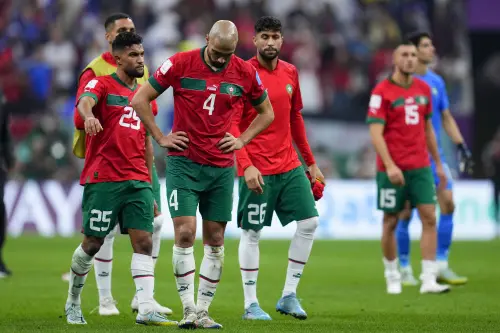
Even though they failed to beat France in their World Cup semifinal on Thursday, it was still a night for success for every Moroccan fan in the stands and millions watching at home. However, many feared the match could witness unrest and hostility, with both nations sharing a troubled history.
Under French rule, Moroccans were denied permission to attend large political gatherings. The beautiful irony is that at Al Bayt Stadium on Thursday, they enjoyed the ultimate freedom while seated beside the French fans, devoid of rules that kept them from events like this a century ago.
For many in the former protectorate, the match against the defending champion was an ample opportunity to show that Morocco was a formidable foe and managed to deliver that on Thursday.
Morocco was under French rule from 1912-56, giving the match political and emotional resonance for both nations. It dredges up everything complex about the relationship in which France still wields considerable economic, political and cultural influence.
For the former protectorate, the match against the defending champion is an opportunity to show that Morocco is a formidable foe — on the soccer pitch at least — even though immigration between the two countries has blurred the lines for many in France and Morocco about who to support Wednesday in Qatar. It is estimated that around 780,000 people of Moroccan origin are residing in France. However, over the past decade, Morocco’s relationship with France has changed.
French entered the political landscape of Africa before they penned a treaty with Morocco’s Sultan Abdul Hafiz in 1912, leading to the African nation becoming a protectorate. The following decade saw French grow its influence in the region. For instance, around 37,000–45,000 Moroccans fought for France.
In the 1950s, France used brutal force to suppress an anti-colonial protest and banned the Moroccan Communist and Istiqlal parties and exiled Sultan Mohamed V to Madagascar. However, the French lost their appeal and leading to the return of the Sultan.
The subsequent years saw the anti-French sentiments earning massive populist support among the masses, leading to the eventual dissolution of the protectorate on 2 March 1956. However, it took years before their presence and policies were replaced with a stable modern governmental structure under a constitutional monarchy.
Morocco has exceeded all expectations in Qatar by beating second-ranked Belgium in the group stage and then eliminating European powerhouses Spain and Portugal in the knockout phase to reach the semifinals.
The team’s success marks the first time an Arab country — and an African country too — has made it to the World Cup semifinals.