Luka Modric: Farewell to Croatian magician
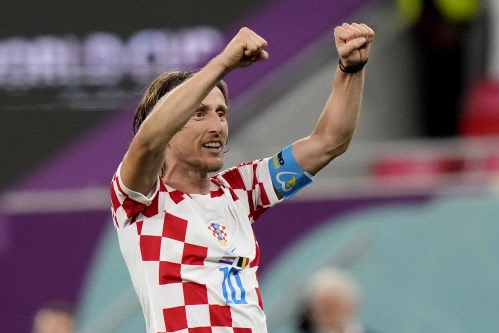
Luka Modric always retraces his steps, and with each stride, he recoils with his path. For him, winning the Ballon d'Or, Champions League or La Liga titles were only minor hurdles he faced in life. His ultimate goal was winning the World Cup, and he did everything to bring that achievement home. However, Lionel Messi and Argentina were too good for the Croatians at Lusail Stadium on Wednesday.
When he walked out of the pitch in the 80th minute, replaced by Lovro Majer, the Croatian fans in the stand applauded him, despite their team losing 3-0. That sums up Luka Modric.
Despite the loss, Modric is leaving a legacy behind, which none of his predecessors managed to achieve. Taking Croatia to the 2018 World Cup final and into the semifinals in the 2022 World Cup will perhaps be his greatest achievement of all.
At 37, it seems highly unlikely that Modric will play in the next world cup. However, Modric always surprised everyone, and his rise to stardom at Real Madrid is nothing short of a wonder. His path to the top was hard, and his story of rags to riches is a well-known story in Croatia.
His biggest challenge was surviving a war-torn nation as a six-year-old child in 1991 and overcoming the death of his beloved granddad at the hands of militant Serbian thugs. The thugs burned their house to the ground, and the family fled to the coastal town kilometres away.
Modric was born on 9 September 1985 in Modrici, SR Croatia, then a republic within SFR Yugoslavia. He fled with his family to a refugee hotel in Zadar. Here, amidst the Croatian War of Independence in 1991, little Luke grew up as a refugee, living in a hotel for seven years without electricity or running water and spending sleepless nights witnessing grenades and shells shattering lives.
Modric and his sister grew up beside landmines, with the future Ballon d'Or winner kicking a small, deflated football around the hotel car park, dreaming of a life free of war. He later recalled in an interview saying his first shin pads had the Brazilian Ronaldo, a player he adored since childhood, beside Zvonimir Boban and Francesco Totti. But little did he know he would one day reach the height of Brazilian greatness and become the shining star for Croatia. In the following years, young Luka started to raise eyebrows in a footballing community in the area, and supported by his family, he participated in representative camps and trained in NK Zadar, a Croatian football club.
Following his success in NK Zadar, a 16-year-old Modric joined Dinamo Zagreb in 2001 and later signed with Tottenham Hotspur in 2008. During his time in Zagreb, he signed his first professional contract, enabling him to buy a flat for his family. Modric grew to his full stature at Spurs, and the subsequent years saw many suitors battling to sign the most promising young midfielder in the World.
After a successful stint with Spurs, he finally joined Real Madrid in 2012. Despite early struggles, Modric managed to settle in Real Madrid. Playing under Mourinho, Ancelloti, Benitez and eventually under Zidane, Modric became an omnipresent figure in the midfield, often shifting his game from the deep-lying playmaker to the coveted No 10 role.
Meanwhile, Modric's stature as Croatia's hope for its national team didn't start well, with the team underperforming in the 2014 World Cup campaign and getting eliminated in the group stages. However, by the time Croatia qualified for the 2018 World Cup, Modric had evolved into one of the most elite footballers on the planet, with three back-to-back UEFA Champions League titles with Real Madrid.
In Russia, they were placed beside Argentina, Nigeria, and Iceland in Group D. Despite predictions favouring their opponents, Croatia defeated Nigeria in the first match and thrashed Argentina 3-0 to catch everybody's attention and qualify as group leaders.
Modric also scored a trademark goal with a long-range strike in the match.
They overcame the Round of 16 and Quarterfinals before beating England in the semifinals but could not get past mighty France in the finals. At 33, he showed that World Cup is not a distant dream for veterans. Four years later, he still plays for Real Madrid and guides his team to a semifinal against a team comprising Lionel Messi, a player he had faced numerous times.