Who is Carlo Acutis, 'God's influencer' and Catholic Church's first millennial saint?
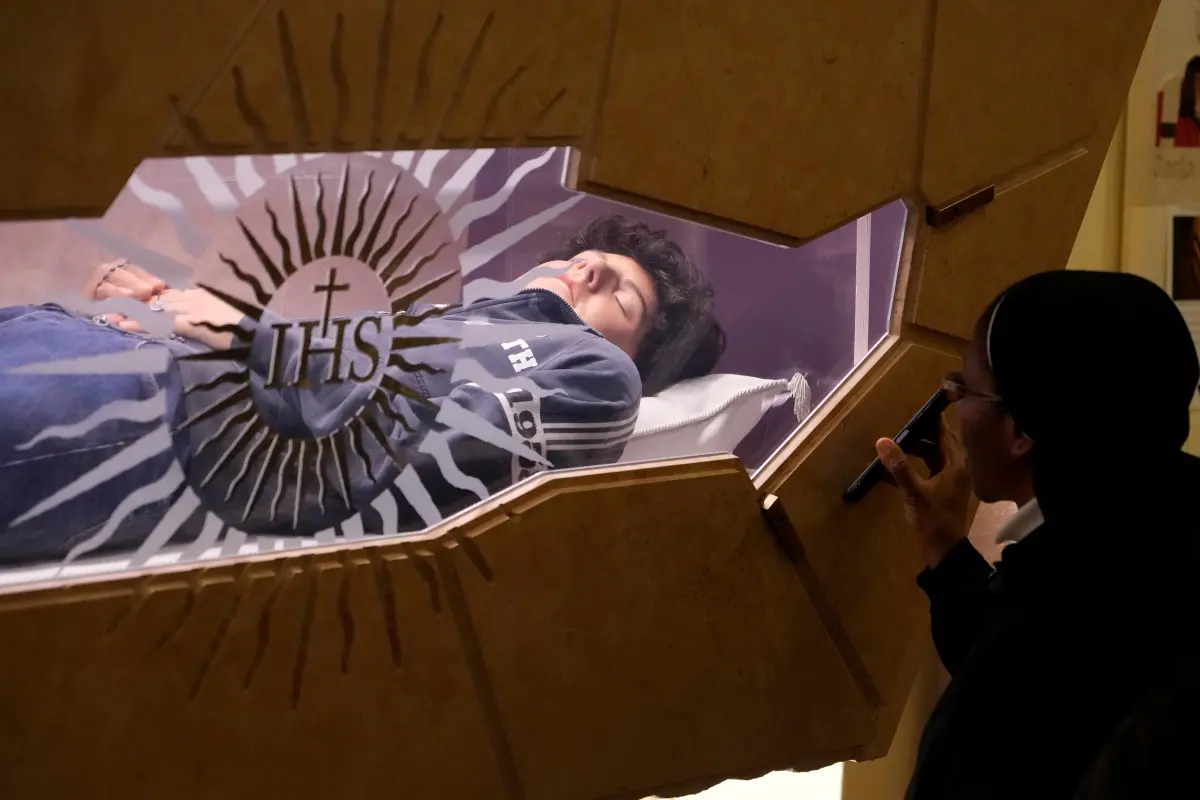
Carlo Acutis, a London-born teenager, is set to make history as the Catholic Church’s first millennial saint. Dubbed ‘God’s Influencer’ for his creative use of technology to spread Catholic teaching, he will be declared a saint by Pope Leo XIV on Sunday, 7 September, in St Peter’s Square at the Vatican.
Early life in London and Italy
Born in 1991, Carlo was baptised as a baby at Our Lady of Dolours Church in Chelsea, London, while his family was briefly based there for work in finance. Although his family did not use the church regularly, his baptism was remembered as a significant moment in the parish’s history.
Before reaching six months of age, his family relocated to Italy. Carlo grew up in Milan, where he developed a remarkable love for both technology and his Catholic faith. While his parents were not especially religious, Carlo would attend daily Mass and pray the rosary. He was also known for his kindness, often speaking with beggars and providing them with food and blankets.
His passion for technology and faith
Carlo did not always appear overtly devout to those around him, but he had a deep sense of commitment to his beliefs. He combined his passion for computers and the internet with his love of the Eucharist, building websites for Catholic groups and even creating a detailed catalogue of miracles.
Teachers recalled him as joyful, curious, and a little mischievous. He would sometimes forget homework or arrive late, but when something caught his interest, he had a ‘healthy curiosity’ and a strong determination to ‘get to the bottom of things’.
A teenager with modern interests
Despite his deep spirituality, Carlo was also very much a typical teenager. He enjoyed playing video games such as Super Mario and using his PlayStation.
But he showed discipline, limiting his gaming to just one hour a week, proving that technology could be enjoyed without being overwhelming. His casual style with jeans, trainers, and a tracksuit top, makes him particularly relatable to today’s young Catholics.
His death and the start of a movement
Carlo’s life was tragically cut short when he died of leukaemia in 2006, at only 15 years old. Yet, from the day of his funeral, people began praying to him for healing, and stories of answered prayers spread quickly. His mother, Antonia Salzano, later campaigned tirelessly for his sainthood, as the Church requires verified miracles for canonisation.
The recognised miracles
Pope Francis attributed two miracles to Carlo. The first involved the recovery of a boy in Brazil suffering from a rare congenital pancreatic disease, and the second was the healing of a student in Florence with bleeding on the brain, whose mother prayed at Carlo's tomb. These events cleared the path for his canonisation, which the Vatican described as vital for inspiring younger generations.
The Vatican fast-tracked Carlo's canonization, seeing it as a crucial step to energize and inspire faith in young people. The Church hopes that his example, showing that holiness can manifest in contemporary ways through everyday life, friendship, study, and even illness, will resonate with the youth who are increasingly becoming "major protagonists" in the Church's evangelical mission.
His relics and global devotion
Carlo’s body, preserved with a wax covering and dressed in his familiar blue tracksuit, jeans, and trainers, is displayed in Santa Maria Maggiore Church in Assisi, where millions of pilgrims have already visited.
Other relics include:
- A strand of his hair at Our Lady of Dolours Church in London.
- Fragments of his clothing and splinters from his bed in Rome.
- His heart, kept in a gold casket at San Rufino Cathedral.
- Parts of his pericardium, which have toured internationally.
His mother has defended the veneration of these relics, saying they are reminders that “each one of us is called upon to become holy” and proof that sainthood is possible for everyone.
Carlo’s legacy continues to grow. Catholic schools worldwide, from Africa to Australia and the United States, are being renamed after him, switching from Blessed Carlo Acutis to St Carlo Acutis. Parish plays, animated films such as “Carlo Acutis, God’s Influencer” (released on 7 September), and even Vatican-issued stamps celebrate his life.
While some critics argue that making him a “supermodel” of sainthood could be problematic, the Church sees him as a modern role model, someone who lived holiness through everyday activities, studies, friendships, and even suffering.
(With agency inputs)