How does US count 100 million paper ballots within hours while India's MLC vote counting takes days?
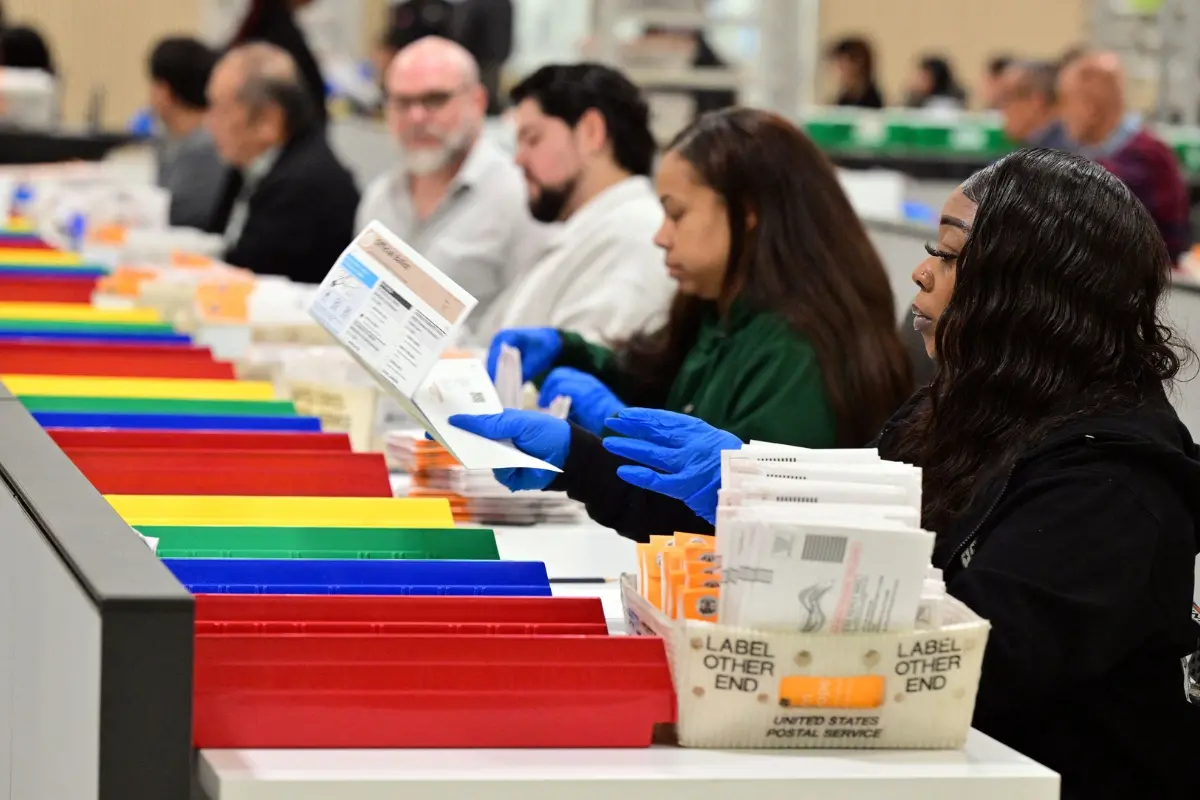
More than 100 million paper ballots, thousands of counting locations and election results emerging within hours of polling ending.
The speed of the US election-counting process contrasts with India, where counting in certain paper-ballot-based elections can take much longer.
The November 3 US midterm elections have once again drawn attention to how the country processes so many votes without relying on Electronic Voting Machines (EVMs) to directly record most voters' choices.
Americans voted for representatives for all 435 House seats, 35 Senate seats, and governors in 36 states.
According to the University of Florida Election Lab, more than 57 million people had already voted before Election Day. The Associated Press (AP) estimated that well over 100 million ballots had been cast.
Results began emerging from different parts of the country within hours of polling ending.
This has raised questions about what makes the American system so much faster at producing preliminary results, especially compared with India's recent Bihar Legislative Council (MLC) elections. In one Bihar constituency, counting just 69,141 votes reportedly took 57 hours.
The difference, however, is not simply about paper ballots versus EVMs. America's counting infrastructure combines electronic scanning technology, advance preparation, decentralised administration and simultaneous processing across thousands of jurisdictions. Here is a closer look at how the system works.
How electronic scanners and advance preparation speed up US vote counting
Unlike Indian voters, who generally press a button on an EVM during Lok Sabha and Assembly elections, Americans typically mark their preferences on paper ballots. They circle or box the candidate they wish to elect.
But the process does not end with election officials manually examining each ballot.
Most jurisdictions use optical scanners or electronic tabulators to read the marked papers and record votes.
Depending on the local system, voters may feed their ballots into scanners at polling stations, or election workers may transport batches of ballots to central counting facilities.
The technology has evolved considerably over the years. According to the MIT Election Lab, approximately 80% of US jurisdictions use batch-fed optical scanners to process mail ballots.
These machines can handle hundreds of ballots per minute, processing large quantities of paper votes without individual manual counting.
Some scanners operate at polling locations, while larger central-count machines process stacks of ballots brought in from different locations.
The machines interpret voters' markings, tabulate selections and generate electronic records of the totals.
Not every ballot necessarily passes through the machines without human intervention. Papers that are damaged, difficult to read or contain unclear markings may require additional examination.
This is one reason the final counting and verification process can continue after election night.
Importantly, the paper ballots are retained. They provide a physical record that election officials can examine during recounts, audits or disputes.
Another significant advantage is that American election authorities do not necessarily have to begin processing every ballot after polling concludes.
Early voting and postal voting are widely used across the country, allowing millions of people to vote before Election Day.
According to the National Conference of State Legislatures (NCSL), 44 states, Washington DC, Puerto Rico and the US Virgin Islands allow election officials to begin processing absentee and postal ballots before polling day.
Such preparation can involve checking voter information, verifying signatures, opening envelopes, sorting ballots and preparing them for scanning. In 33 states, Washington DC and Puerto Rico, officials can also scan processed postal ballots before Election Day in at least some circumstances.
However, officials cannot access or announce results before polls close.
This distinction is crucial. Election officials can complete several administrative and technical tasks beforehand, leaving less work to be handled after the final vote is cast.
Why results emerge within hours, but official counting takes longer
The American election system does not rely on one central authority to collect and count every ballot across the country. Instead, election administration is spread across thousands of local jurisdictions, including counties, cities and towns.
According to the AP, more than 10,000 local election jurisdictions administer elections across the US. Their counting teams work simultaneously, processing ballots and transmitting figures to the relevant authorities.
This decentralised arrangement means that one region does not have to wait for another to finish counting before reporting its results.
The Associated Press also operates an extensive election-reporting network to gather and verify figures.
Its published explanation describes a team of about 5,000 people, including about 4,000 vote-count reporters who collect figures directly from election offices.
These are cross-checked against official websites and electronic data feeds before being published.
The agency also uses automated quality checks and election researchers to identify discrepancies and unusual changes in reported figures. Its system can process a massive volume of updates as results arrive from different jurisdictions.
However, another important reason Americans often know who has won a race before every ballot has been counted is that they can infer the result.
News organisations such as AP analyse the available vote totals, the number of outstanding ballots and the areas from which the remaining votes are expected.
If the lead is sufficiently large and the remaining ballots cannot mathematically overturn it, they may project a winner.
For instance, if a candidate leads by 1,00,000 votes and only 20,000 ballots remain, the trailing candidate cannot overcome that deficit even if every outstanding vote goes their way. Such projections are not official declarations by election authorities.
The US Election Assistance Commission (EAC) makes clear that election-night figures are preliminary.
After polling, officials must complete a process known as canvassing, which involves reconciling ballot numbers, checking results, examining provisional and other outstanding ballots and confirming that valid votes have been included.
Post-election audits may also verify the voting equipment's accuracy. Competent authorities then formally certify the final results.
The process can take several days or even weeks, particularly when elections are closely contested or recounts are required.
Therefore, the apparent speed of American elections should not be confused with the completion of the entire counting exercise. What emerges within hours is often a combination of preliminary official figures and projections by news organisations.
The key difference is that the US has built a system in which ballot preparation, electronic tabulation and result reporting happen across multiple locations at the same time.
Paper ballots remain central to the process, but manual counting is not the primary method for processing millions of votes.