Spain train collision: Death toll crosses 60, over 100 injured in high-speed crash
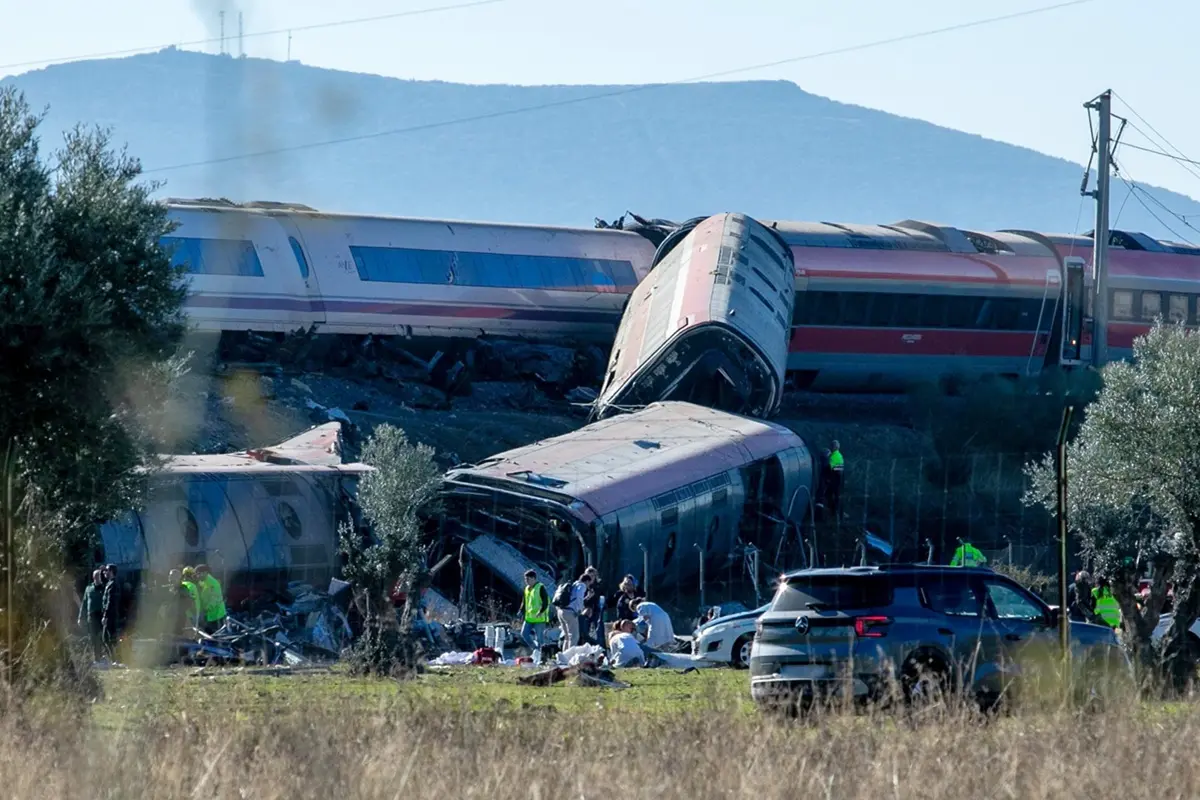
At least 64 people have been killed and over 100 injured after two high-speed passenger trains collided in central Spain on Wednesday morning. The disaster occurred in Toledo province within the Castilla-La Mancha region, along the main high-speed railway line connecting the capital city of Madrid to Seville in the south.
A train operated by state-owned rail company RENFE crashed into the back of a stationary service operated by private company IRYO. The violent impact knocked two carriages off the track and tore one car into metal fragments, scattering debris down a gravel embankment.
How the collision occurred
The two high-speed trains were travelling in the same direction from Madrid towards southwestern Spain. The IRYO service was carrying 147 passengers and five staff members, including the driver, while the RENFE service was carrying 397 passengers.
According to rail operator statements and eyewitnesses, the IRYO train had come to a halt on a straight, flat stretch of track surrounded by olive fields between the towns of Urda and Los Yébenes. The RENFE train ran directly into the rear of the stationary IRYO service.
Investigators noted that the crash took place under sunny, dry weather conditions. Official rail authorities stated that the exact cause of the crash remains unknown and is currently under investigation.
Passengers recount moments of terror
Survivors described chaotic and terrifying scenes inside the carriages during the crash. Ignacio Relaño, a passenger on the RENFE train, told state broadcaster TVE that his train had stopped briefly before moving forward again and hitting the IRYO service.
"We all felt the train abruptly slowing down and then the impact," Relaño recalled. "The car leaned to one side like it was about to tip over. I hit my nose, everything went flying, luggage, cell phones. Everything shook".
Another female passenger told Cadena Ser radio that she was thrown forward as the train slammed on its brakes, smashing the small table in front of her. She described seeing trapped passengers covered in blood and scattered body parts amidst the wreckage.
Local residents and workers rushed to assist the victims before emergency services arrived. Construction worker David Gómez told El País: "People were trying to get out through the windows ... We cut through some fences to access the area and treated people with the first-aid kits we had brought". He added soberingly: "As I was trying to pull a young woman out, there was a piece of a leg".
Manuel Ortiz, 49, a resident of nearby Urda who spent the morning ferrying survivors in his car, stated that passengers told him their train was completely still when hit. He described a "horrific, horrible" scene that "smelled of an accident, of metal".
Emergency response and growing casualties
Rescue workers worked frantically at the site as helicopters hovered overhead and funeral vans arrived to collect the dead. Castilla-La Mancha regional leader Emiliano Garcia-Page confirmed the heavy death toll.
"We are speaking of approximately 64 (dead), but this is probably going to grow even more," Garcia-Page told reporters at the scene.
Over 100 people received injuries in the collision, with 58 admitted to hospital and 15 remaining in critical condition. Spanish Health Minister Mónica García stated: "It was a high-speed impact, so we are expecting this to be a tragedy". She confirmed emergency crews focused their efforts on extracting survivors and bodies from the two most severely damaged carriages.
A military emergency brigade was deployed alongside firefighters, police, and medical personnel. Local officials prepared a sports pavilion in Urda to receive injured passengers, while uninjured survivors were moved away on buses. High-speed rail connections between Madrid, Ciudad Real, and Andalusia were suspended.
Official condolences and political fallout
Spanish Prime Minister Pedro Sánchez cancelled his schedule and travelled to the crash site. Writing on X, Sánchez stated he was "dismayed by the serious train accident in Toledo". He added: "Emergency services are working on site to attend to the affected passengers. All my thoughts are with the victims and their families".
Spain's King Felipe VI and Queen Letizia expressed deep sadness, stating: "We share in the grief of the families and loved ones of those who lost their lives, and we send our heartfelt support to the injured and all those affected". European Commission President Ursula von der Leyen also offered condolences, saying: "My heart goes out to the victims’ families and loved ones. Today, Europe mourns with you".
As a sign of respect, the Spanish football federation postponed 24 Copa del Rey matches. Politically, the disaster comes just one month before Prime Minister Sánchez faces an early general election on 29 November.
Safety questions surround privatised rail network
Spain boasts the world's second-largest high-speed rail network after China, covering approximately 3,900 kilometres of track. Until this year, the dedicated high-speed system had not recorded a fatal crash since opening in 1992.
However, Wednesday's tragedy marks the second fatal high-speed train collision in Spain this year on the Madrid-Seville route. In January, another crash outside Adamuz left 46 people dead when an IRYO train jumped the track and struck an oncoming RENFE train, sending carriages plunging down a four-metre slope. The country's worst overall rail tragedy occurred in 2013 near Santiago de Compostela, which claimed 80 lives.
The repeated accidents have raised questions regarding safety following the recent opening of the network to private competition. Private Italian-owned operator IRYO began services in 2022.
Joan Rodríguez, spokesperson for Spain's train workers' union, raised concerns over track maintenance amidst increased traffic.
"We are not convinced that the liberalization of the high-speed passenger rail service was matched by the necessary upkeep of the lines," Rodríguez told TVE. "I am not saying it was a determining factor (in the crashes), but yes, the increase in use of the network is a factor to keep in mind"