And All That Is In Between: Saudi art biennale aims to modernise Islamic tradition
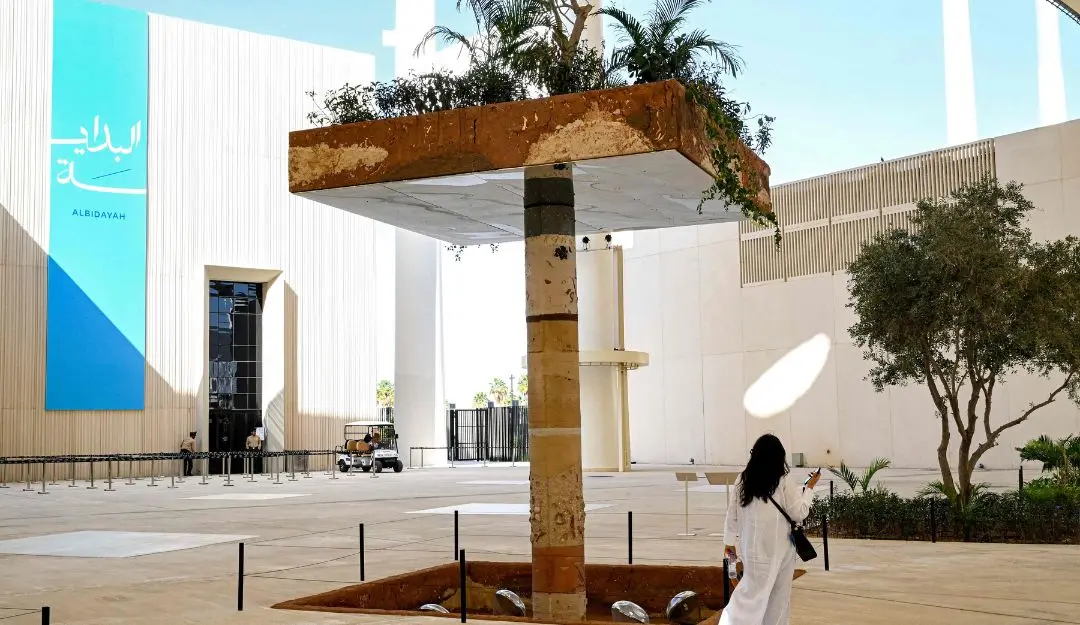
Jeddah, Saudi Arabia: The Islamic Arts Biennale in Jeddah is seeking to bridge the gap between traditional Islamic art and modern creativity, highlighting Saudi Arabia's ongoing transformation.
Set under a vast canopy of tents in Jeddah, the second edition of the Islamic Arts Biennale, titled "And All That Is In Between", showcases a range of exhibits that merge religious artefacts with contemporary art. One of the key highlights is the display of segments from the "kiswa", the black cloth embroidered with gold and silver that covers the Kaaba, the holiest site in Islam.
International collaborations, iconic artefacts
Hundreds of additional artworks are being exhibited at the King Abdulaziz International Airport. These include rare objects on loan from some of the world's most renowned museums, such as the Victoria & Albert Museum in London, the Louvre in Paris, and the Vatican Library. Among the valuable artefacts is a medieval Quran written in Hebrew script.
Muhannad Shono, a Saudi artist and curator of the exhibition, shared his perspective: “This bringing together of the contemporary and the past really emphasises the change that Saudi Arabia is going through."
Cultural shift in Saudi Arabia
Saudi Arabia, long dominated by Wahhabism, a strict interpretation of Islam, has traditionally prohibited the representation of human and animal figures in art. This led to the widespread use of geometric patterns in Islamic art. However, the biennale challenges this tradition by featuring medieval Persian illuminations and royal portraits. It also presents bold modern works, such as a fountain designed by Yemeni-Indonesian artist Anhar Salem. The fountain features mosaic tiles created by artificial intelligence using avatars sourced online.
Visitor Abdelelah Qutub, an architect from Mecca, commented, “We have traditional conceptions of Islam and its history, which I feel we should begin to re-examine from a new perspective.”
Innovative installations, vision for future
One of the most striking installations at the biennale is by Franco-Lebanese artist Tamara Kalo. She recreated the camera obscura, an ancient device invented in the 11th century by Muslim philosopher Ibn al-Haytham. Kalo explained that her work aimed to raise the question of “what it means to see and what it means to be a witness.”
The exhibition also encourages large-scale art. One such piece, created by Italian artist Arcangelo Sassolino, is a massive spinning disc covered in petrol. It symbolises time and constant evolution, reflecting Saudi Arabia's changing role on the global stage as the leading crude oil exporter. Sassolino said, “For me it represents time... it's something that keeps evolving while we're watching the piece.”
Saudi Arabia's vision 2030, cultural transformation
The Islamic Arts Biennale is part of Saudi Arabia's broader cultural shift under Crown Prince Mohammed bin Salman’s “Vision 2030”. The aim is to transform the kingdom's image, which has long been associated with repression and ultraconservatism.
James Dorsey, an expert from the National University of Singapore, noted that these efforts, including the biennale, are crucial in addressing what he called a “reputation deficit.” He explained that the kingdom is seeking to shift its image from a “secretive, ultraconservative kingdom” to a more open and internationally engaged nation.
Global platform for art, dialogue
Strategically located near the terminal for Muslim pilgrims heading to Mecca, the biennale draws a diverse audience. The first edition in 2023 attracted 600,000 visitors, and the event is expected to exceed one million visitors in 2025. Art historian Julian Raby highlighted how the biennale offers a unique international perspective on Saudi Arabia: “That internationalism is exactly the opposite of how many people consider Saudi Arabia. They look at Saudi Arabia and consider it as a cloistered country. The Islamic world has never been cloistered, it’s been in dialogue, dynamic.”
The biennale has also provided a valuable platform for regional artists. Jordanian artist Raya Kassisieh, whose monumental black steel sculpture of roses floats above a fountain, expressed pride in the opportunity: “We are able and at the level to converse and share space with the West."
Agency