Pakistan’s ‘Fizaon K Pasbaan’ Video: Cheap animation, wild claims and a propaganda backfire
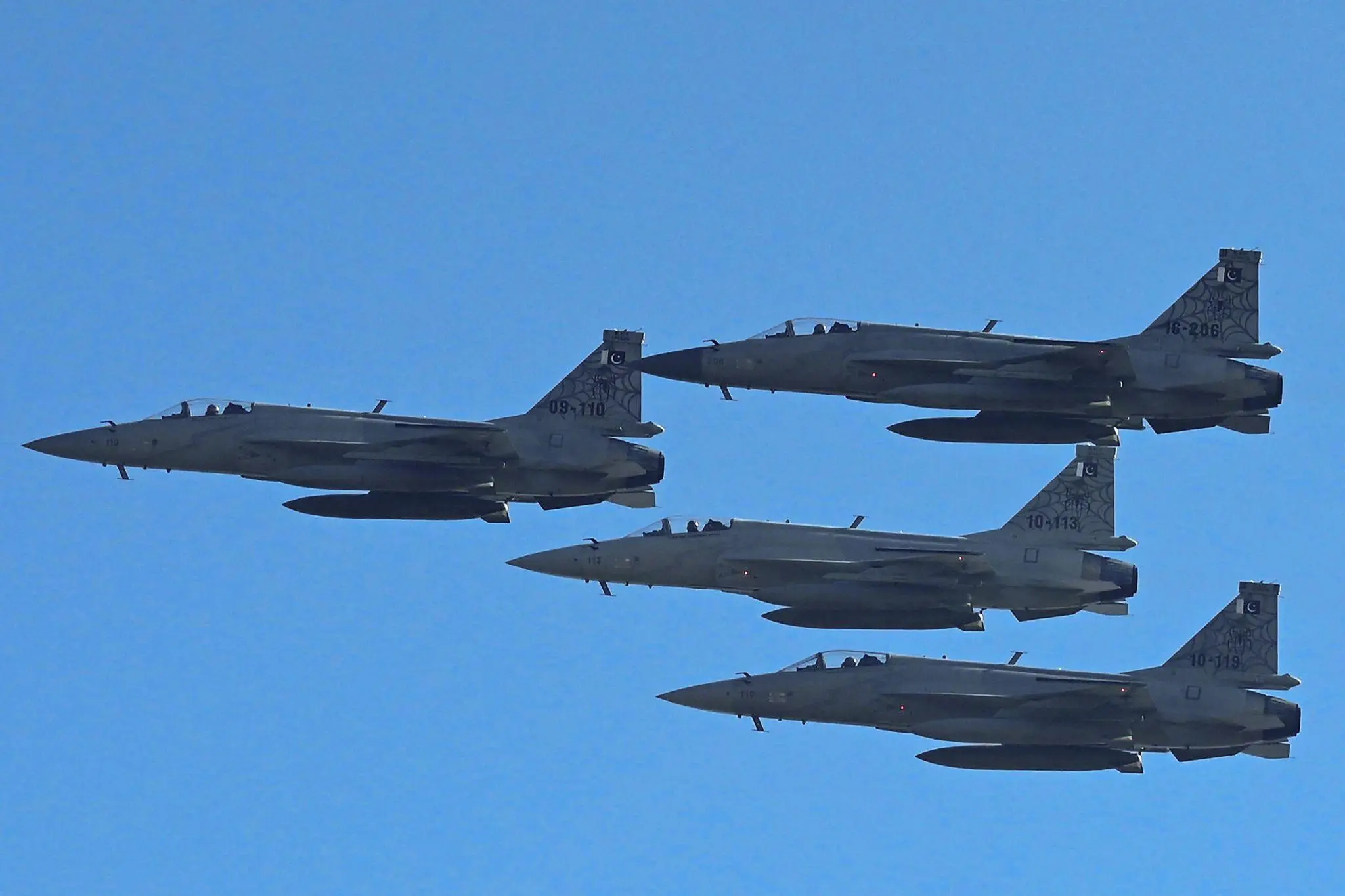
Pakistan’s latest attempt at psychological warfare looks less like a serious deterrence message and more like a low‑budget war‑gaming reel. Titled “Fizaon K Pasbaan” (Guardians of the Skies), the Pakistan Air Force’s new video marks Air Force Day with a flurry of cartoonish missile strikes, video‑game‑style explosions and grandiose text claims -- including an assertion that the PAF has hit 32 Indian Air Force bases in a hypothetical war.
The result has been a wave of ridicule from Indian defence analysts and social media users, who see it as proof that Islamabad’s propaganda machine is running on empty.
Rather than showcasing verifiable capability, the video leans heavily on crude animation and speculative scenarios. It mixes a few clips of real pilots and aircraft with computer‑generated sequences that show missiles and drones striking deep inside India -- from the Indian Parliament in New Delhi to the port of Kandla and even the flight deck of the INS Vikrant, India’s indigenous aircraft carrier.
The visuals are slick enough to pass as a YouTube fan edit, but they collapse under the slightest scrutiny. The most mocked element is the bold claim that 32 IAF bases were hit.
Defence observers on X quickly pointed out that this would mean striking more than half of the IAF’s 60‑plus air stations, yet the video offers not a shred of evidence -- no satellite imagery, no debris, no independent verification.
As one analysis noted, the entire narrative is built on animation, graphics and alleged strike locations, with no proof that any of the illustrated sites were actually damaged.
In an age where open‑source intelligence and satellite photos are routinely used to confirm or debunk military claims, Pakistan’s reliance on cartoon explosions looks increasingly desperate.
The sequences showing attacks on Parliament and Kandla, carried out in the video by Turkish‑made YIHA‑III suicide drones, and the JF‑17‑launched CM‑400AKG strike on INS Vikrant, play out like a cut‑scene from a strategy game.
Indian defence researchers have dismissed them as psychological messaging rather than operational assessment, designed to project technological prowess while sidestepping the hard question of evidence.
What makes the video even more embarrassing for Islamabad is the contrast with past Indian disclosures. When the IAF has showcased satellite imagery and video footage of strikes on Pakistani air bases, some of it was verified by Western media.
By comparison, the PAF has repeatedly failed to produce satellite imagery of its claimed strikes on IAF bases, leaving its assertions hanging in the realm of assertion and animation.
Pakistan may have intended “Fizaon K Pasbaan” as a morale booster at home and a deterrence signal to the region. Instead, it has become a meme factory in India and a case study in how not to do military propaganda.
The video’s cheap animation, overblown claims and complete absence of proof have turned what was meant to be a showcase of strength into a symbol of insecurity -- a reminder that in today’s information environment, flashy graphics cannot substitute for facts.