Mount Etna's latest eruption a mix of drama and data
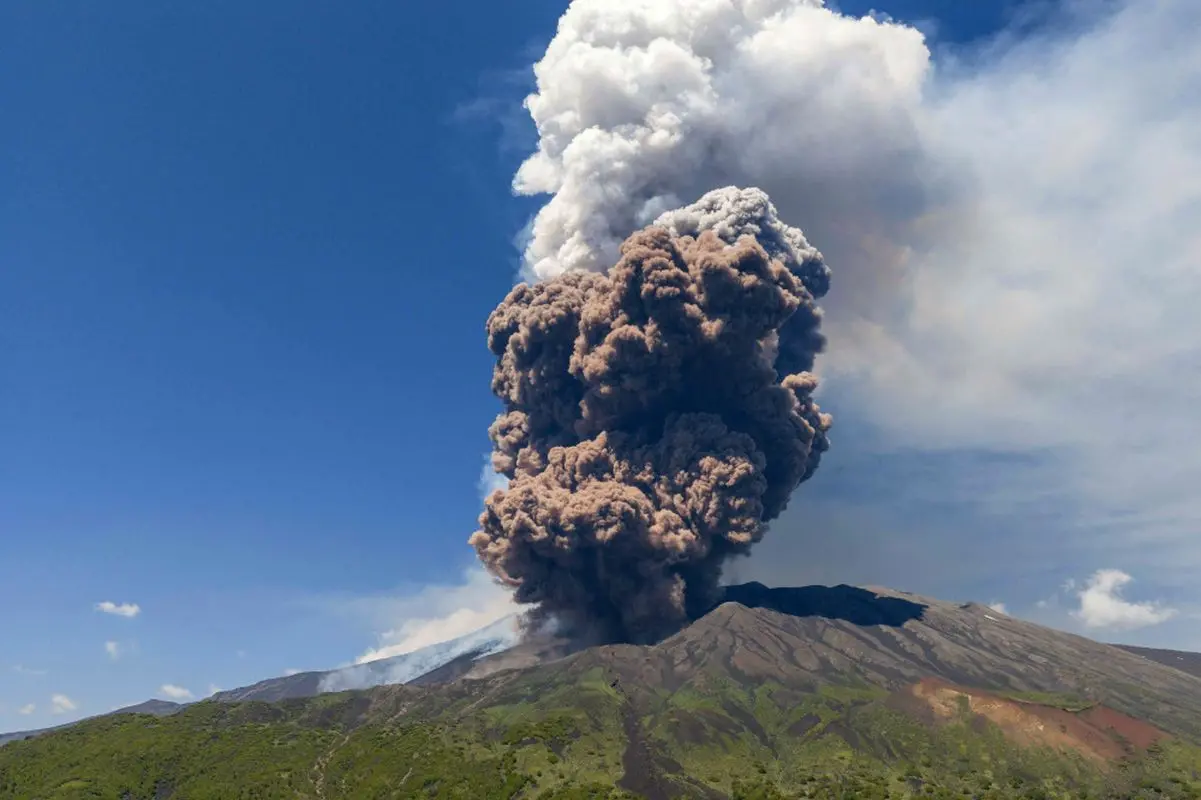
Mount Etna, Europe's most active and largest volcano, put on a captivating display on Monday, spewing smoke and ash high into the sky. While the visual spectacle was familiar, the defining event of this eruption was a more uncommon pyroclastic flow emanating from its southwestern crater.
The fast-moving mixture of rock fragments, gas, and ash was not visible from a distance but extended approximately 2 kilometers (more than a mile) into the Valle del Leone, or Lion Valley, which acted as a natural containment area.
Authorities quickly assured the public that there was no danger to the population and no injuries or evacuations were reported. However, a video shared on social media captured a group of tourists on the volcano's flanks scrambling away as the smoke billowed in the background.
A day of explosive activity
After a 19-day lull, Etna roared back to life with "lively explosive bursts of gas and ash," followed by mild lava flows on its eastern and southern slopes. The most significant activity began around 10:00 AM on Monday, marking the first major, violent eruption of the year. Lava fountains erupted, sending a column of ash and gas several kilometers into the air.
The event reached its climax around 11:23 AM, when the pyroclastic flow, triggered by magma mixing with snow, surged down the slopes. By late afternoon, scientists confirmed the volcanic activity had subsided.
Marco Viccaro, president of Italy's national volcanology association, noted that this was the 14th eruption episode since mid-March. He highlighted recent significant pyroclastic flows on February 10, 2022; October 23, 2021; December 13, 2020; and February 11, 2014.
Life in the vicinity of volcano
Towering approximately 3,350 meters (around 11,050 feet) above sea level and spanning 35 kilometers (22 miles) in diameter, Mount Etna is a constant presence in eastern Sicily. Its volcanic activity has historically altered its height.
While occasionally causing temporary closures of Catania's airport due to ash in the air, an aviation warning was issued during this latest event, but the airport remained operational.
Despite its fiery nature, life continues in the towns and villages on Etna's slopes, with its lava flows largely contained to uninhabited areas. The volcano is a source of fertile farmland and a major draw for tourism, attracting hikers and backpackers to its slopes and offering breathtaking views from the Ionian Sea.
Etna has a rich history of eruptions, even inspiring ancient Greek legends. A 396 BC eruption is famously credited with deterring the army of Carthage. One of its most devastating known eruptions occurred in 1669, burying parts of Catania and devastating dozens of villages. In 1928, an eruption severed a rail route circling the mountain's base.