Jihadi threat to India brewing in Bangladesh with government support?
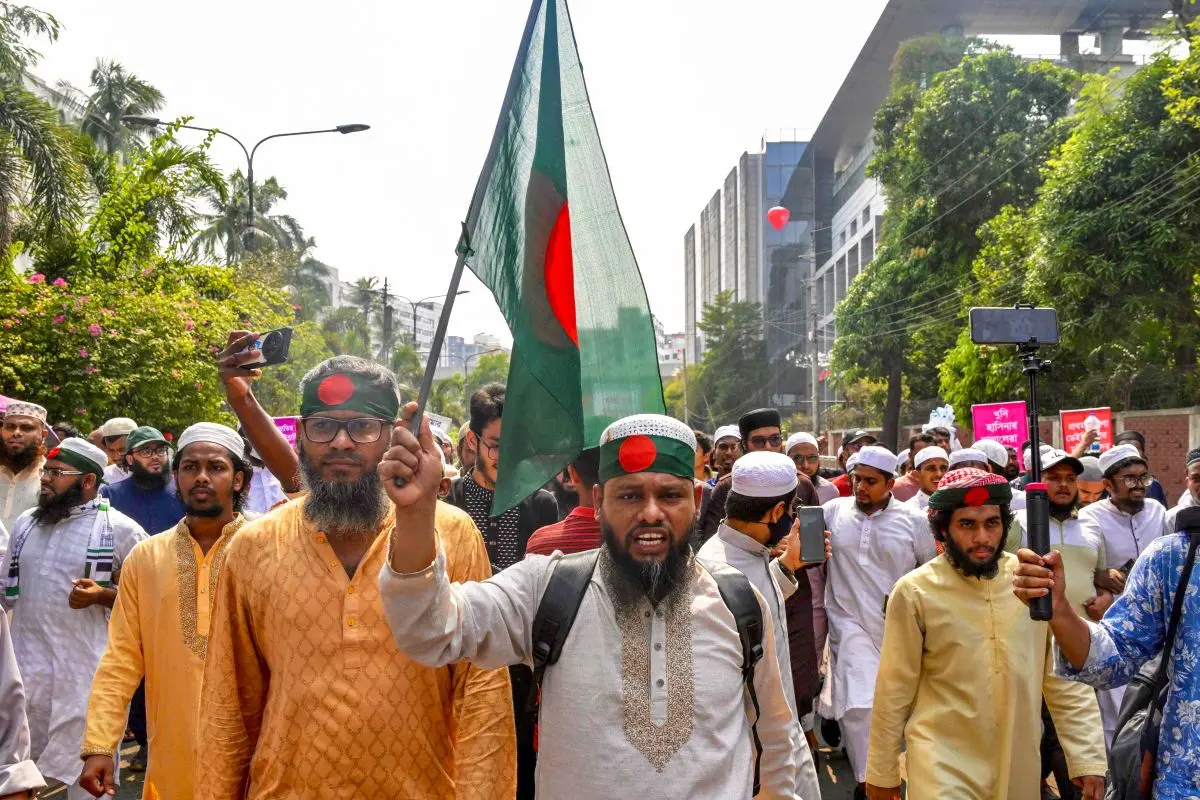
A political crisis is unfolding in Bangladesh as the interim government, led by Muhammad Yunus, intensifies its crackdown on former Prime Minister Sheikh Hasina's Awami League (AL). On Monday, the government issued a gazette notification, effectively banning all activities of the Awami League and its affiliate organizations.
The ban, enacted under the Anti-Terrorism Act, will remain in effect until the International Crimes Tribunal (ICT) completes its trial of the party and its leaders. The sweeping measures prohibit all forms of activity, including publications, media campaigns, online and social media presence, processions, meetings, gatherings, and conferences.
Sources cites by IANS suggested that these actions are part of a larger strategy by Yunus to appease Pakistan and exploit India's 'Operation Sindoor' to foster anti-India sentiment within Bangladesh, further straining relations between the two nations.
The ban follows a series of sit-in demonstrations organized by Hasnat Abdullah of the National Citizen Party (NCP), which pressured the interim government to take action against the Awami League. These demonstrations drew support from radical Islamic leaders, including Mufti Jashimuddin Rahmani of Ansarullah Bangla Team (ABT), also known as Ansar-al Islam Bangladesh or Ansar Bangla, and Mufti Harun Izhar, a key figure in Lashkar-e-Taiba's (LeT) Bangladesh module.
According to South Asia and Eurasia expert Baidya Bikash Basu, the reappearance of Mufti Jasim Uddin Rahmani, the head of the globally banned ABT and a long-time ally of Al-Qaeda, has raised significant concerns. Rahmani was recently seen leading an anti-Awami League rally in Dhaka's Shahbagh on May 11th, despite having been imprisoned for inciting murder.
Other radical groups, such as Hizb ut-Tahrir (HuT), are also openly advocating for the establishment of a caliphate and calling for action against India, while the Yunus regime has remained silent.
Critics argue that instead of addressing these radical elements, the interim government is using the Anti-Terrorism Act to suppress the country's largest secular force. The ban on Awami League activities has removed legal obstacles to arresting the party's leaders and activists, with police now authorized to detain anyone involved in rallies, processions, or clandestine meetings.
The legality of banning a party's activities without banning the party itself has been questioned by legal experts. The future of the Awami League's registration as a political party is also uncertain. There are also concerns about the interim government's stance on Jamaat-e-Islami's (JeI) alleged crimes against humanity in 1971, particularly if the law is amended to allow the Awami League to be tried as a party for similar offenses.
Following the ban, the Bangladesh Election Commission de-registered the Awami League, disqualifying the party from participating in any future elections until the ban is lifted and party registration is restored.
Sources indicate that Yunus's next objective is to remove President Shahabuddin and install either himself or a hard-line Islamist figure in the presidency. This move is seen as a way to ensure that even if the Bangladesh Nationalist Party (BNP) comes to power, the president will remain aligned with Yunus and his supporters. However, Army Chief General Waker-uz-Zaman is reportedly opposing this move.
Further escalating the political turmoil, the Yunus-led administration plans to issue the 'July Declaration' by June 10th, which would effectively abolish the Constitution of Bangladesh, necessitate the resignation of the current President, and pave the way for a new president. Sources confirm that General Waker-uz-Zaman and his associates held a secret meeting at Bangabhavan on Monday to brief the President on the interim administration's plans.
Basu, who was formerly with Manohar Parrikar Institute for Defence Studies and Analyses, noted that there are also strong rumours that the Army Chief intends to remove Yunus, a move that could result in severe punishment for Zaman, including being labeled a traitor. In a related development, Yunus recently instructed General Zaman to cancel his scheduled five-day visit to the United States.
Adding to the concerns, Bangladesh's interim government's Legal Advisor, Asif Nazrul, reportedly met with Harun Izhar, a known jihadist with a history of plotting terror attacks, at the Ministry of Law office in Dhaka on April 23rd. This meeting occurred shortly after the massacre of 26 Indian tourists in Pahalgam.
A senior officer from Bangladesh's Army intelligence confirmed that the meeting was recorded, revealing a potentially dangerous alignment between radicals and figures within the interim administration.
Izhar has close ties to Hefazat-e-Islam (HeI), a hardline Islamist organization, and has been instrumental in the radicalization of many individuals. He has also been involved in organizing mass protests and advocating for jihad against India and Myanmar.
In light of these developments, Indian security forces and agencies have been placed on high alert along the India-Bangladesh border due to the increasing presence of Pakistan's ISI and military officials in Bangladesh. The Yunus-led interim government is allegedly providing direct support to various jihadi, extremist, and terrorist organizations, with Islamic radical elements reportedly infiltrating key sectors of governance, the judiciary, and law enforcement, posing a serious security threat to the region and the world.