Is Trump’s ‘Golden Dome’ missile defence plan already facing challenges?
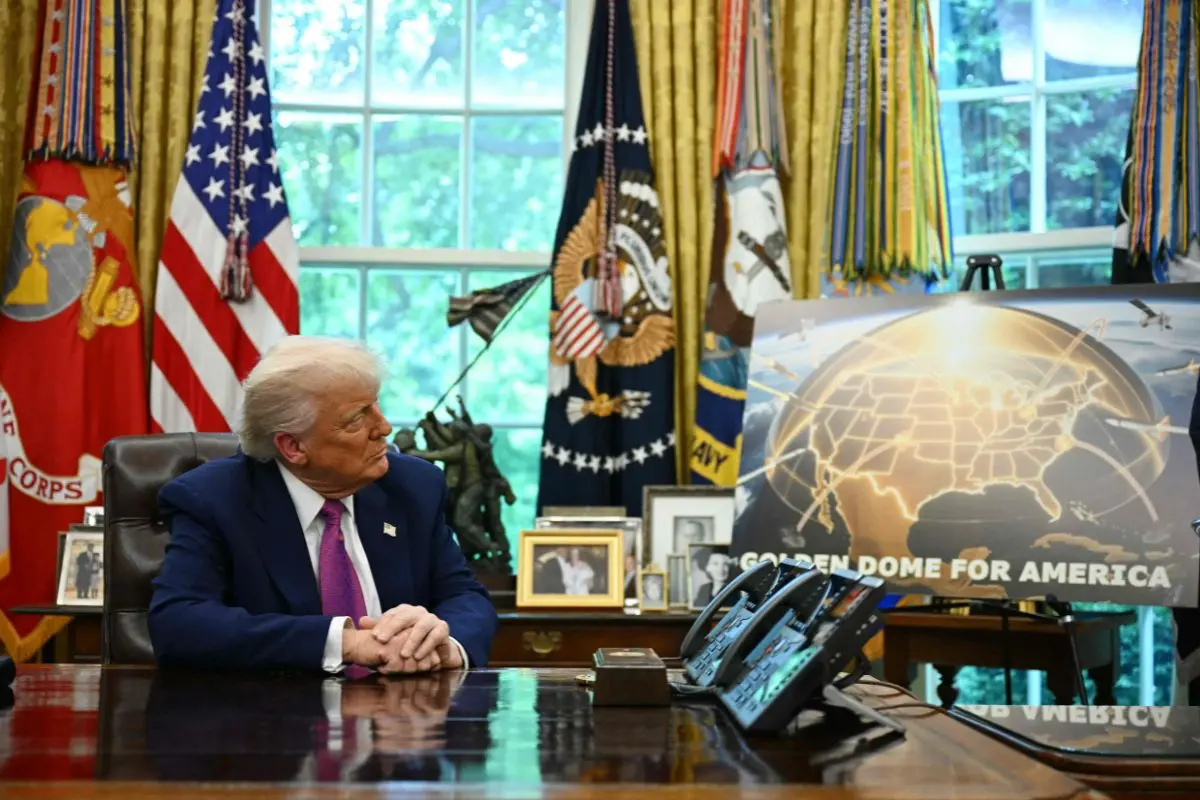
Washington: US President Donald Trump’s ambitious plan to build a nationwide missile defence system, dubbed the Golden Dome, is facing mounting questions over its feasibility, cost, and timeline — just months after he unveiled the proposal.
Designed to shield the United States from a broad range of threats — including intercontinental ballistic missiles (ICBMs), hypersonic and cruise missiles, and unmanned drones — the system is being touted by Trump as a key pillar of national security during his second term. However, experts warn that the vision is far from realisation and fraught with obstacles.
Trump has pledged $25 billion in initial funding and estimated the total cost at around $175 billion. But defence analysts and budget experts argue that figure vastly underrepresents the true price tag of such a sophisticated and wide-reaching system.
“The challenge with the statements from yesterday is that they lack the details needed to develop a model of what this constellation would really look like,” said Thomas Roberts, an aerospace engineering and international affairs expert at Georgia Tech, calling Trump’s cost estimate “not realistic.”
An earlier report from the non-partisan Congressional Budget Office (CBO) estimated that deploying a space-based missile interceptor system capable of countering just a limited number of ICBMs could cost between $161 billion and $542 billion over 20 years — suggesting that the Golden Dome, which aims for broader protection, could be even more expensive.
Major technical hurdles
The project remains in its early stages, with few concrete details released since Trump ordered the Pentagon to develop options four months ago. Defence experts say the challenges are not only financial, but also deeply technical.
“The main challenges will be cost, the defence industrial base, and political will,” said Melanie Marlowe, senior associate at the Center for Strategic and International Studies. “They can all be overcome, but it will take focus and prioritisation.”
She noted that America’s defence manufacturing sector has suffered from years of decline and will require significant investment to support a project of this scale.
Key components such as advanced sensors, high-speed interceptors, and space-based systems are still under development or not yet viable at the scale envisioned.
“There are a number of bureaucratic, political, science and technological milestones that will need to be achieved if Golden Dome is ever going to enter service in any meaningful capacity,” said Thomas Withington of the Royal United Services Institute. “This is serious, serious money. I’m not holding my breath.”
Strategic gaps
The name Golden Dome evokes comparisons to Israel’s Iron Dome system, which has been effective in intercepting short-range rockets. But experts stress that the United States faces a very different threat landscape, including long-range strategic missiles from state actors such as Russia, China, North Korea and Iran — not to mention growing threats from non-state actors using drones and precision-guided munitions.
“The threat is clearly getting worse,” said Chad Ohlandt, a senior engineer at RAND Corporation. “But the key question is how to most cost-effectively counter it. Any questions of realism or feasibility depend on where we set the bar.”
The Pentagon’s 2022 Missile Defense Review highlighted the pace at which countries like China are advancing their hypersonic and ballistic missile capabilities, and warned of emerging drone threats that have been seen in recent conflicts such as the war in Ukraine.
Despite the growing need for improved defence systems, there appears to be a lack of consensus — both within the defence establishment and on Capitol Hill — about whether Golden Dome is the right solution, and whether it can be delivered in time.
Trump has called for the system to be operational within three years, effectively by the end of his current term — a timeline many experts view as highly unrealistic.