From trade deals to defence pacts: What’s behind the India-UK reset?
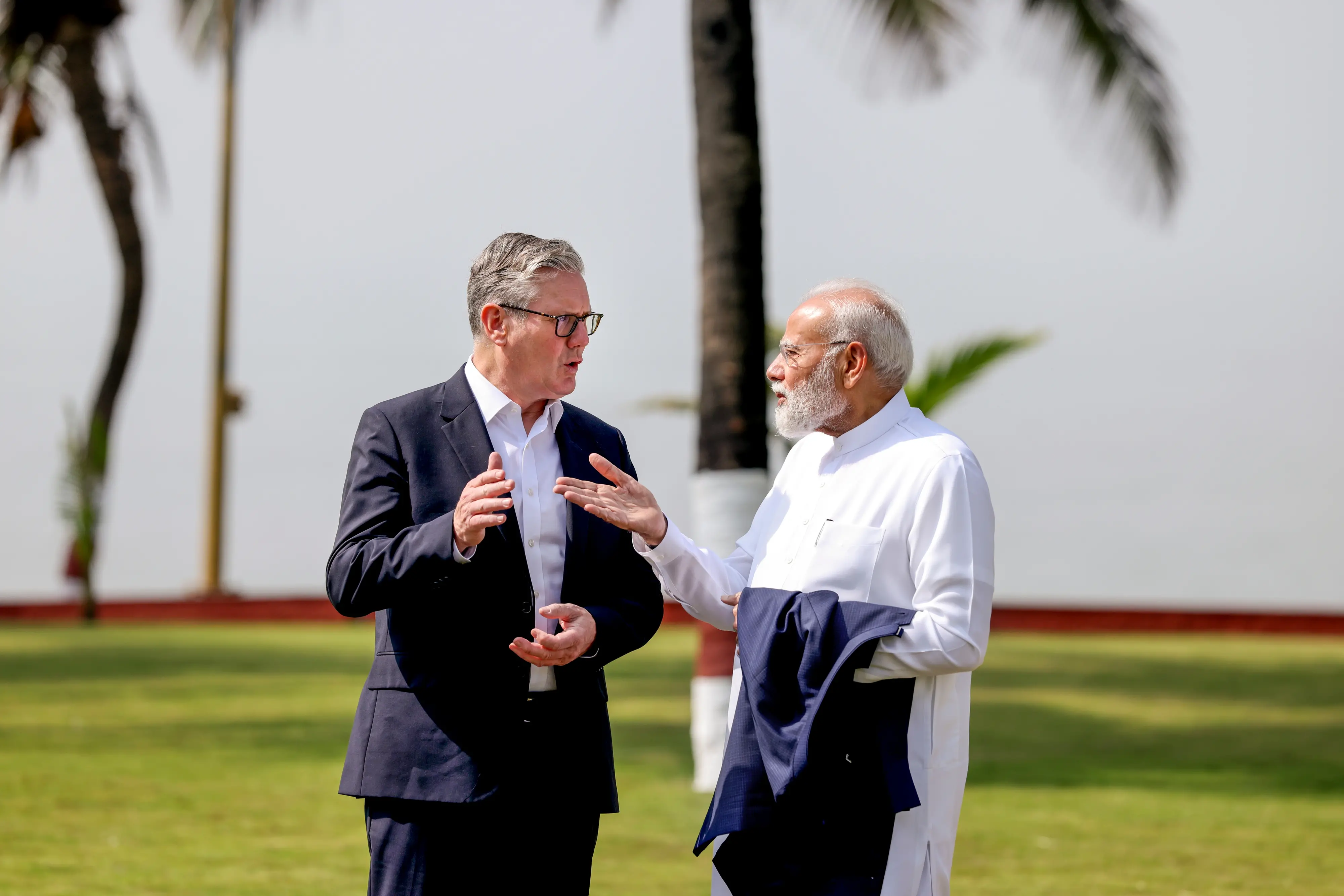
Mumbai: In a significant diplomatic engagement held in Mumbai, Indian Prime Minister Narendra Modi and British Prime Minister Keir Starmer pledged to advance India-UK relations through a modern, future-focused partnership.
The leaders highlighted growing cooperation in economic, defence and educational spheres, building upon the Comprehensive Economic and Trade Agreement (CETA) signed in London in July.
Under the trade accord, India agreed to reduce tariffs on imports of British goods such as whisky, cosmetics and medical devices, while the UK committed to lowering duties on Indian clothing, footwear and food products, including frozen prawns. Modi described the deal as a major step towards creating jobs and reducing import costs for both nations.
“Our relations have made significant progress. This agreement will boost trade and benefit both our industries and consumers,” Modi said, noting that Starmer’s visit “symbolises the new energy” in bilateral ties.
Starmer, making his first visit to India as Prime Minister with a 125-member delegation, echoed optimism about India’s economic trajectory. He described India’s “growth story” as “remarkable” and said the country’s vision of ‘Viksit Bharat’ — a developed India by 2047 — was “on track to succeed”.
“It is significant that we are meeting in Mumbai, India’s financial capital. Everything I have seen since I have been here is proof that India is on track to achieve its vision. We want to be partners on that journey,” he said.
Starmer called the CETA a “breakthrough moment”, emphasising that beyond tariff cuts, the agreement represents growing confidence between the two nations. “We are creating a new modern partnership focused on the future and availing the opportunities together,” he said.
During the visit, both sides also announced an agreement to strengthen cooperation in military training and defence exchanges, while also promoting higher education links, including support for nine British universities establishing campuses in India.
The leaders addressed shared concerns about global conflicts and regional stability, including the wars in Ukraine and Gaza, as well as security in the Indo-Pacific. Modi reaffirmed India’s position of supporting “peace through dialogue and diplomacy”, and said India-UK cooperation remains an “important pillar of global stability and economic progress”.
India and the UK currently share bilateral trade worth around $54.8 billion, supporting more than 600,000 jobs across both economies. India surpassed the UK as the world’s fifth-largest economy in 2022 and is expected to overtake Japan to become the fourth-largest later this year, according to IMF data.
Starmer concluded his visit by expressing confidence that the trip would “secure major new investments” and “create thousands of high-skilled jobs” in both nations, marking a forward-looking phase in India-UK ties rooted in shared economic and strategic ambitions.
Both leaders hailed the evolving partnership as a foundation for economic growth, strategic collaboration and global stability, underscoring a shared vision for a stronger India-UK relationship in the years ahead.
India–UK partnership, though presented as a “modern and future-focused” alliance, reflects more continuity than transformation. Critics argue that much of the rhetoric around a “reset” masks the uneven gains and underlying political calculations on both sides. For India, the trade deal’s tariff cuts on key imports such as whisky and cosmetics may serve British exporters more than Indian manufacturers, while the promised benefits for Indian goods in UK markets remain to be seen amid stricter immigration and labour rules.
For the UK, the post-Brexit pursuit of bilateral trade pacts, including with India, is often viewed as an attempt to offset its diminished access to the European market and project global relevance. Moreover, while the defence cooperation and education tie-ups signal intent, analysts note that concrete outcomes will depend on implementation — an area where past India–UK agreements have often faltered. In essence, beneath the optics of warmth and partnership, the relationship remains shaped by pragmatic interests, uneven leverage, and cautious trust rather than genuine strategic parity.
(With PTI inputs)