'Horrendous': Trump decries court ruling halting White House ballroom construction
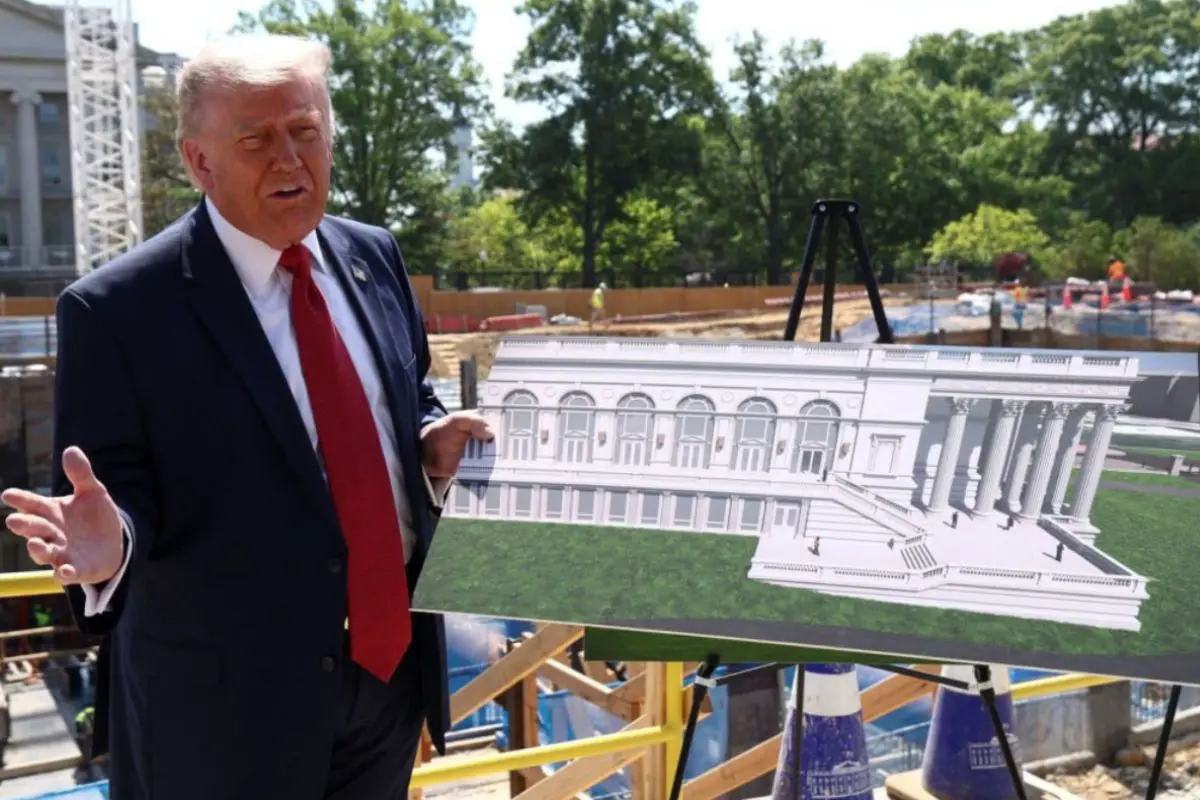
Washington: US President Donald Trump on Friday strongly denounced a federal appeals court decision ordering a halt to construction on his marquee $400 million White House ballroom, pledging to challenge the verdict before the US Supreme Court.
“We will be immediately appealing to the United States Supreme Court,” Trump said in a post on Truth Social, describing it as “a horrendous, politically motivated and unlawful ruling” that goes against national security interests.
The reaction followed a 2-1 decision by a three-judge panel for the US Court of Appeals for the District of Columbia Circuit, which ruled that the administration lacks unilateral authority to build the proposed 90,000-square-foot (8,400-square-meter) facility on the site of the former East Wing without congressional approval. The East Wing was demolished under his orders last autumn.
The appellate ruling marks the second time within a week that the administration's construction plans have drawn scrutiny. A separate assessment by the National Park Service warned that a proposed 250-foot-tall (76-meter) triumphal arch could compromise the historical significance of dozens of heritage sites near its planned location between the Lincoln Memorial and Arlington National Cemetery.
In its decision regarding the ballroom, the court ruled in favour of historic preservationists seeking to halt the project. However, the court granted a two-week stay on its order to allow the administration time to appeal to the highest court.
Writing for the majority, the appellate panel stated, “Whether or not a massive ballroom should be constructed is for Congress to decide and is not a matter for Executive self-help.”
“This holding has nothing at all to do with whether the proposed ballroom is desirable, or not, as a matter of policy. This ruling does not even necessarily mean that the Defendants may not ultimately construct the ballroom.
“What it does mean,” the court continued, “is that the Defendants may not do so during the district court’s expeditious litigation without securing Congress’s authorisation, as the Constitution and laws require.”
Trump has previously maintained that legislative authorisation is unnecessary because the project relies on private donations rather than public funding, noting he secured hundreds of millions of dollars in pledges from corporations, wealthy individuals, and his own funds.
“He’s saying I need congressional approval and he’s so wrong,” Trump said in March after US District Judge Richard Leon's initial ruling against the ballroom. “This is being financed privately,” he had said.
The legal challenge was initiated by the National Trust for Historic Preservation, which praised Friday's ruling.
“From the beginning, our position has been clear and consistent: the law states that only Congress can authorise the construction of a ballroom at the White House,” Brent Leggs, the group's president and CEO said in a statement. "We are pleased with the DC Circuit Court’s decision to uphold the District Court’s preliminary injunction, which although stayed for 14 days will block any above-ground ballroom construction unless and until Congress takes action.”
The divided panel upheld an April 16 order from Judge Leon halting above-ground construction on the planned 999-capacity venue, while permitting subsurface work to continue on bunkers and other underground national security facilities.
Trump previously criticised Leon's ruling on social media, calling him a “Trump Hating” judge who “has gone out of his way to undermine National Security, and to make sure that this Great Gift to America gets delayed, or doesn’t get built.”
The appellate panel comprised Judges Patricia Millett, appointed by Barack Obama, Neomi Rao, appointed by Trump, and Bradley Garcia, appointed by Joe Biden. Millett and Garcia formed the majority, while Rao dissented.
Government attorneys have argued that the project, the largest structural alteration to the White House complex in over 70 years, is essential to protect against modern threats, including drones, ballistic missiles and biohazards.
“These upgrades, alterations and improvements are essential to protecting the President, his family, and his staff, as well as the White House itself, and the entire project flows from them,” government attorneys wrote in a court filing.
Attorneys representing the preservation group countered, “That commonsense conclusion is not clearly erroneous, and there is no basis to disturb it.”
While the project secured approval from the 12-member National Capital Planning Commission on April 2, above-ground construction remains blocked pending the administration's appeal to the Supreme Court or action by Congress.
Agencies