Doomsday clock hits closest point in history | Experts warn ‘time is running out’
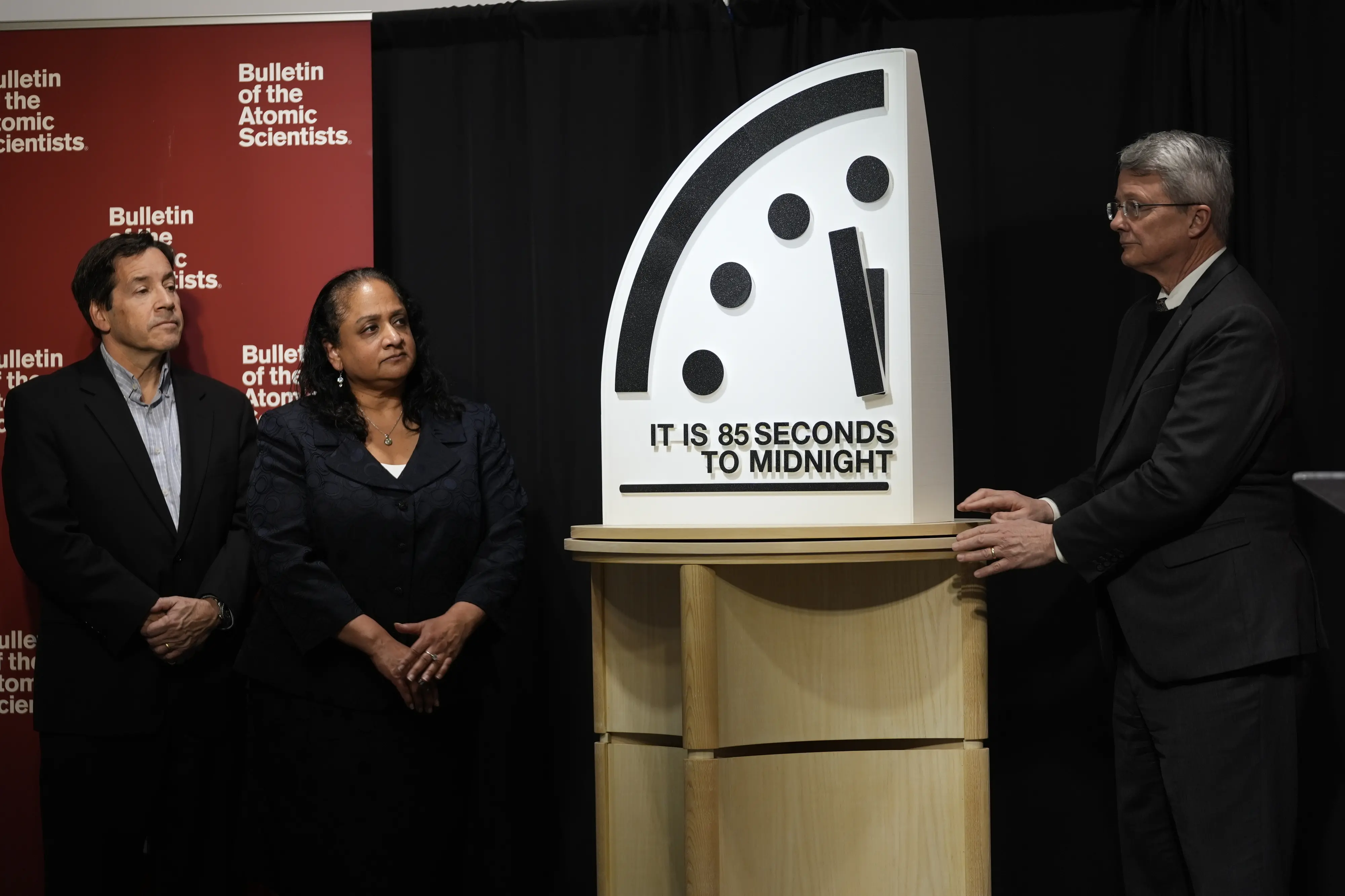
The Bulletin of the Atomic Scientists has moved the Doomsday Clock closer to midnight than at any point in its history, setting it at 85 seconds to midnight, the nearest the world has come to symbolic catastrophe since the Clock was first introduced 80 years ago.
Last year, the Clock stood at 89 seconds to midnight. Announcing the change, Bulletin president and CEO Alexandra Bell warned that "every second counts, and we are running out of time."
First created in 1947 at the dawn of the Cold War, the Doomsday Clock emerged as the United States and the Soviet Union entered a nuclear arms race. Since then, it has served as a symbolic measure of how close humanity is to global disaster.
Also read | US ‘Doomsday Plane’ makes rare appearance in 51 years: What it means amid global tensions | VIDEO
Maintained continuously since 1947, the Clock acts as a proxy for threats posed by unchecked scientific and technological advances. Midnight represents a hypothetical global catastrophe, while the number of minutes or seconds to midnight reflects the Bulletin’s assessment of how near the world is to that point. The evaluation is conducted each January.
The main factors influencing the Clock include nuclear warfare, climate change, and artificial intelligence. The Bulletin’s Science and Security Board monitors emerging developments in life sciences and technology that could inflict irreversible harm on humanity.
Also read | ‘Financing war against themselves’: Scott Bessent slams Europe over India-EU trade deal
The Clock was originally set at seven minutes to midnight in 1947. Over the decades, it has been adjusted backward eight times and forward 18 times. The farthest it has been from midnight was 17 minutes in 1991, while the current setting of 85 seconds marks the closest ever recorded.
In recent years, the Clock has moved steadily forward. It was set at 150 seconds in 2017, shifted to two minutes in 2018, remained unchanged in 2019, moved to 100 seconds in 2020, 90 seconds in 2023, 89 seconds in 2025, and now 85 seconds in 2026.