Have we really gone to space? Glass of water on China’s Tiangong Space Station sparks conspiracy theories
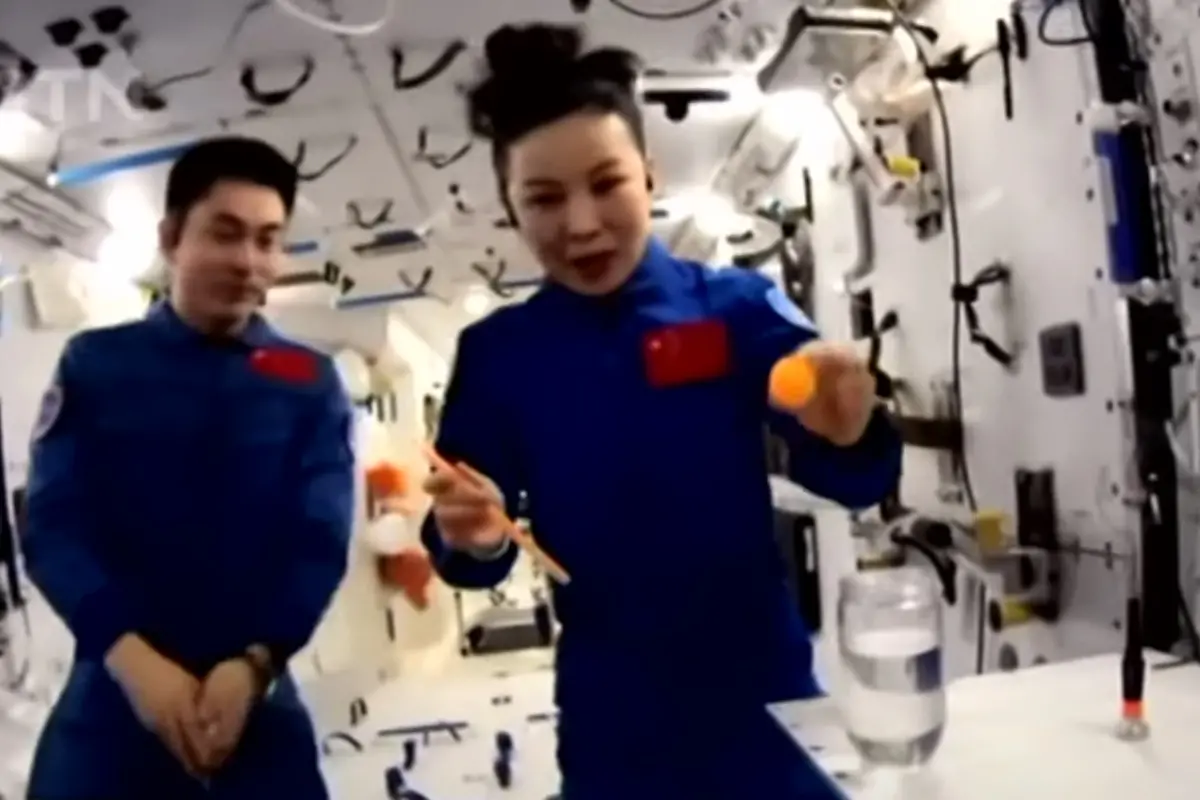
A video from China’s Tiangong Space Station, intended as part of a space education programme, has triggered a wave of conspiracy theories online, with some questioning the legitimacy of human space travel altogether. The source of the speculation? A seemingly ordinary glass of water.
A glass that wouldn’t spill?
In the now-viral clip, viewers see an open glass of clear liquid resting on a table, entirely undisturbed. The footage was featured in ‘Tiangong Class,’ a live-streamed science lesson conducted by the Shenzhou-13 crew in late 2021. But it resurfaced recently on social media, where users questioned the physical plausibility of the scene.
Some internet commentators expressed scepticism about why the water wasn’t floating out of the glass in microgravity. One social media user wrote, “That water should be floating.” Another added, “Apparently they are not in zero gravity.” Others took it further, suggesting the entire video may have been staged — evidence, they claimed, that space travel may be a carefully orchestrated lie.
AI misstep fuels theories
The online speculation intensified after Elon Musk’s AI chatbot, Grok, incorrectly responded to questions about the clip. “Yes, water would float out of a glass in a space station due to microgravity,” it stated, inadvertently adding credibility to the claims for some viewers.
However, scientists and researchers have since clarified that what’s seen in the video is entirely plausible in a weightless environment — and backed by well-understood laws of physics.
Experts say: It’s just physics
Jordan Bimm, a space historian at the University of Chicago, debunked the claims in a conversation with the Associated Press. He explained that in zero gravity, surface tension causes water to behave very differently than it does on Earth.
“Water molecules like to stick to glass and also to other water molecules more than they like to disperse in the air,” Bimm said. “So if there is no external force, water remains in ‘clumps’ in the weightless environment, and in this case inside the glass,” he said, adding that surface tension “works to help maintain the static shape and presents the illusion of how water would act on the ground.”
The full version of the video, which many sceptics did not view in its entirety, provides more context. In it, Chinese astronaut Wang Yaping is seen filling the glass using a straw and then placing it carefully on the table, where it is held in place with adhesive strips.
The demonstration was part of an experiment to show how buoyancy works in microgravity. To illustrate the point, the astronauts submerged a ping-pong ball in the glass of water. Unlike on Earth, where it would float to the top, the ball remained suspended — a visual proof of microgravity at play.
Space researcher Molly Silk from the University of Manchester also weighed in on the claims. Speaking to the Associated Press, she dismissed the notion that China would fake such a demonstration.
“It is extremely unlikely that the video was faked, as Chinese space program actors have very little reason to fake a video,” she said. “The presence of the space station has been verified by international actors, including China’s biggest space competitor the US.”
A proven and advanced space programme
China’s recent achievements in space exploration add weight to the credibility of its space operations. In May 2025, lunar samples collected during the Chang’e 5 mission were shared with the UK’s Open University for scientific analysis. The country’s Chang’e 6 mission has also successfully returned samples from the far side of the Moon — a feat few nations have accomplished.
These milestones, along with international collaboration and verification, provide strong evidence of the authenticity of China's presence in space.
While the still water in a glass may have surprised those unfamiliar with space science, experts maintain there is no reason to doubt the video’s authenticity. The physics of surface tension in microgravity, the full context of the video, and the responses from independent scientists all affirm that what was seen onboard Tiangong was real — and expected.