‘Don’t send us back’ Why migrants from Morocco and beyond are seeking asylum in Spain
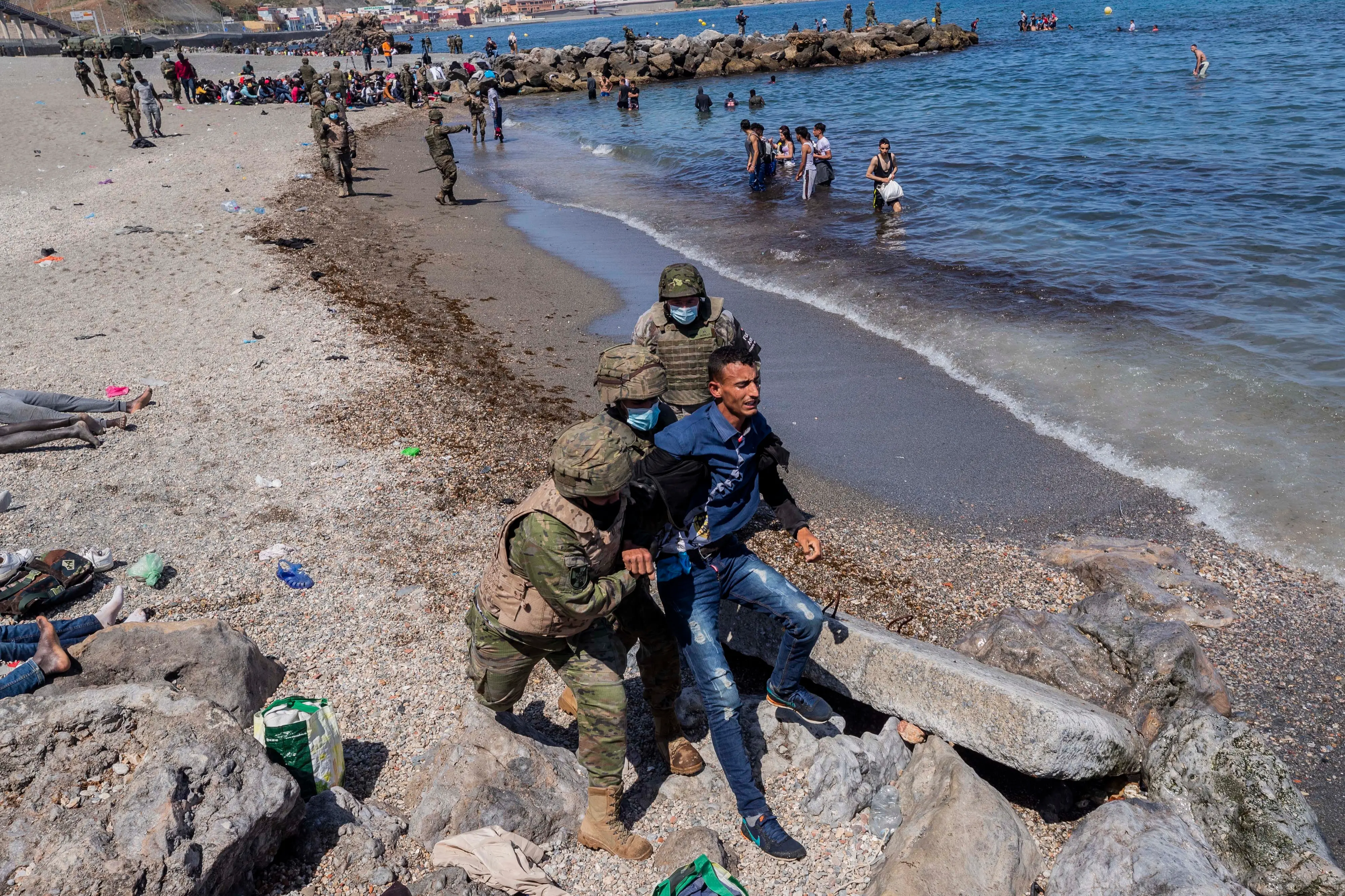
Hundreds of migrants in Spain's North African enclave of Ceuta have protested against being returned to Morocco, highlighting the difficult conditions they face after a mass border crossing two weeks ago and the wider migration pressures along Spain's border with Morocco.
What is happening in Ceuta?
Hundreds of migrants who recently entered Ceuta gathered on a beach on Sunday, carrying Spanish flags and demanding the right to seek asylum rather than being sent back to Morocco.
Protesters displayed messages including “We don't want to go back to Morocco” and “We are also human”, while calling for authorities to provide a solution to their situation.
The demonstration came after a mass movement of people towards Ceuta two weeks ago. More than 72,000 people reportedly crossed or attempted to cross into the territory, although the vast majority subsequently returned voluntarily.
Between an estimated 5,000 and 8,000 migrants remain in Ceuta, according to the report.
Why is Ceuta attracting migrants?
Ceuta is a small Spanish territory on the North African coast, surrounded by Morocco. Although geographically located in Africa, it is part of Spain and therefore sits at one of Europe's external borders.
For migrants travelling from Morocco and elsewhere in Africa, reaching Ceuta can represent a possible route into the European Union and eventually mainland Europe.
Migrants interviewed by Reuters described several reasons for attempting the journey, including low wages, unemployment, poverty, conflict, insecurity and persecution.
One Moroccan automation specialist said his salary made it difficult to afford a home or start a family. Others said they were seeking employment and better opportunities in Europe.
Some migrants have travelled thousands of kilometres and crossed several countries before reaching Morocco.
Why are some migrants asking for asylum?
Not everyone in Ceuta has the same reason for migration.
Some Moroccan migrants interviewed said they primarily wanted to work in Europe. Others described situations that could potentially raise asylum or protection claims.
A Nigerian electrician said he had travelled through several countries after his children stopped attending school because of fears of kidnapping.
A Bangladeshi migrant described a journey through multiple countries after leaving his homeland.
Another migrant from Senegal said he was seeking asylum because of alleged persecution linked to his sexual orientation.
These accounts illustrate why migration flows contain both people seeking economic opportunities and people who may be seeking international protection. Whether an individual qualifies for asylum is determined through the relevant legal process rather than simply by reaching Spanish territory.
Why can't everyone stay in Ceuta?
Spanish authorities have said migrants who entered the enclave irregularly will generally not be permitted to remain in Ceuta, travel to mainland Spain or obtain legal status, except in limited cases involving extreme vulnerability.
This has created uncertainty for those currently living in the territory.
Many migrants have reportedly been staying in precarious conditions around El Trampolin beach and on the outskirts of the city because local resources have been stretched.
One migrant told Reuters that people were sleeping beside the sea in cold and unhygienic conditions and said police were preventing migrants from travelling into the city centre.
What happened at the Morocco border?
The situation has also triggered a renewed security response on the Moroccan side.
Moroccan state television reported that security forces arrested 294 migrants from sub-Saharan Africa who were allegedly attempting to reach Ceuta by land and sea on Saturday.
Authorities also reportedly arrested 61 Moroccan nationals accused of facilitating migration attempts.
The latest attempted crossings followed social media posts encouraging migrants to travel towards Ceuta.
Moroccan and Spanish authorities subsequently increased security around the area and restricted movement towards the border.
Why is Morocco involved?
Morocco is a major transit country for migrants attempting to reach Europe from Africa and elsewhere.
Its northern coastline lies directly opposite Spain, making the country a key staging point for people attempting to reach either Ceuta, Melilla or mainland Spain.
Moroccan authorities regularly deploy security forces to prevent irregular crossings, while Spain relies heavily on cooperation with Morocco to manage migration along its southern borders.
According to a Moroccan diplomat cited by AP, more than 20,000 Moroccan security personnel are deployed along the Ceuta border each day.
How serious was the recent migration surge?
The latest crisis follows one of the largest recent attempts to reach Ceuta.
The rush towards the enclave reportedly resulted in at least 90 deaths, according to official figures cited by AP. Human rights organisations have reported higher numbers.
The crisis was driven by a combination of poverty, economic hardship, instability and misinformation circulating on social media.
Most of those who reached or entered Ceuta subsequently returned to Morocco voluntarily, leaving several thousand still in the territory.
Are health services under pressure?
The large number of migrants remaining in the territory has placed additional pressure on Ceuta's limited public services.
Enrique Roviralta, head of Ceuta's medical board, said healthcare workers were exhausted and reported cases of infectious diarrhoea and scabies, as well as injuries linked to violence.
Spain's Health Minister Monica Garcia rejected claims that the healthcare system had collapsed but acknowledged that services were under pressure.
Garcia also warned against associating migration itself with disease, saying such claims could be unjust and xenophobic. She said there was a moderate risk of epidemic outbreaks among migrants and a low risk for local residents.
Why migration to Europe is so difficult
The Ceuta crisis reflects a much wider migration challenge facing Europe.
People leave their countries for different reasons. Some are fleeing war, persecution or threats to their safety. Others are seeking jobs, higher wages and better living conditions. Many have a combination of economic and security reasons.
The journey itself can be extremely dangerous. Migrants travelling across the Sahara or attempting sea crossings can face dehydration, exploitation, violence, detention and death.
For European countries, the challenge is balancing border control with obligations towards people who may have legitimate asylum claims.
For migrants, reaching European territory does not automatically guarantee the right to remain. Authorities assess individual circumstances under immigration and asylum rules.
What is the Ceuta enclave?
Ceuta is a Spanish city and territory on the northern coast of Africa, surrounded by Morocco.
Along with Melilla, another Spanish territory on Morocco's northern coast, Ceuta forms one of the EU's most unusual and heavily monitored external borders.
Its location makes it a focal point for migration into Europe.
Unlike most migration routes into Europe, migrants attempting to reach Ceuta do not need to cross the Mediterranean to reach Spanish-controlled territory. They can attempt to cross the land border from Morocco or swim around the border area.
This geographical position has made Ceuta a recurring flashpoint in Spain-Morocco migration relations.
Why the crisis matters
The latest protests show that the immediate border crisis has evolved into a question over what happens to those who successfully reach Ceuta.
Spain is attempting to prevent irregular migration and maintain control over its external border, while migrants remaining in the enclave are demanding access to asylum procedures and opposing return to Morocco.
Morocco, meanwhile, is increasing security efforts to prevent another mass crossing.
The result is pressure on all three sides: migrants facing uncertain legal futures and difficult living conditions, Ceuta's limited public services dealing with a large population increase, and Spain and Morocco trying to prevent another mass border movement.
Analysis
The Ceuta crisis is not simply about people crossing a border. It sits at the intersection of migration, asylum law, border security, economic inequality and Spain-Morocco relations.
The most important distinction is between irregular migration and asylum. A person may enter a country irregularly and still have a right to request international protection if they have grounds for asylum. At the same time, making an asylum claim does not automatically mean the person will be granted protection.
The situation is also shaped by geography. Ceuta is Spanish territory but sits inside North Africa, making it one of the EU's closest land borders with Africa. This gives migrants a potential direct route into Spanish jurisdiction while making the territory particularly sensitive for border-control authorities.
Morocco's role is equally important. Spain depends on cooperation with Moroccan authorities to limit crossings, while Morocco faces its own pressures from migrants travelling through the country towards Europe.
The recent arrests and security build-up show that authorities are trying to prevent another mass movement after the previous surge. However, the presence of thousands of migrants already in Ceuta means the crisis cannot be addressed solely through border security.
The conditions at El Trampolin beach, pressure on healthcare and uncertainty over whether migrants will be permitted to seek protection have shifted attention towards what happens after a border crossing.
Ultimately, the current dispute is about two competing demands: Spain's effort to control irregular entry and migrants' demand for an opportunity to have their individual protection claims considered. How authorities handle those claims, returns and living conditions in Ceuta will determine whether the current standoff remains a temporary border crisis or develops into a larger political and humanitarian dispute.