94 Palestinians killed in Israeli strikes in Gaza; Amnesty International says aid-seeking turned into ‘a booby trap’
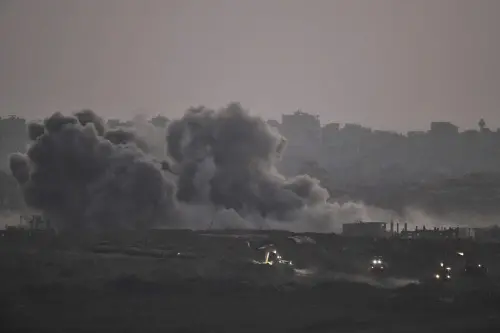
Israel airstrikes have reportedly killed 94 Palestinians in Gaza late Wednesday and Thursday, including 45 who were attempting to get much-needed humanitarian aid, hospitals and the Health Ministry said on Thursday. The toll from strikes emerged as more Palestinians were killed in near-daily shootings while trying to obtain aid.
Families wept over the bodies from a strike that hit a tent camp during the night as displaced people were asleep in southern Gaza. Reports state that at least 13 members of a single family were killed, including at least six children under 12.
Scenes of grief as families mourn their dead
Intisar Abu Assi sobbed over the bodies of her son and daughters and their young children,“My children, my children … my beloved.” Another woman kissed the forehead of a dead little girl wrapped in a blanket on the floor of the morgue at Nasser Hospital in the city of Khan Younis.
In central Gaza, a boy stroked the face of his dead sister, 6-year-old Heba Abu Etiwi, in a morgue at Al-Aqsa Martyrs’ Hospital. The girl and another of her brothers were among eight people killed when a strike Wednesday evening hit near a stand selling falafel.
A separate strike on a school in Gaza City sheltering displaced people also killed 15 people.
45 killed while accessing GHF and UN humanitarian aid
Five were killed on the roads leading to food-distribution sites run by the Gaza Humanitarian Foundation (GHF), the newly created, secretive American organization backed by Israel to feed the Gaza Strip’s population. According to hospital officials, another 40 were killed while waiting for trucks carrying U.N. aid in several locations around Gaza.
Witnesses have said Israeli troops regularly unleash barrages on crowds of Palestinians trying to reach the GHF sites. There have also been reports of troops opening fire when crowds of people gather near military-run zones of Gaza, waiting for U.N. trucks to enter.
More than 500 Palestinians have been killed and hundreds more wounded since the food-distribution sites opened in May.
The Israeli military, whose forces are deployed on the roads leading to the sites, says it fires warning shots to control crowds or at Palestinians who approach its troops. Armed U.S. contractors guard the sites.
Amnesty accuses Israel of using starvation as a weapon
Amnesty International on Thursday issued a report saying Israel was continuing to “use starvation of civilians as a weapon of war … as part of its ongoing genocide.”
It said the GHF distribution system appeared intended only to “placate international concerns” even as Israel allows in only a small amount of food for the U.N. to distribute separately.
“By maintaining a deadly, dehumanizing and ineffective militarized ‘aid’ scheme, Israeli authorities have turned aid-seeking into a booby trap for desperate starved Palestinians,” it said.
Israel rejects Amnesty’s allegations
Amnesty accused Israel last year of committing genocide, saying it has sought to deliberately destroy Palestinians by mounting deadly attacks, demolishing vital infrastructure and preventing the delivery of food, medicine and other aid.
The Israeli Foreign Ministry denounced the Amnesty report, saying the organization has “joined forces with Hamas and fully adopted all of its propaganda lies.”
Israel has rejected allegations claiming that it is committing genocide in Gaza in the war with Hamas, and is currently challenging the accusation filed by South Africa at the International Court of Justice.
Israel claims Hamas siphons off UN aid
Israel wants GHF to replace the U.N. humanitarian network, which has delivered massive amounts of aid to Palestinians throughout the war. Israel maintains that Hamas misappropriates large amounts of aid from that system, a claim that the U.N. and aid groups deny.
Israel cut off all food and other supplies to Gaza for more 2 ½ months this year, driving its population toward famine, in what it said was a move to push Hamas to make concessions in negotiations and release hostages. The blockade was removed in March.
The U.N. has rejected GHF, saying the latter cannot deliver enough aid, endangers Palestinians and is being used by Israel to carry out its war goals.
Lack of sufficient aid has made violence commonplace
The Foreign Ministry and Coordinator of the Government Activities in the Territories (COGAT), the Israeli defense body in charge of coordinating aid to Gaza, said on Wednesday that Israel has facilitated the entry of over 3,000 aid trucks into the Gaza Strip since May 19.
That amounts to around 28 trucks a day, a fraction of the hundreds of trucks a day aid workers say are actually necessary.
In a statement Tuesday, GHF rejected criticism of its operations and said it has delivered the equivalent of more than 52 million meals. GHF distributes boxes of food staples such as lentils and rice, saying one box holds the equivalent of more than 50 meals.
Witnesses have reported scenes of chaos at GHF sites as desperate crowds race to pick up food boxes, with some taking more than one while many others go empty-handed. Much of the food is sold in markets at astronomical prices.
Death toll inches closer to 60,000; ceasefire in talks
The Gaza Health Ministry said the number of Palestinians killed in Gaza has passed 57,000 since the war began on Oct. 7, 2023. The ministry does not differentiate between civilians and combatants in its death count but says more than half of the dead are women and children.
The deaths come as Israel and Hamas inch closer to a possible ceasefire that would end the 21-month war.
Trump said Tuesday that Israel had agreed on terms for a 60-day ceasefire in Gaza and urged Hamas to accept the deal before conditions worsen. Hamas’ response emphasized its demand that the truce lead to an end to the war.
The Israeli military blames Hamas for the civilian casualties because it operates from populated areas. The military said it targeted Hamas militants and rocket launchers in northern Gaza that fired toward Israel on Wednesday.
The beginning of the war and impact on Gaza
The war began when Hamas-led militants attacked southern Israel, killing 1,200 people and taking roughly 250 hostages.
Coastal Palestinian territory is in ruins, with much of the urban landscape flattened in the fighting. More than 90% of Gaza’s 2.3 million population has been displaced, often more than once.
AP